














They survived Russian imprisonment, torture and sexual violence. In "Traces", seven Ukrainian women tell their story - and transform pain into strength. A documentary about war crimes, dignity and the fight for justice.
Traces is a documentary about almost unimaginable cruelty as seven women from Ukraine talk about their experiences of violence at the hands of Russian soldiers.
 ADVERTISEMENT
ADVERTISEMENT
ADVERTISEMENT
The film, which premiered at the Berlinale in its Panorama programme, also deals with the terrible reality of women in Russian captivity or under Russian occupation and tales of women who did not let it break them.
One of them, Iryna, fought her way through and created something new - strength, community, and hope.
Traces left behind by the war
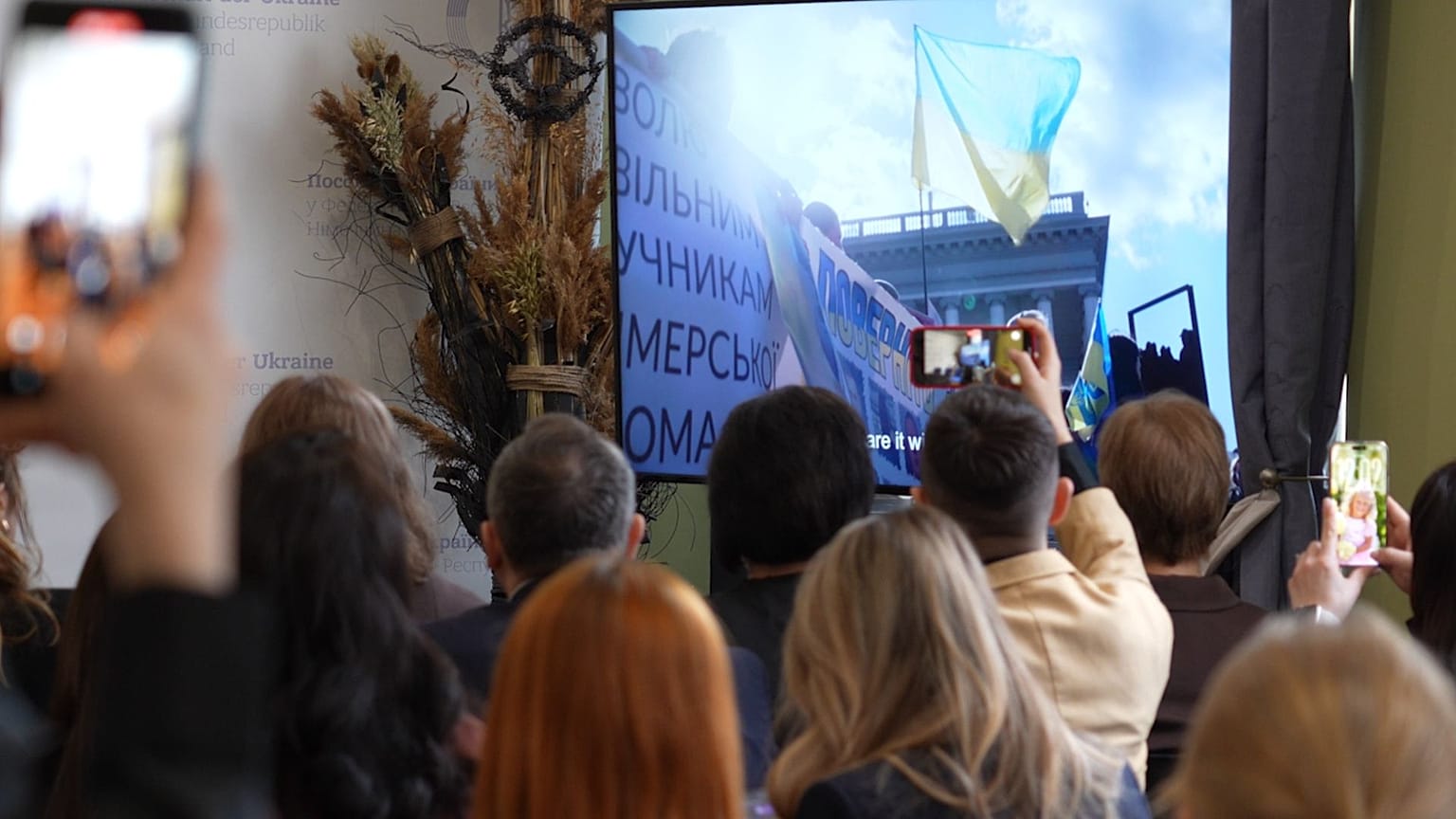
The Ukrainian embassy fell silent as the trailer for the documentary began. The protagonists all sat in the front row; the seven women who say they experienced violence in Russian captivity.
When Iryna spoke, the audience listened attentively. She talked about imprisonment, abuse and trying to preserve her dignity. The descriptions of violence were hard to fathom in the warm, safe space of the screening in the centre of Berlin. For Iryna, however, they are part of her reality. She survived and with her the memories of what she experienced.
"They threatened to rape my son and said that people like us shouldn't live," said another woman in the trailer. "And only after that will I kill you with this child. Time stood still and I just stood there."
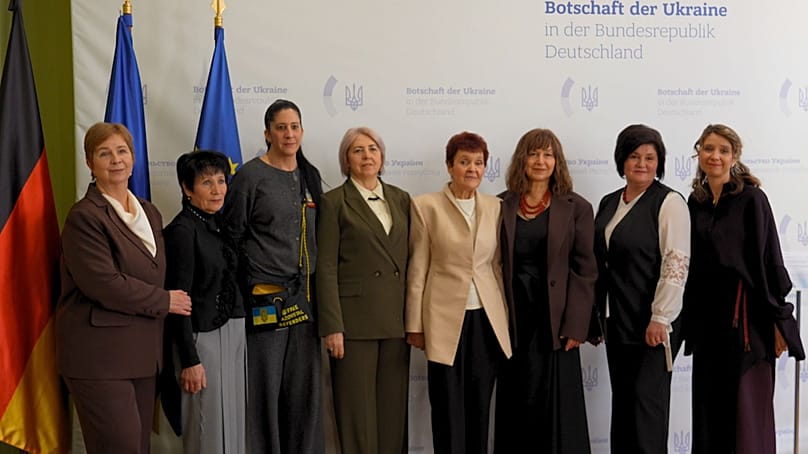
We've gathered for the launch of the social impact campaign for Traces. Representatives of civil society have come to the embassy, along with a UN representative and the Ukrainian ambassador Oleksii Makeiev. The majority of the invited guests are women.
The campaign aims to draw attention to the fate of imprisoned and abused Ukrainians - and to demand political and legal consequences.
Portrait of seven women: "They sacrifice their privacy"
In the film, Iryna takes us through her own fate and that of six other women in Russian captivity. They survived torture, sexual and other forms of violence - war crimes allegedly committed by Russian soldiers.
Iryna is accompanied by documentary filmmaker Alisa Kovalenko, who is also a survivor of suspected sexual violence at the hands of Russian soldiers.
The filmmaker fought against the occupation of Crimea in 2014 and experienced Russian captivity herself. "To be honest, I didn't want to make this film. I just had the feeling that I had to do it," Kovalenko tells Euronews. "I knew it would be very, very difficult. That I would suffer. But I knew why I was doing it. It was worth it to me."
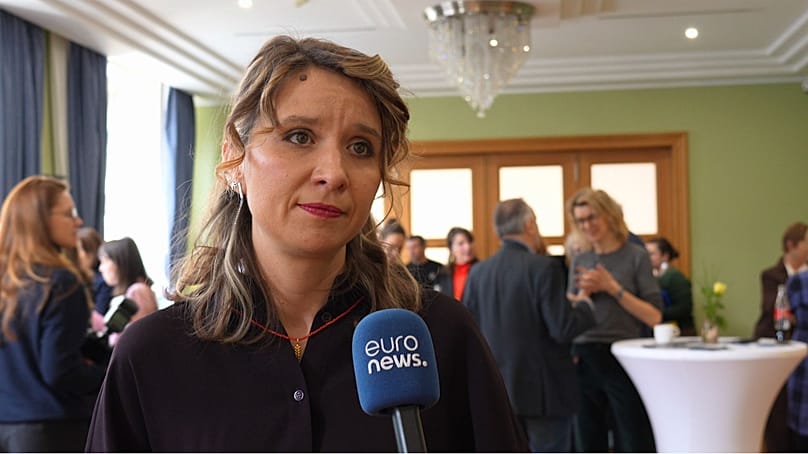
In her opinion, the women also had to make another sacrifice. "They sacrifice their privacy. But they know what they did it for. Because they also speak for those who are still silent," said Kovalenko.
The film is proof of dignity, solidarity and the common fight for justice and sisterhood.
According to the director, Iryna and the other women have succeeded in transforming their pain into strength. "So I believe that this film can evoke empathy, active empathy that is followed by action," Kovalenko added.
"I spoke about it for the first time after five years"
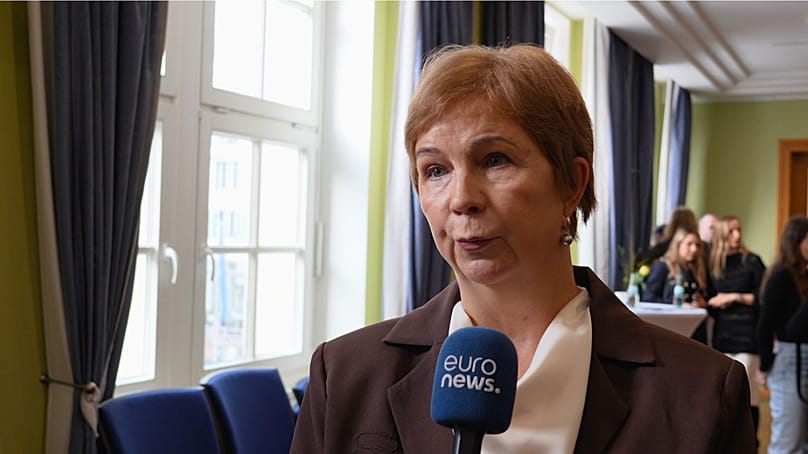
Few women have gone public with their story. Iryna is part of the SEMA Ukraine association, which encourages women to share their experiences with each other. "It took me many years to gather this strength," she told Euronews. "I only spoke about it for the first time five years after my experience, and that wasn't easy."
Ultimately, she wants to document Russia's use of sexual violence against women as a weapon of war and records interviews with six other women. In the course of the film, the viewer not only learns about their harsh experiences, but also perceives the strength of their community and the mutual support.
"This will be our small victory. And once again, this will be proof that justice does exist," says Iryna about the film and the campaign, Iryna says:
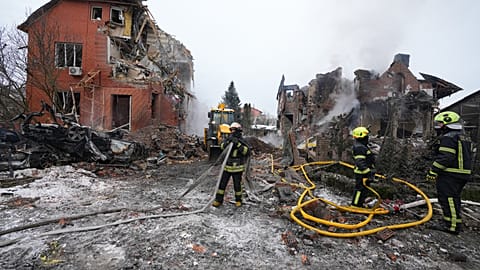
No explicit depictions of violence are shown; instead, the women return to their former homes, some of which have been bombed and destroyed, to tell their stories. They find walls with dozens of bullet holes, parts of the roofs missing, the garden infiltrated by mines. In one scene, a fire can be seen in the distance, it bangs every second, then the siren alarm sounds. Some of the audience are startled.
Alisa Kovalenko deliberately refrained from showing the interviews: "I decided that I wouldn't film any women, but only make audio recordings," explained the director. You're more likely to build trust "when you talk to a person, when you look them in the eye, when you're not behind the camera."
However, when she was in the Kherson region for the interviews, she saw traces of war everywhere. "There were minefields, burning fields, destroyed houses, but also wounded people." Ultimately, however, she also wanted to depict the wounds that are not visible at first glance, such as the women's memories of the violence they experienced.
Carrying on as proof that the enemy had failed
However, the aim was not only to make a documentary film, but also to depict possible Russian war crimes. Iryna, Kovalenko and the other women don't just want the world to know what Russian soldiers did. They are standing in the Ukrainian embassy in Germany and using the platform of the Berlinale to ensure that their film's message is just the beginning.
"The best way to overcome a trauma is to look forward. For me, it was very important not to let them make me unhappy," says a woman in the trailer. "This is my weapon that I could give to other women. The fact that they have overcome it is the best proof that the enemy has failed."
On the sidelines of the Berlinale, numerous civil society representatives in the embassy supported the women's initiative called SEMA, which fights against sexual violence as a weapon of war and supports those affected.
The organisation demands recognition that Russia is using sexual and gender-specific violence (conflict-related sexual violence, CRSV) as a weapon of war. The organisation offers both financial and psychological support to those affected.
Recognising systematic violence as a war crime
At the end of the documentation, it is written that Russia should be placed on the UN's "shame" list. The United Nations organisation has its own definition of CRSV. The violence used is linked to a conflict.
According to the latest UN report for 2023, 85 cases of conflict-related sexual violence against civilians and prisoners of war were identified in Ukraine. This is said to have been directed equally against men and women.
"In most of the documented cases involving adult male victims, sexual violence was used as a method of torture during their captivity by Russian armed forces and law enforcement agencies," the report states.
The Ukrainian side is also said to have initiated 10 such cases. They range from the threat of violence to execution. The SEMA Ukraine association assumes that the number of unreported cases of Russian CRSV violence is high.
"This is not a documentary that people will talk about. Many people prefer to look the other way," said Ukrainian Ambassador Oleksii Makeiev. For him, the community of Ukrainian women, "this pursuit of truth", is "a component of Ukrainian resilience".
"Ukrainians today can be a good example of how society works, how democracy is defended and what the European values that underlie our consciousness in Europe actually mean," Makeiev continued.
Both the world premiere of the film and the presentation of the campaign at the Ukrainian Embassy left the audience with a feeling of hope and strength.
The way the women have pulled each other out of the cruel memories and stand shoulder to shoulder on the stages of Berlin also shows the creative power that has arisen from this. They see their voices as a sword against the violence of the Russian soldiers.