














Brazil's cinematic output has given audiences some of this year's very best, including 'I'm Still Here' and 'The Secret Agent'. But it all started with Gabriel Mascaro's 'The Blue Trail', which won this year's Silver Bear Grand Jury Prize in Berlin...
Brazilian cinema has had a great 2025, with the country’s first Oscar win for Walter Salles’ I’m Still Here, and Kleber Mendonça Filho’s Best Director and Best Actor wins for The Secret Agent in Cannes. But before these milestones, Gabriel Mascaro (Neon Bull, Divine Love) kicked off the banner year for his country with O último azul (The Blue Trail), which won the Silver Bear Grand Jury Prize at the Berlinale.
 ADVERTISEMENT
ADVERTISEMENT
ADVERTISEMENT
Set in a near-future Brazil, The Blue Trail starts with a seemingly benevolent broadcast from the government, blaring out to the population that the elderly need to be looked after and that “the future is for everyone.”
Indeed, older citizens are celebrated with government tributes in the shape of laurels on their homes and medals honouring them as “national living heritages”.
However, the reality is that the ageist authoritarian regime now forces the elderly to retire and relocates them to an isolated senior housing colony so that younger generations can focus on productivity. Refusal to accept one’s fate can lead a citizen to be reported by their neighbour and picked up by the “Wrinkle Wagon”, before being transferred to the Colony.
Tereza (Denise Weinberg), 77, thought she was three years away from her forced relocation. However, the government has lowered the age threshold to 75, so she’s unknowingly been breaking the law. She is now under the official guardianship of her daughter, which means she can no longer make a simple purchase without prior approval. She also gets retired from her job at a factory that processes alligator meat.
“The government wants you to rest,” says her supervisor.
“Why would I want to rest? I want to live,” she replies, having previously asked the tribute distributors: “Since when is getting old an honour?”
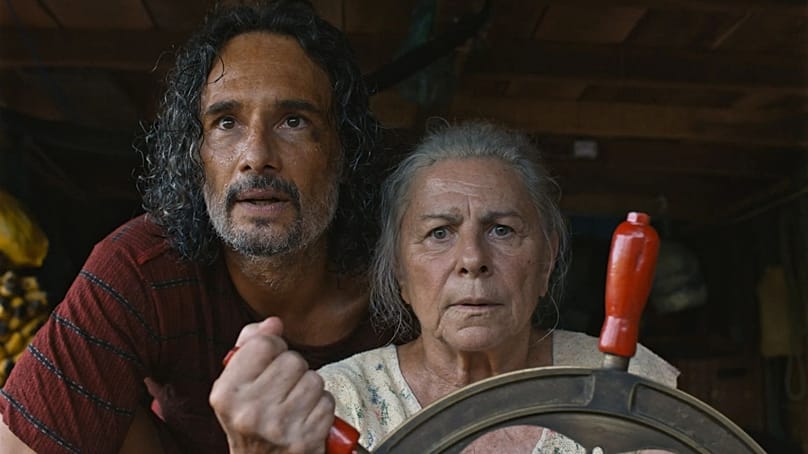
With only days left before her relocation, Tereza embarks on a journey to tick one last wish off her bucket list before she loses her freedom: she wants to take her very first plane ride.
Her daughter Joana (Clarissa Pinheiro) refuses the ticket purchase, which leads the headstrong septuagenarian to find another way to embrace her last moments of true autonomy. She hears about a light aircraft in Itacoatiara and decides to clandestinely buy her way onto a riverboat and sail down the Amazon with captain Cadu (Rodrigo Santoro).
When they are forced to stop, Cadu finds a rare “blue drool snail” that apparently appears on its own terms. In other words, you don’t find it; it finds you. The gastropod’s slime, if used as eye drops, triggers a hallucinogenic trip which allows you to see your future destiny. And temporarily look like one of Dune’s Fremen.
Let’s get straight to it: The Blue Trail is a heart-spearing, heart-filling triumph.
Mascaro delicately embraces his central concept – which Yórgos Lánthimos would have loved to get freaky with - and instead of overplaying his hand, understands that a poetic tone can create a meaningful clash with the dystopian set-up.
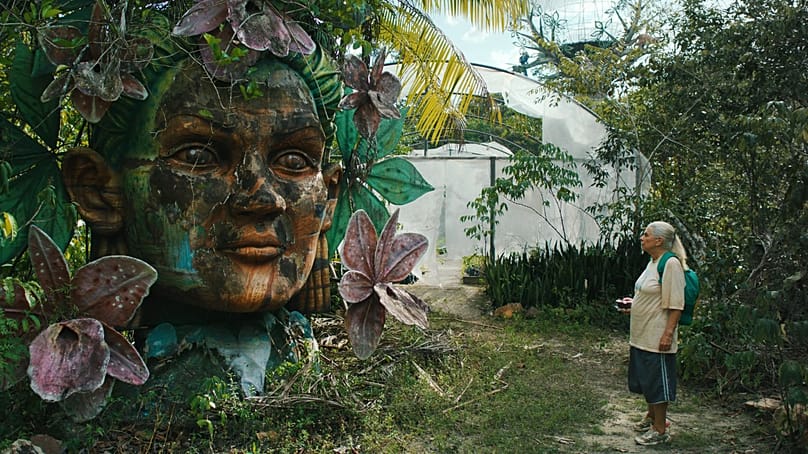
He crafts a hypothetical future that feels plausible, limiting the on-screen dystopia to a few subtly peppered details. Unlike his previous film Divine Love, which showed a neon future in which religion has been institutionalised and Brazil is ruled by evangelicals, Mascaro and his production designer Dayse Barreto create an imaginable projection of Brazil that feels only a couple of years away. Apart from the standard issue backpacks and obligatory diapers, the director shrewdly elects to never show the Colony; even if some visual cues (“Give me back my grandpa” graffiti on the walls) do suggest a place you don’t return from - which can lead to Soylent Green-shaped suspicions.
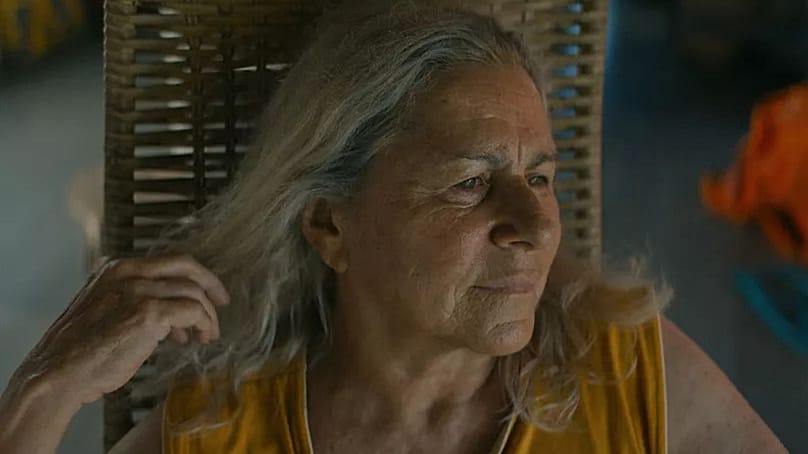
Rather than heavy-handedly leaning into the horrors inherent to a separationist society, Mascaro focuses his attention on Tereza and her moving road movie. Well, mostly water movie. She is played to perfection by Denise Weinberg, who gives the character layers beyond her initial brash and no-nonsense attitude.
Weinberg delicately allows vulnerability to peek through the stages of her late-life odyssey of self-discovery, especially when she meets Roberta (Miriam Socarrás), a free spirited “nun” who, Tereza learns, managed to buy her freedom...
Mascaro’s impactful and unpredictably funny protest against ageism recalls Shōhei Imamura’s The Ballad of Narayama and Chie Hayakawa’s Plan75, but feels refreshing on its own terms, as dystopian insurrection routinely belongs to the young. Tereza’s older body shows that our elders are more than capable of rebellion - especially when it comes to the forced displacement of communities and the dark possibilities that could decry from an eerily conceivable future.
The Blue Trail could have stumbled into traps so many other late-life renaissance movies have fallen into, chiefly being either too bleak or overly sentimental. However, buttressed throughout by deft narrative and tonal command, a superb central performance and some goregously shot riverscapes (and fish fights - don’t ask, watch), Mascaro’s film is as affecting in its surreal poetry as it is provocative as a cautionary tale about the marginalization of the elderly.
It is the most beautiful warning cry of 2025 – one which, sadly, goes beyond cinema screens. Despite a banner year, there have been reports of Brazil’s film industry stalling amid bureaucracy and political swings, threatening the steady promise of a vibrant filmmaking industry. Let’s hope things look up, as the country's artistic output has given international audiences some of this year’s best cinemagoing experiences. And it all started with The Blue Trail...
The Blue Trail is in select European cinemas now, and a US release is scheduled for next year. The Secret Agent gets a wide European theatrical rollout in 2026.