































As we head towards carbon-neutral aviation in 2050, the sustainable aviation fuel industry is set to boom. We spoke to a key innovator to learn more.
“Today, the European aviation market is $56 billion. In 2030, it will be over $100 billion,” the CEO of sustainable aviation fuel innovators, EcoCeres told The Big Question.
 ADVERTISEMENT
ADVERTISEMENT
ADVERTISEMENT
But is it possible for the aviation industry to grow and for Europe to achieve its sustainability targets? And with increasingly unpredictable geopolitics posing a threat to the continued supply of fuel, how will the industry power its planes?
Recent events have seen the cost of oil go over $100 a barrel which has led to jet fuel doubling in price, jumping from $750 to $1,500.
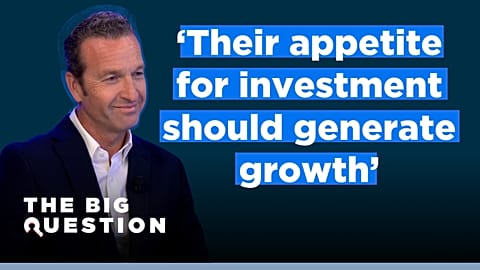
In this episode of The Big Question, CEO of EcoCeres, Matti Lievonen joined Angela Barnes in the studio to discuss why their sustainable aviation fuel (SAF) could provide the solution.
How is sustainable aviation fuel made?
EcoCeres’ SAF is made in much the same way as traditional jet fuel, but instead of mining for fossil fuels, they use existing feedstocks like used cooking oil, animal fat and fish fat.
The benefits? Up to 90% less greenhouse gas emissions.
The Hong Kong based company already has partnerships with 350,000 restaurants, ranging from McDonalds and Subway across China, who provide their used cooking oil for use in EcoCeres’ production process.
Having developed their own technology to filter and process these “dirty feedstocks,” Matti proudly declared that EcoCeres’ input to output conversion is “the best in the world,” boasting an 85% yield.
Though EcoCeres is a relatively new company, still considering themselves a start-up, they’re already the second biggest producer in their field, with an annual output of around 770,000 tonnes per year.
And with eyes on plans to build a third and fourth production plant, and looking at the potential to start production in Europe, that is set to grow.

Does sustainable aviation fuel cost travellers more?
EcoCeres has already partnered with the likes of British Airways, Lufthansa, KLM and AirFrance. EU regulations currently mandate a 2% SAF mix, rising to 6% in 2030 and again to 70% by 2050. That said, many airlines are already opting to use a higher mix of SAF before the mandated deadlines.
A standard flight between Hong Kong and London needs around 60 tonnes of jet fuel, meaning EcoCeres’ 770,000-tonne output can power tens of thousands of these flights per year.
But is there an added cost for travellers? Matti estimates on the Hong Kong to London route, passengers are looking at a roughly €42 premium when using a 10% SAF mix.
“I think that we should all, as individuals, take responsibility for [SAF] because if I ask airlines ‘What is your biggest risk?’ They all say that it's climate change. It's not today, but when there is more hazardous weather, people are not travelling,” he explained.
“So I think that it's a common goal that we should decarbonise aviation but also other transports. So it's really the climate change question but also it's the security of supply. Now we see that.”
Though SAF is currently more expensive to produce, it is protected from the fluctuations in price we see in traditional oil and gas connected to geopolitical developments. Where we have seen recently doubling in price of jet fuel, SAF has only increased 30%. This means the price gap is falling. Before recent crises, SAF was 200-300% of the price of traditional jet fuel, which has now fallen to 150%.
Does SAF spell the end for low cost flights?
While SAF might mean a slight increase in prices for airline tickets, Matti pressed that rules will be the same for all airlines and so price differences will remain.
“So if they have another cost competitiveness, it will stay there, even if they need to add extra for sustainable aviation fuel,” Matti reassured.
“It's not really killing them, but I don't know if it’s wise that we are travelling so low cost? I don’t know.”
The Big Questionis a series from Euronews Business where we sit down with industry leaders and experts to discuss some of the most important topics on today’s agenda.
Watch the video above to see the full discussion with EcoCeres.