































Uzbekistan is overhauling its labour market to better match skills with employer demand, expand vocational pathways and support enterprise growth, as demographic pressures raise the stakes for productivity, job creation and long-term economic expansion.
Uzbekistan is undergoing a significant transformation of its labour market, aiming to equip its young and growing population with the skills required for a rapidly evolving economy. According to the Ministry of Employment and Poverty Reduction, the country’s unemployment rate fell to 4.9% in the third quarter of 2025. Despite the improvement, around 760,000 people remain registered as job seekers, underscoring the continued need for job creation.
 ADVERTISEMENT
ADVERTISEMENT
ADVERTISEMENT
Employment growth is increasingly driven by services, information technology and manufacturing, alongside substantial labour migration abroad. In 2025, 4.45 million people secured income-generating employment: 2.74 million in services, 1.29 million in agriculture, 172,300 in construction and 256,200 through investment projects.
Experts say Uzbekistan’s young population presents both opportunity and risk. “Each year, around 700,000 young people enter the job market,” says Akiko Fujii, Resident Representative at the United Nations Development Programme (UNDP) in Uzbekistan. “The main challenge is the mismatch between what young people learn in school and what employers actually need. Many graduates lack practical, market-relevant skills, especially in technical and vocational fields.”
Entrepreneurship and project-based work
For young entrepreneurs, Uzbekistan offers an increasingly supportive ecosystem.
“In entrepreneurship, you’re not limited to one role. You have to think strategically, sell your services, work with clients and organise your team,” says Kseniya Leonteva, founder of photo production company Xen-production. “The government has created very favourable conditions by simplifying procedures and making many services available online. This encourages growth in the creative sector and marketing.”
She notes that while project-based employment can be unpredictable, state initiatives are increasingly helping young people build skills and sustainable businesses.
Youth entrepreneurship has become a government priority. Under the Youth Employment Programme, 354,000 young people found jobs in 2025, representing 92% of participants. Support measures include covering the costs of driving lessons and international examinations, as well as up to 50% of university tuition fees for low-income youth. Specialised parks offer preferential tax regimes, including a 50% reduction in income tax for young designers, programmers and artists.
Gender inclusion and women in the workforce
Uzbekistan has enacted legislative reforms to boost female workforce participation. Restrictions on women working in certain industrial roles have been lifted, while equal pay for equal work has been formally introduced. UNDP-supported initiatives, including internships at technology-focused companies, aim to transition women from informal into formal employment, providing social protection and benefits.
“Social norms remain deeply entrenched,” Akiko Fujii adds. “If women participated on par with men, national income could rise by 29%, lifting more than 700,000 people out of poverty.”
Programmes such as the Hamroh initiative offer women entrepreneurs with integrated support combining finance, training and mentorship. Meanwhile, the Equal Opportunities Project, launched in late 2025, aims to employ 40,000 people with disabilities through vocational training and employer incentives.
Vocational training and international collaboration
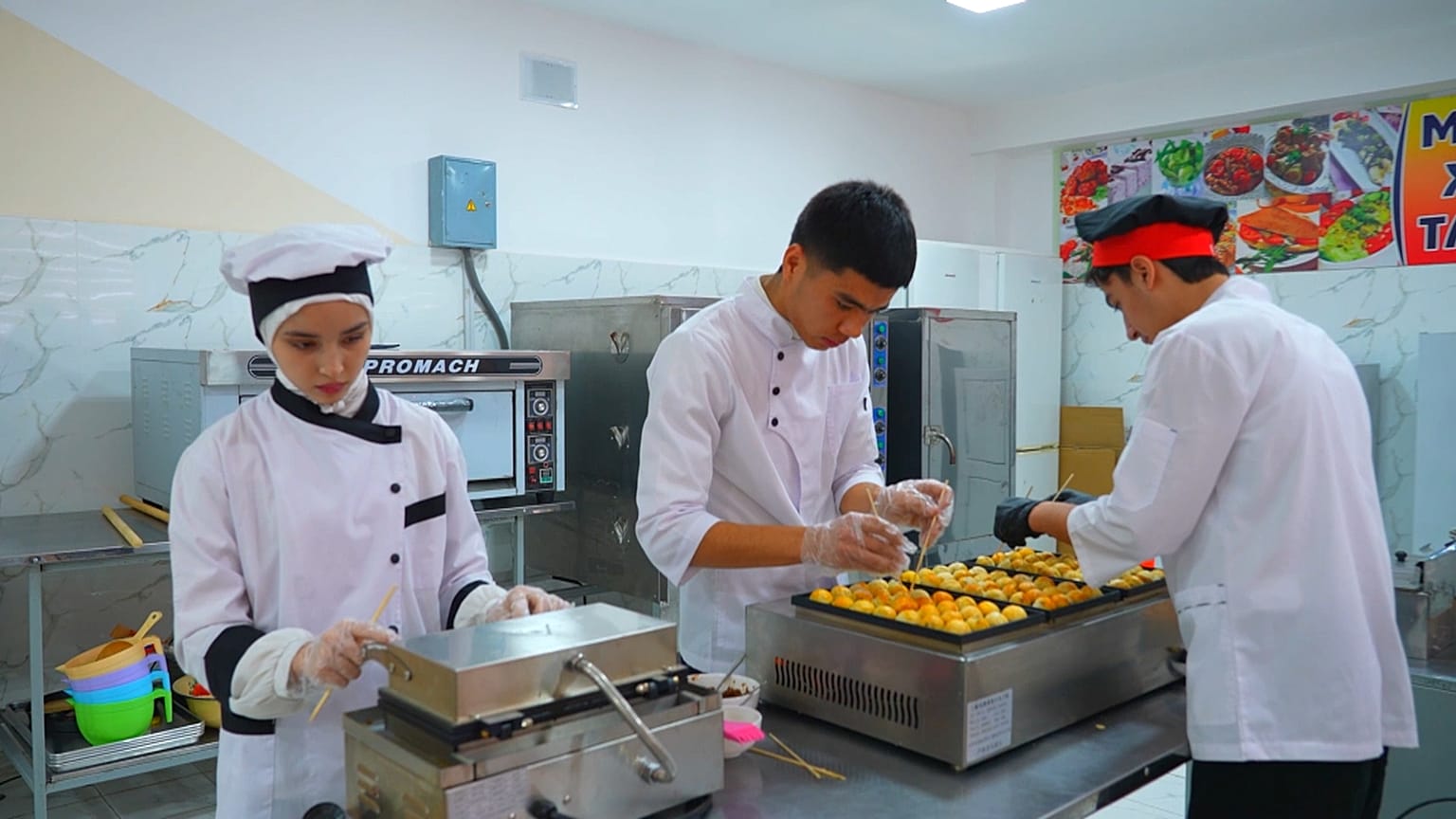
Vocational education has expanded rapidly, with 80 vocational skills centres now able to train up to 250,000 people each year. Short-term courses lasting one to six months prepare participants for in-demand roles including computer graphics, web development, call-centre operations and human resources inspection. Employment centres increasingly act as intermediaries, linking job seekers with employers and aligning training with labour-market demand. Nearly 500,000 students are currently enrolled in 643 technical schools, combining classroom learning with hands-on experience.
Azimjon Khusanov, Director of the Agency for Vocational Education, says programmes are being aligned with international standards. “We are forming partnerships with international institutions so students gain skills demanded locally and abroad,” he says. “Dual education programmes with Germany, Slovakia, Japan and Bulgaria allow students to acquire practical skills while studying. We are also introducing international certifications, including ISO and IELTS.”
Khusanov adds that employers are encouraged to participate through access to loans and tax incentives, while students now receive dedicated stipends for the first time.
Saidazim Ganikhodjaev, Director of the Tashkent Technical School of Tourism and Cultural Heritage, says the system also supports those already working. “People without formal qualifications can earn professional diplomas without leaving their jobs, attending classes two days a week while gaining practical skills.”
These programmes combine classroom learning with internships at partner hotels, restaurants and service providers. Tourism student Muhabbat Hakimova says the approach builds confidence. “We gain both theoretical knowledge and practical experience. After graduation, I am confident I will secure a profession in this sector.”
Another student, Berivan Lezgieva, highlights the value of international partnerships. “A Turkish company created a practical training complex in our college. We learn guest services and hospitality, and I am improving my English to better interact with tourists.”
A growing workforce and future challenges
Uzbekistan’s working-age population is projected to increase by 10 million by 2050. Policymakers face the dual challenge of creating sufficient jobs while ensuring relevant skills development. Failure to absorb this workforce could increase informality, migration and social strain, while success could unlock significant economic gains.
“Policies must focus on inclusivity, career guidance and linking education to market needs to fully harness the demographic dividend,” Akiko Fujii says.
Read more