





























New international corridors and fleet upgrades are expanding cross-border rail connectivity, supporting trade flows between Europe, Asia and South Asia, while modernisation and electrification aim to improve passenger and freight services.
Uzbekistan is expanding its international railway corridors as part of a strategy to strengthen its role as a transit country linking Europe, Asia, and South Asia. The new and upgraded routes aim to reduce transit times, improve trade flows, and provide alternative connections between major global markets, according to officials.
 ADVERTISEMENT
ADVERTISEMENT
ADVERTISEMENT
“We are actively opening new corridors with neighbouring countries and with Asia and Europe. The goal is to unlock the full potential of Uzbekistan as a transit hub, making trade faster, more efficient, and more accessible,” said Jasurbek Choriyev, deputy minister of transport.
The expanded network includes several key corridors. These range from the TRACECA route through the Black Sea, to the China–Kazakhstan–Uzbekistan railway via the Altynkol/Korgos border crossing, and routes through Turkmenistan and Iran leading to the port of Bandar Abbas. Additional connections provide access to Baltic ports via Russia.
One of the shorter routes is the Hairatan–Mazar-i-Sharif railway, which links Uzbekistan with Afghanistan and provides access towards Pakistan. Officials say this connection opens new possibilities for trade with South Asia while supporting the transit of goods such as cotton, natural gas, and agricultural products.
“Our vision is to make Uzbekistan’s railways a world-class system: efficient, green, and capable of meeting the needs of the economy, passengers, and international partners,” said Khikmatualla Rakhmetov, first deputy chairman of Uzbekistan Railways JSC.
A central element of the strategy is the planned Trans-Afghan Railway, designed to connect Uzbekistan with Pakistan’s seaports and the Indian Ocean. The project is intended to create a continuous land route between Central Asia and South Asia.
“The Trans-Afghan Railway is a historic project. It links Central Asia with South Asia and the Indian Ocean, opening new opportunities for trade and economic growth across the region,” Choriyev emphasised.
Development of these corridors is supported through cooperation with international financial institutions, including the European Bank for Reconstruction and Development, the Asian Development Bank and the World Bank, according to the Ministry of Transport.
Fleet modernisation and infrastructure upgrades
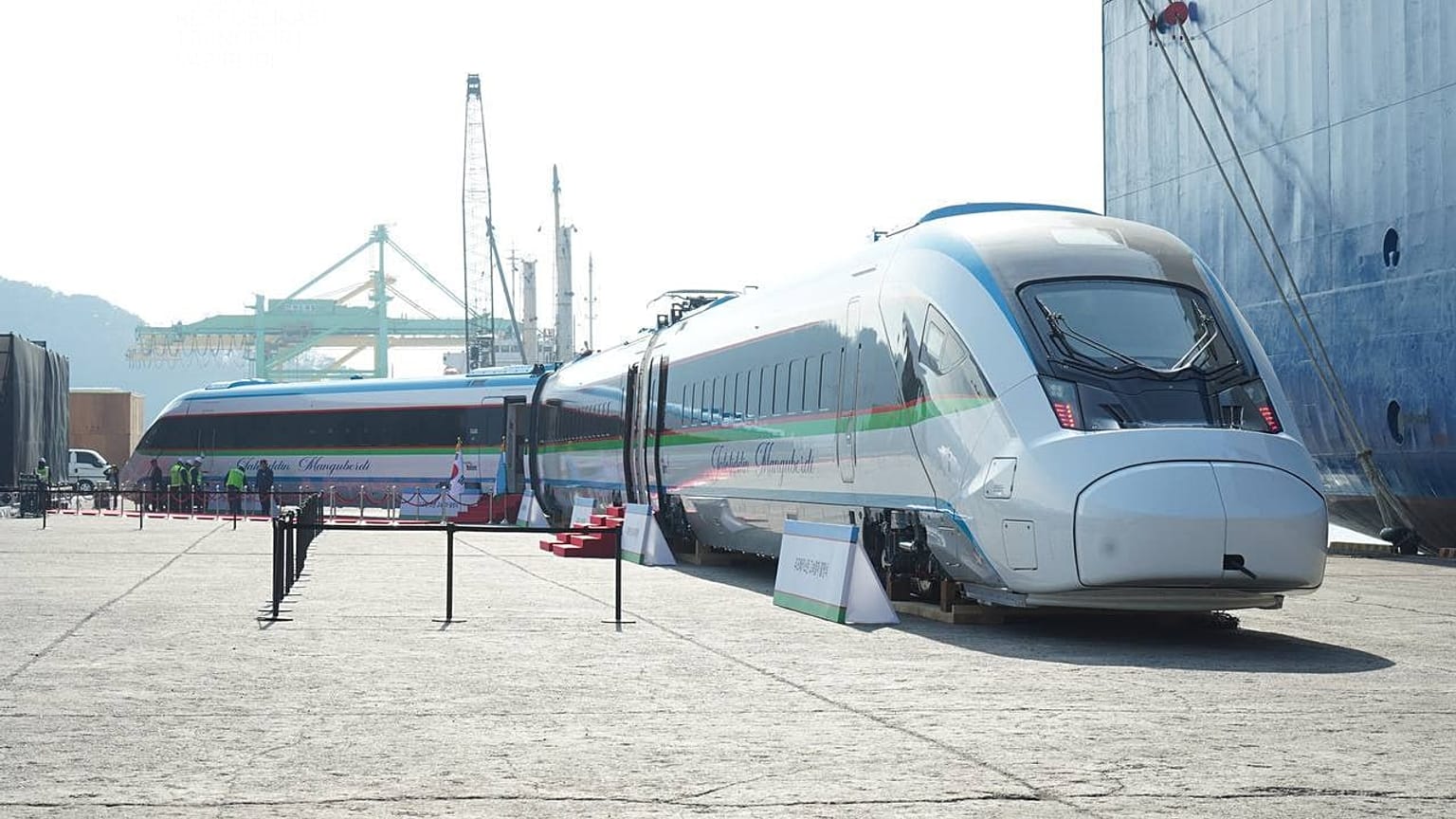
Alongside corridor development, Uzbekistan Railways is modernising its rolling stock and infrastructure. The programme includes the purchase of 38 mainline locomotives and 50 shunting and hybrid locomotives from China, as well as six high-speed electric trains produced by South Korean manufacturer Hyundai Rotem.
The first of these high-speed trains is scheduled to operate on the Tashkent–Urgench–Khiva route, reducing travel time from about 14 hours to around 7.5 hours. The broader programme also covers the acquisition of 250 passenger carriages, 23 intercity electric trains and around 10,000 freight wagons. More than 6,000 existing wagons are undergoing refurbishment, while 12 electric locomotives are being overhauled.
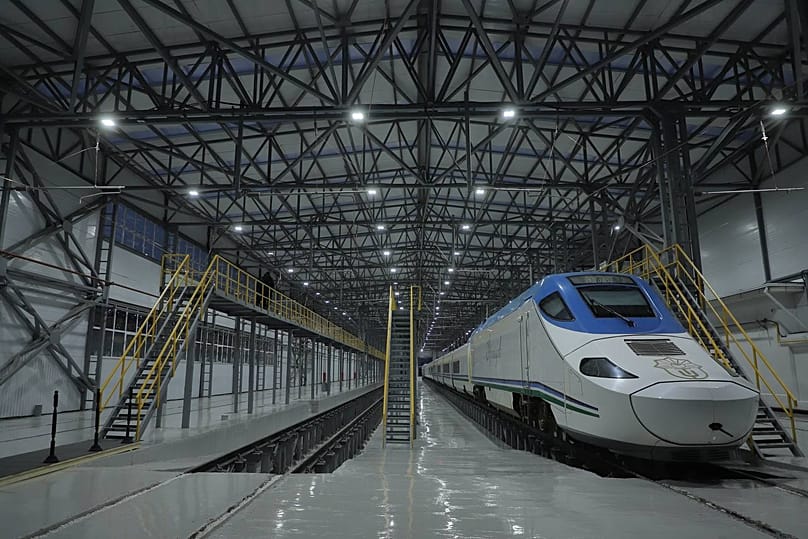
Domestic rail capacity has also been expanded. Uzbekistan Railways has added 1,200 new freight wagons and introduced digital systems that reduce wagon ordering times from 72 hours to around 12 hours. According to officials, train throughput in the Tashkent area has increased by about 30%.
New and upgraded domestic lines, including Navoiy–Uchquduq–Sulton Uvaystog’ and Toshguzar–Boysun–Qumqo‘rg‘on, have strengthened internal connectivity, while the Hairatan–Mazar-i-Sharif line continues to support access towards South Asia.
“Uzbekistan is developing alternative corridors to overcome regional constraints. These initiatives are crucial to securing reliable transit routes and expanding our international connections,” said Bekzod Kholmatov, director of the Centre for the Study of Transport and Logistics Problems.
Passenger service and tourism
High-speed passenger services are growing rapidly, with volumes expected to triple by 2026. The network supports tourism to cities such as Samarkand, Bukhara and Khiva, which have seen rising interest from foreign visitors.
Data from the National Statistics Committee shows that during January to June 2025, railways transported an average of about 29,400 passengers per day.
“Passenger transport is a priority. High-speed trains improve mobility and help connect visitors with Uzbekistan’s historical and cultural centres,” Rakhmetov said.
Investments in station modernisation, rolling stock upgrades, and service standards are intended to improve travel times, comfort, and safety for both domestic and international passengers.
Sustainability and green technology
Electrification and renewable energy form a core part of Uzbekistan’s railway strategy. Electrified rail services reduce dependence on diesel-powered transport and lower greenhouse gas emissions. More than 70% of the country’s rail network is currently electrified, with plans to raise this share to 85% by 2030.

Over the past eight years, Uzbekistan has invested more than €17.2bn in solar and wind power projects, which complement the expansion of electrified rail services.
“Electrification not only reduces transport costs but also benefits the environment, making railways a key part of Uzbekistan’s sustainable future,” Rakhmetov said.
Long-term strategy
Officials describe rail transport as a central component of Uzbekistan’s economic infrastructure, linking production centres, consumers, and international markets.
“Railways are not just a transport system; they are the backbone of Uzbekistan’s economy, connecting people, goods, and opportunities across Central Asia and beyond,” Rakhmetov emphasised.
Over 70% of Uzbekistan’s network is already electrified, with plans to reach 85% by 2030, making it one of the most electrified networks in Central Asia.
Read more