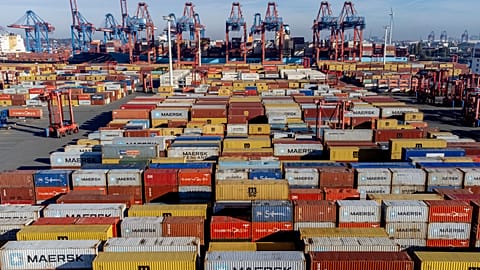

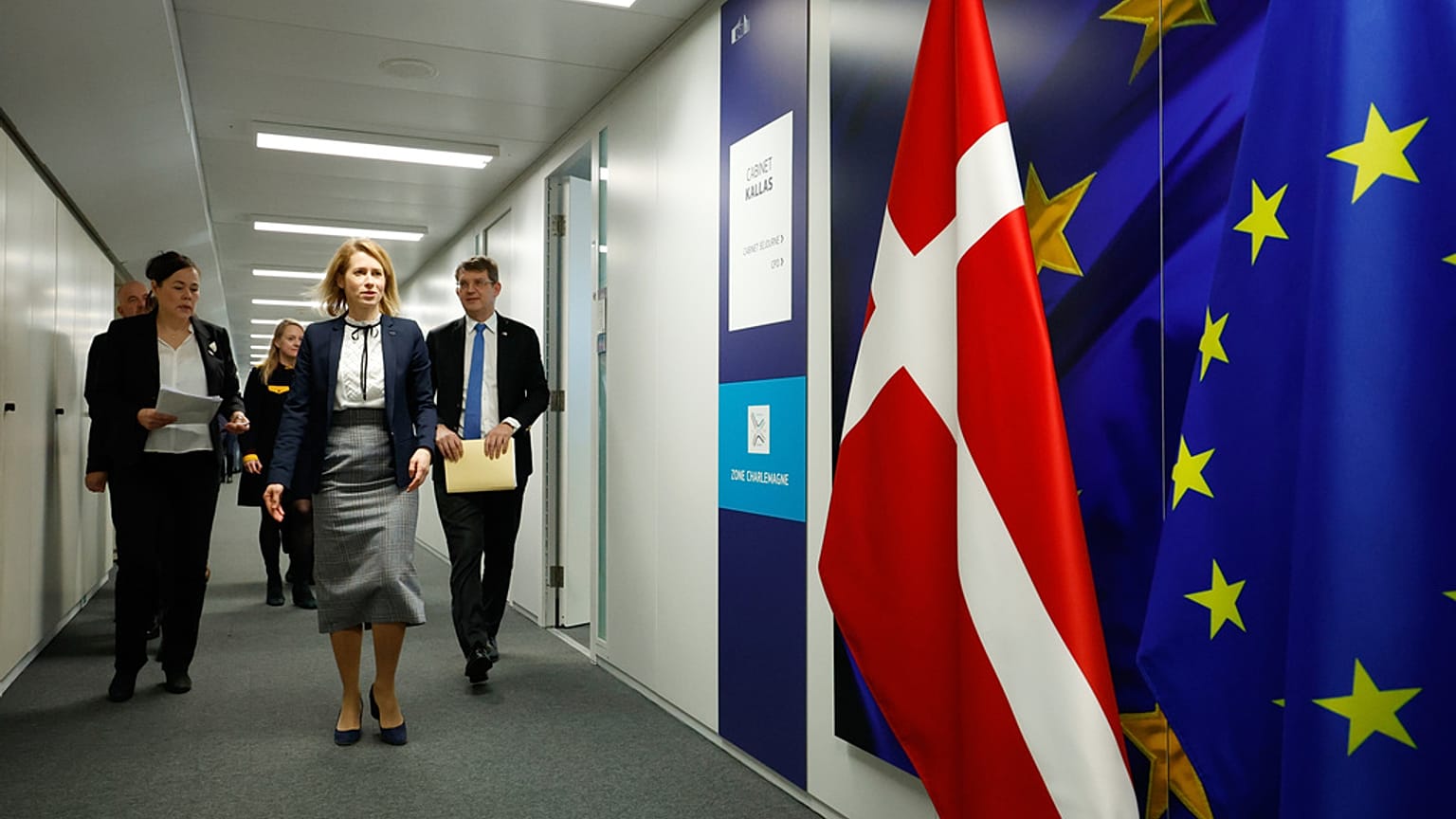














With Washington openly tying tariffs to geopolitical demands over Greenland, EU capitals are considering a never-used mechanism that would allow them to hit back — not as individual states, but as a single market of 450 million consumers.
Washington’s increasingly hostile talk on Greenland has prompted some EU capitals to consider reaching for its relatively new, never-used economic kill-switch power.
 ADVERTISEMENT
ADVERTISEMENT
ADVERTISEMENT
The yet-untested Anti-Coercion Instrument is a law that entered into force in late December 2023 giving the EU a mechanism for a collective response when a member of the bloc is being pressured into "making a particular choice by applying, or threatening to apply, measures affecting trade or investment."
US President Donald Trump, ostensibly surprised that key European powers did not immediately nod along to his renewed push to "buy" or gain some form of control over Greenland, responded by threatening to impose an additional 10% tariff on goods from Denmark, Norway, Sweden, France, Germany, the Netherlands, Finland and the UK starting 1 February.
The tariff would jump to 25% on 1 June if they continued to resist.
These new levies would be stacked on top of an existing 15% EU tariff, painstakingly negotiated down from a 50% threat in the summer of 2025 by Ursula von der Leyen after the European Commission president chased Trump down to his golf course in Turnberry in Scotland to sign a deal.
In response to the latest threat, finance ministers of Germany and France, gatekeepers to the bloc's biggest economies, have publicly come out and said they would not allow the economic blackmail to be used to force them into complying with US demands.
Unlike Trump's previous tariff threats, which were dressed up as trade deficit disputes, these ones have a direct political tie-in or what the Anti-Coercion Instrument defines as economic pressure to force a geopolitical outcome — constituting undue interference "with the legitimate sovereign choices of the European Union and its member states."
NATO's Article 5, but for trade?
Even though Greenland is not an EU member state, it is tied to one, namely Denmark.
Coercion aimed at Greenland can function as coercion aimed at an EU member state’s guaranteed independent choices — which is exactly the scenario the instrument is written for.
Effectively, the mechanism was conceived so that the EU could use the threat of a break with the full weight of its economic might to protect one or several of its members.
If you economically squeeze one capital to force a political decision, you do not just pick a fight with that country — you pick a fight with the entire single market.
If that sounds familiar, then it is because it is eerily similar to NATO's Article 5 pledge where an attack on one is an attack on all, except that instead of military responses, the response is a form of economic warfare, or "war" by other means.
And unlike NATO, the EU is a club the US does not belong to — meaning a move against Washington under the Anti-Coercion Instrument would not automatically put the entire alliance on the line, the way a NATO confrontation ultimately would.
It forms an uncharacteristically harsh response from a union that is better known, and at times ridiculed for, its calm and at times underwhelming responses to international crises.
Yet, in many ways, it is a quintessentially EU response — its members are sovereign when it comes to domestic issues and their militaries, but the EU single market is holy.
After all, the 27-member bloc was formed primarily as an economic union, deeming free-flowing trade to be the ultimate tool that could discourage future conflict on the continent.
Similarly to NATO, the instrument was not meant to be turned against steadfast allies such as the US, but mainly countries such as China or Russia who exhibited coercive economic behaviour to force a political stance on a country — think Beijing blocking imports from Lithuania in 2021 after Vilnius allowed a Taiwanese Representative Office to operate in the country.
At the time, both the EU and Lithuania filed a case against China at the World Trade Organization, which was dropped in late 2025 when trade resumed. Lithuania has since then been one of the main countries advocating for an EU-based "in-house" anti-coercion instrument.
How does it work?
In setting out the ACI’s scope, the law also lays down a fairly tight runway for how a complaint can move from allegation to action.
The process can begin either with the Commission launching a case on its own initiative or with a request from a member state.
The Commission then examines the alleged “injury” over a period generally not exceeding four months — including whether the third country has a pattern of similar interference in the EU or elsewhere — which policy choices it appears to be trying to influence and whether it attempted to achieve its objective through other channels before resorting to trade- or investment-linked pressure.
If it finds coercion and proposes action, the Council then has roughly two months — up to 8 weeks, and at most 10 — to formally determine that coercion exists
The Commission then requests the third country stop engaging in these measures and attempts to engage with the third country.
If that fails, then “as a last resort" the EU can adopt response measures designed to induce the third country to stop.
Those measures include restricted access to the EU market and other economic disadvantages across goods, services, foreign direct investment, financial markets, public procurement, trade-related intellectual property, export controls and more.
Any retaliation is adopted via a Commission implementing act, after member states have weighed in through an examination procedure.
The Commission can also decide to request "reparation for the injury caused by the economic coercion, in line with public international law." The response is terminated as soon as measures are no longer needed.