












Large-scale, global cooperation is weakening as trade, finance, and tech links shift toward smaller, interest-based groups of countries, says the World Economic Forum.
The world’s multilateral machinery is slowing at the precise moment crises are multiplying, yet global cooperation measured across trade, capital, technology, climate, health and security is proving more resilient than expected.
 ADVERTISEMENT
ADVERTISEMENT
ADVERTISEMENT
In other words, while overall cooperation is continuing at a steady rate, this allyship is increasingly happening among smaller groups, rather than between many countries.
That is the central finding of the latest Global Cooperation Barometer, published by the World Economic Forum, which finds that formal, UN-centred action is increasingly outpaced by conflict and distrust.
“As a new global era takes shape, multilateralism is under strain, even as global cooperation continues to deliver in some key areas," it stated.
Despite the finding, the report’s headline result is largely optimistic. The system is fraying, but not yet breaking.
It argues that although classic multilateral cooperation has weakened, alternative coalitions are picking up the slack — often in narrower, interest-based formats that are easier to sustain politically.
That shift is visible in trade data. Rather than a wholesale retreat from global commerce, the report describes a re-routing of goods flows along more resilient geopolitical lines. Despite this, countries are still trying to diversify suppliers and markets among trading partners they consider more secure.
“The average geopolitical distance of global goods trade has fallen by about 7% between 2017 and 2024… Taken together, these shifts suggest that global trade is redistributing within aligned networks while diversifying across partners,” it continued.
Developing countries and China see benefits
The redistribution has also benefitted emerging manufacturing exporters.
In 2024, developing economies and China expanded their slice of exports, according to the report, even as advanced economies harden trade policies and build barriers around strategic sectors.
“[They] have gained a larger share of manufacturing exports: in 2024, their exports rose by $276 billion, or 5 percentage points, of which China represented more than half the total growth.”
The tariff shocks of 2025 did not, on the report’s reading, crush trade outright. Instead, they accelerated a reshuffle — with volumes still expanding, but patterns shifting rapidly, especially in US imports.
“Undeniably, a series of US tariff announcements in 2025 raised questions about the future of trade. Early indicators suggest that rather than leading to a contraction, these announcements have fuelled a reconfiguration," the report explained.
Trade volumes are estimated to have grown in 2025 by about 2.4%, though slightly below the pace of real GDP growth at 3.2%.
Where goods trade is being rewired, the report suggests flows of capital and services are still climbing, often driven by governments trying to secure know-how and build domestic capability in sensitive industries.
The centre of gravity is shifting from efficiency-first globalisation to resilience-first investment — a change companies are already pricing into their supply chains.
Foreign direct investment focused on AI
Investment is clustering around strategically sensitive sectors or "future-shaping” industries. The Barometer highlights a sharper tilt towards semiconductors, AI infrastructure, batteries, and critical minerals.
But while capital and services continue to move, the report argues the “classic” markers of multilateral cooperation are sliding — and nowhere more visibly than in aid.
Donor priorities have tightened as politics harden and fiscal pressure rises, leaving development budgets more exposed to domestic recalibration.
“Official development assistance (ODA) had the largest decline in this pillar, 10.8% in 2024… Only four countries exceeded the UN target of 0.7% Gross National Income… For 2025, the Organisation for Economic Co-operation and Development (OECD) estimated another 9–17% fall in ODA.”
Migration, too, appears to be turning. After years of growth, the report points to early signs of slowdown in 2024 and a sharper contraction in 2025, with major destinations pulling back. Net migration inflows into the US and Germany fell by an estimated 65% and 39% year-on-year in 2025.
Decline in peace and security
The report’s starkest warning, however, comes on the topic of peace and security as crises spread and displacement rises.
“The number of UN Security Council (UNSC) resolutions fell from 50 in 2023 to 46 in 2024, and the ratio of multilateral peace operations to conflicts declined by about 11% YoY," the report stated.
It argues that geopolitics is making UN intervention harder, and that peacekeeping is being squeezed not just by veto dynamics, but by budgets and manpower.
Personnel deployed to multilateral operations has dropped steeply over the past decade.
“The UNSC had not mandated a new peacekeeping operation since 2014… Furthermore, budget cuts have put pressure on existing missions – personnel deployed to multilateral peace operations fell by more than 40% between 2015 and 2024.”
As a result, it says, the UN’s role is shifting away from large deployments and towards diplomatic engagement and regional frameworks, even as conflict risks rise.
“In this context, the role of the UN’s engagement has evolved, leaning more on special political missions and special envoys, concurrent with a rise in regionally led frameworks.”
Business leaders are not treating this as abstract geopolitics. The report finds that instability is increasingly filtering into operating conditions — from insurance and shipping risk to investment decisions and talent mobility.
“About half of surveyed council members expected cooperation to deteriorate, and about half of surveyed executives pointed to developments in peace and security as affecting their ability to conduct business.”
Increased defence
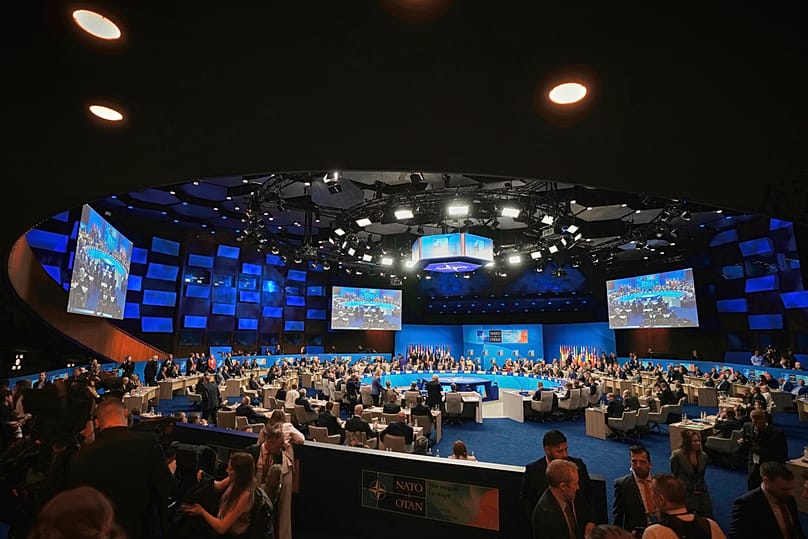
Governments, meanwhile, are preparing for a more contested future by spending more on defence. The report highlights NATO’s jump in compliance and notes that even higher targets are now being discussed.
“All 32 NATO member states met the defence spending target of 2% of GDP in 2025, whereas more than 10 fell short the year before… With NATO raising its spending target to 5% of GDP for 2035, national defence spending is set to rise further.”
That may be the clearest takeaway for markets and multinationals, namely that the world is not running on one operating system anymore.
Cooperation is increasingly local, modular and conditional — a patchwork of deals, corridors and coalitions that can keep trade and investment moving, but struggles to deliver on the hardest collective problems.
The Barometer suggests global cooperation is not dying — it is being rebuilt in fragments. The risk is that the world becomes very good at striking selective bargains, while remaining dangerously bad at the kind of multilateral action that prevents crises from spreading in the first place.