













The Commission has offered early access to €45 billion of fuding under the next Common Agricultural Policy budget as soon as 2028 to appease farmers. While France’s backing for the Mercosur deal remains highly uncertain, all eyes are on Italy. Prime Minister Meloni welcomed the proposal.
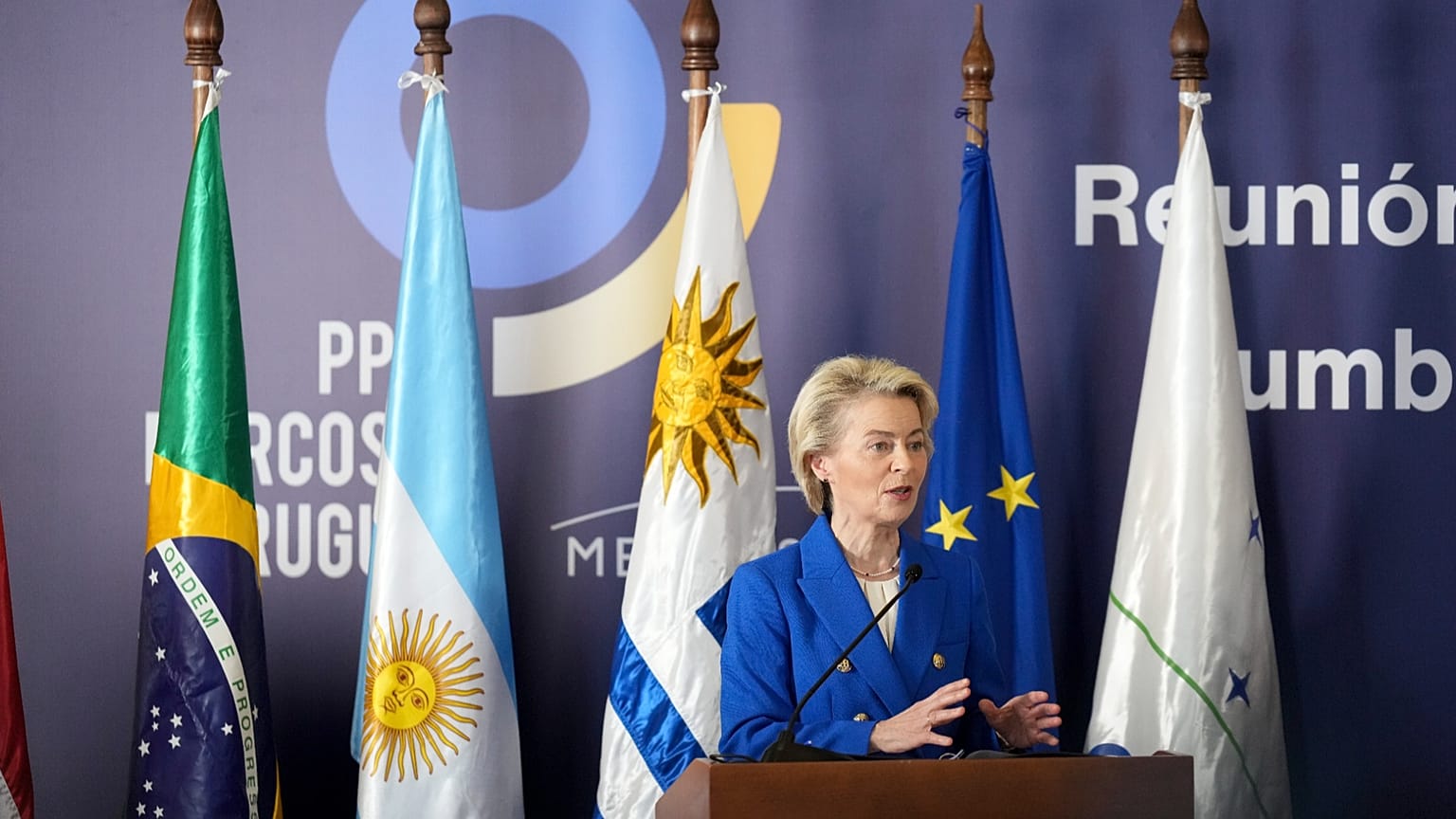
European Commission President Ursula von der Leyen has promised EU farmers early access to €45 billion from 2028 under the next Common Agricultural Policy budget if the Mercosur trade agreement is signed in a last-ditch effort to secure backing for the deal.
 ADVERTISEMENT
ADVERTISEMENT
ADVERTISEMENT
The proposal comes at a pivotal moment to finalise the Mercosur agreement, a trade deal with regional heavyweight economies like Brazil and Argentina, for which negotiations have now dragged on for more than 25 years.
Von der Leyen made her pledge in a letter on Tuesday as France and Italy continue to seek guarantees for their farmers, who fear unfair competition from Latin American imports, before a crucial vote on the agreement in Brussels on Friday.
In her message, von der Leyen said the €45 billion in CAP funds would “ensure additional resources are available as of 2028 for addressing the needs of farmers and rural communities” in a move designed to sway Italy in favour.
That represents two-thirds of the amount set aside until the mid-term review of the 2028-2034 EU budget and comes on top of a €6.3 billion reserve already planned to address market disruptions.
At an EU summit last December, the Commission and Germany, a supporter of the Mercosur, said they were confident the Mercosur will be sealed even if no date was set.
Giorgia Meloni said signing it off in December was premature but argued that she would be open to it at the start of 2026 once her concerns were addressed.
In a statement on Tuesday, Meloni said she welcomed the proposal put forward by the Commissioner "as requested by Italy" to protect European farmers.
All eyes on Italy to decide fate of Mercosur deal
Von der Leyen clinched the Mercosur agreement in December 2024 with Argentina, Brazil, Paraguay and Uruguay, aiming to create a free-trade area across the Atlantic.
The deal has exposed deep divisions within the EU.
Supportive states, led by Germany and Spain, have pushed hard to get the deal signed, while a group led by France has sought to block it.
The future of the deal now comes down to Italy, whose support is mathematically decisive. The deal requires a qualified majority of member states, while a blocking minority of just four countries representing 35% of the EU population could derail it.
The Commission is convening EU farm ministers in Brussels on Wednesday to discuss CAP funding, as well as a French demand for reciprocity in production standards and tighter controls on farm imports.
While the French have historically opposed the trade accord, which has a toxic reputation in the country, Italy is the country to watch. The indications coming from Rome suggest that a deal is now possible after the Commission's latest overture.
The ambassadors of the 27 member states will vote on the deal on Friday. If it passes, von der Leyen will be able to sign the agreement in Latin America next week.