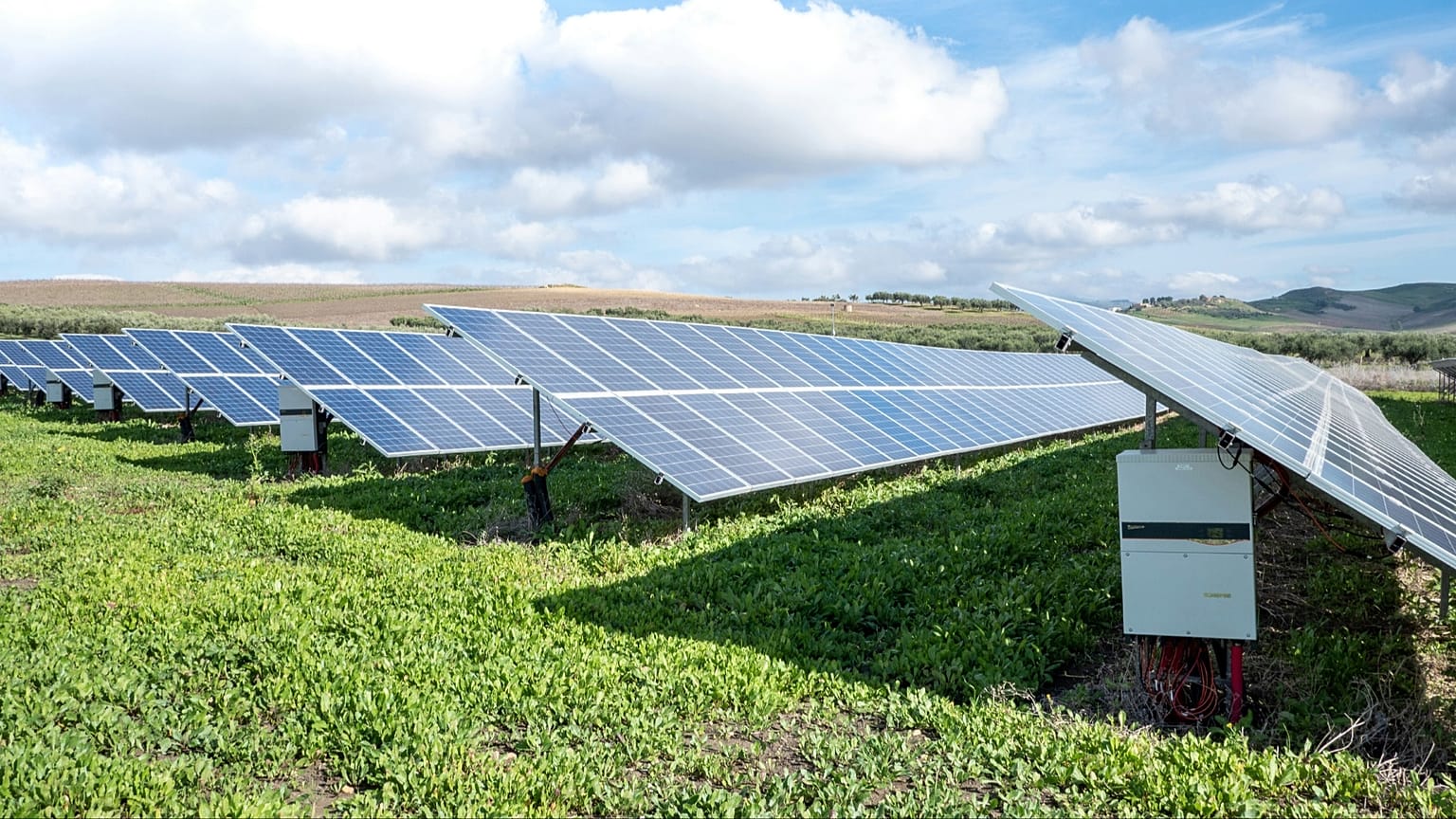













“Italy has plenty of sun, but it still runs its evenings on expensive gas – batteries can change that.”
Italy’s reliance on sky-high gas prices could be eased by a boom in battery storage, helping lower energy bills for cash-strapped households.
 ADVERTISEMENT
Despite achieving 49 per cent of its electricity share from renewable sources last year, the country is still dependent on gas – the most expensive way to generate electricity – when demand is at its highest.
This tends to be around 8pm when people come home from work and school, which coincides with a dip in solar generation due to a lack of sunlight.
A new analysis from energy think tank Ember, in collaboration with Cleantech for Italy and Energy Square, found pairing solar and wind power with battery storage systems (BESS) is becoming central to Italy’s power system – and the country needs to act fast.
How batteries can slash Italy’s electricity prices
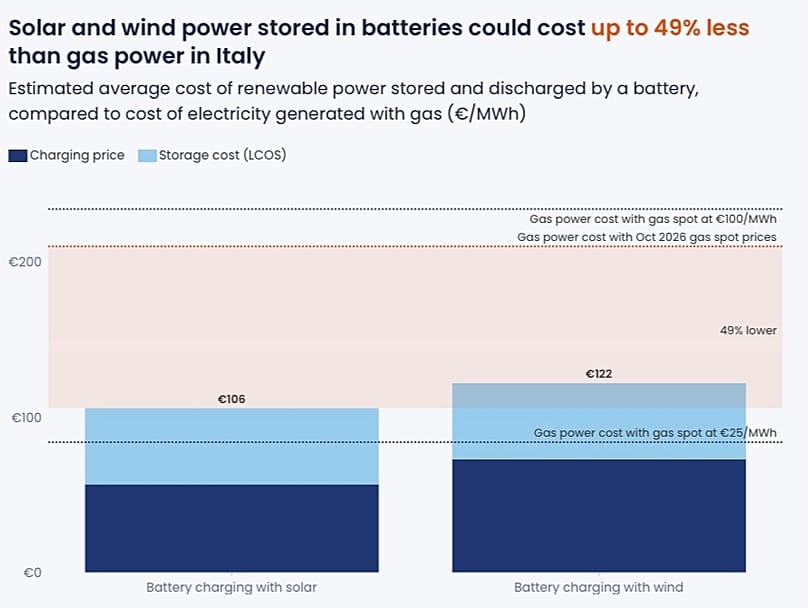
The study found that even under conservative estimates, renewable power stored and shifted to the evening could cost €106/MW against €210/MWh for gas power at October 2026 gas prices.
This means that battery storage could cut electricity prices by up to 49 per cent compared to producing electricity with a typical gas power plant.
“Italy has plenty of sun, but it still runs its evenings on expensive gas,” says Beatrice Petrovich, a principal energy analyst at Ember.
“Batteries change that, carrying low-cost renewable power into the hours when prices peak. Italy is already one of the most advanced EU countries for batteries connected to the power grid."
Batteries met an average of 2.8 per cent of Italy’s peak demand in the first half of 2026, more than double the level in the first half of last year, and are already displacing soaring gas prices.
This may seem small in comparison to fossil power’s 40 per cent, but analysts say it could grow quickly as contracted projects start to come online.
This is already happening across the EU, as nations scramble to balance renewable power and reduce curtailment (when clean energy is wasted due to supply outstripping demand).
Take Bulgaria, which has grown its grid-scale battery fleet from almost nothing in 2024 to almost 3 GWh by the end of 2025 and 16 GWh by August 2026 – overtaking Italy despite having a much smaller power system.
In the first half of 2026, batteries routinely supplied over a quarter of Bulgaria’s electricity demand (28 per cent) during the 8pm evening demand peak, up from four per cent one year prior, while fossil power’s share of the evening peak fell from 35 per cent to 31 per cent.
Bulgaria experienced less extreme price spikes during the summer 2026 heatwave than neighbouring countries, with strong battery discharge being one of the main drivers.
‘Storage and new generation need to develop together’
The price of electricity remains tied to volatile fossil fuels due to what is known as the merit order principle.
This ensures that electricity prices are based on the most expensive power plant still needed to meet demand.


So, if Italy’s electricity needs cannot be covered solely by clean energy (which it can’t when there is a lack of wind and sunshine), more expensive sources like coal or gas step in.
As Michele Torsello, director of Energy Square, points out – Italy’s challenge therefore isn’t to simply install more batteries, but to build an electricity system that “makes the most” of renewable energy.
“Storage, grids and new generation need to develop together,” he adds.
“As renewables grow, the value of each investment increasingly depends on the others. Capturing these synergies is key to translating this progress into lower costs for the electricity system as a whole.”