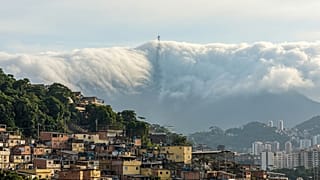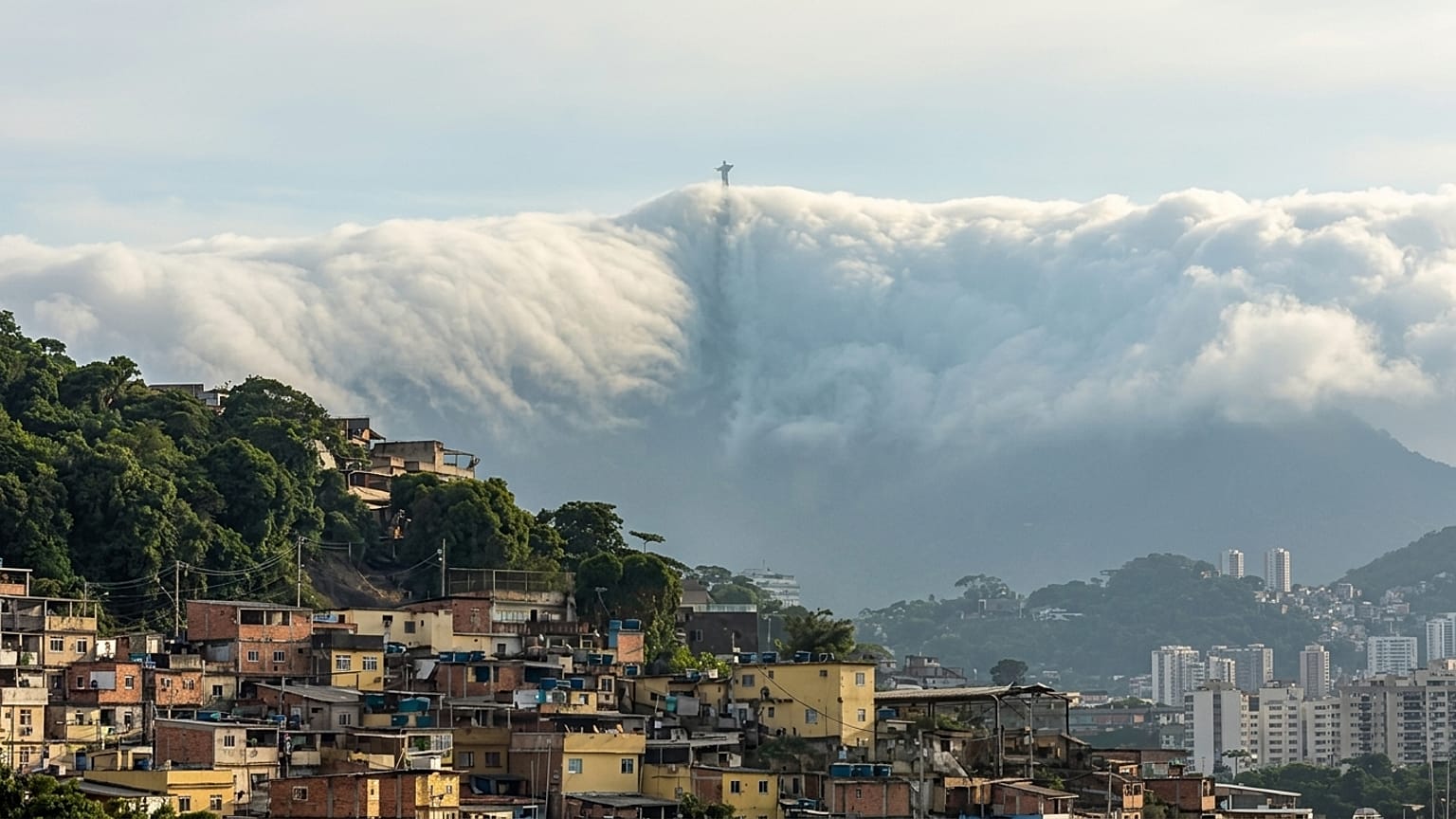













Captured last Saturday, the phenomenon went viral on social media. The film-like scene is explained by atmospheric science: moist sea air is pushed up a slope, cools, forms clouds and, descending the other side, creates a waterfall effect.
The expression "Cidade Maravilhosa" as an epithet for Rio de Janeiro gained strength at the start of the 20th century and, in the year 2026, the city still lives up to its name.
 ADVERTISEMENT
At dawn last Saturday, the city offered a natural spectacle to rival the works of the most talented painters, surprising residents and tourists. A dense mass of cloud wrapped around Corcovado Hill, where the world-famous Christ the Redeemer stands at about 710 metres above sea level.
Only the top of the mountain, with its iconic statue, and the highest peaks remained visible above a white blanket that created the effect of a waterfall overflowing down the slopes.
The moment was captured on a mobile phone by filmmaker and photographer Márcio Amaro from the Santa Teresa neighbourhood, and quickly went viral on social media because of the beauty of the landscape.
"I had never seen Corcovado like this before," wrote Márcio Amaro, making it clear that the "image is real, no AI".
The scene looks like something out of a film, but it is entirely real and has an explanation in atmospheric science. The technical term is orographic cloud, a rare phenomenon triggered by winds coming from the ocean that push a mass of moist air against a natural barrier.
In this case, that air rose up the slopes of Corcovado. On its upward path it cools very quickly, a change that leads to the condensation of water vapour and the formation of dense clouds near the top of the mountain.
As the air crosses the summit, the mist is carried to the opposite side and, when it begins to descend, it follows the curves of the terrain, creating the illusion of a waterfall.
As it continues to drop, the air warms up again and the droplets evaporate, which reinforces the effect of a veil or curtain sliding over the vegetation, before the fog finally disperses.
Given that Corcovado Hill is close to the Atlantic Ocean and covered by the Atlantic Forest, the orographic cloud phenomenon is actually frequent in Rio and the surrounding region, especially when cold fronts pass through or early in the morning.
Other photographers had already recorded a moment like this in August 2026, showing Christ the Redeemer rising through a tangle of clouds at daybreak. However, that was only the result of static fog that had built up in the valleys.
The image of a moving cascade depends on a precise combination of factors: the altitude of the cloud, which must sit exactly at the level of the statue's feet so that Christ remains uncovered, the density of the vapour and a steady current of wind that drives the mass of air down the slope without dispersing it immediately.
Rio de Janeiro was already an inevitable destination for nature lovers. After this spectacle, there really are no excuses left. You just have to get up early.