

















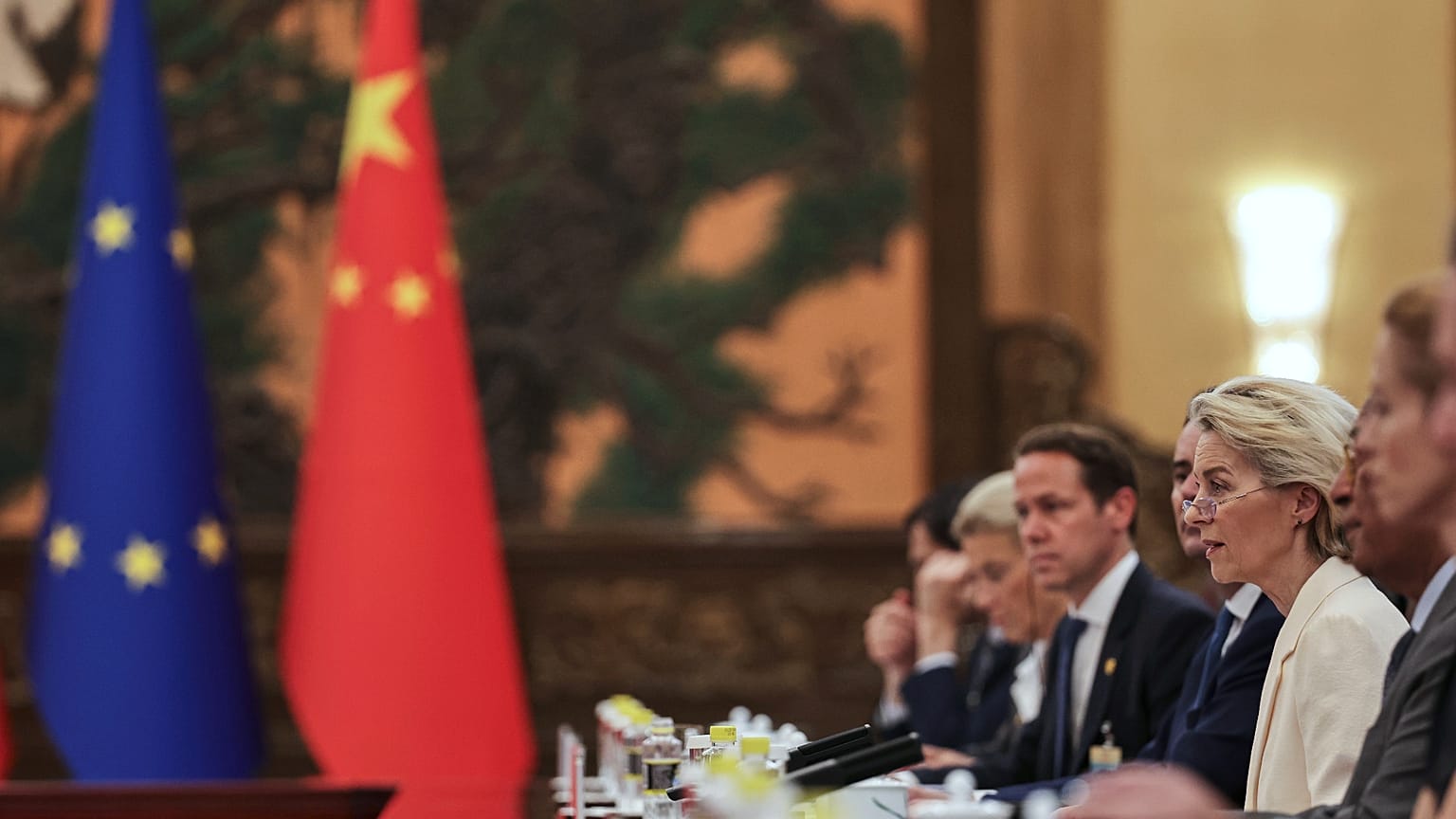













Paris and Berlin call for a new EU "systemic reaction" tool that would let Brussels move fast to counter China-driven market distortions, as well as retaliation planning and a revamp of trade defence tools.
France and Germany have proposed new powers for the European Commission to counter market distortions as the EU confronts mounting trade pressure from China.
 ADVERTISEMENT
ADVERTISEMENT
ADVERTISEMENT
In a letter to Commission President Ursula von der Leyen on Monday, accompanied by a policy paper on global economic imbalances, Paris and Berlin called for tools to restrict access to the EU market, diversify supplies and prepare for possible retaliation.
Brussels describes its economic relationship with Beijing as unsustainable, with the EU’s trade deficit reaching an estimated €1 billion a day in 2025. It has given China until this month to offer concessions.
The issue is due to come before EU leaders at next week’s European Council summit, where France and Germany will press for urgent action.
"We need a comprehensive framework to complement our toolbox with new legal instruments – in a lean and non-bureaucratic way," reads the letter, signed by President Emmanuel Macron and Chancellor Friedrich Merz.
The accompanying paper warns that “a massive industrial shock” is hitting sectors central to Europe’s economic model, including pharmaceuticals, aerospace, automotive, industrial machinery and chemicals.
New powers
The letter calls for a new instrument to be activated "where third countries seek to undermine the restoration of a level playing field and fair market conditions by political or economic means, leading to severe and systematic distortions."
The tool would restrict access to the European single market, which Paris and Berlin see as the EU’s main leverage in negotiations with China.
They want decisions taken swiftly through a procedure known as comitology, in which member state representatives scrutinise Commission measures.
Crucially, the instrument would be activated “unless a qualified majority is opposed”, making it easier for the Commission to act.
The tool should also be "country agnostic, capture all market distortions, from a single production to a whole sector, from subsidies to currency manipulation," the policy paper says.
The aim is to enable the Commission to devise tailor-made solutions that reflect the EU's interests and do not place obligations solely on European companies.
Diversifying supplies
The letter also calls for a diversification instrument, which von der Leyen already announced at the last European Council in June.
According to the paper, it should "reduce European dependencies, resolve existing supply chain concentration and prevent emerging concentration risks – taking into account import concentrations from a given country, company or stakeholder nationality, market share at the global level."
In other words, Berlin and Paris want a comprehensive framework that serves diversification goals in line with the economic security agenda and covers distortions beyond trade.
Preparing for retaliation
The paper acknowledges that retaliatory measures are likely to test the EU's political unity, and that a united front will be crucial in any trade war with China.
"The EU must be prepared and factor in international reactions and potential retaliations to its policies, instruments and measures. Understanding the extent and variety of coercion is essential," it continues.
The proposal calls for an inventory of possible retaliatory measures and an assessment of their impact on each member state, alongside coordination among EU leaders.
Strengthening trade defences
The paper also calls for measures to reduce risks and sever dependencies, urging the Commission to make greater use of trade defence instruments by launching more investigations on its own initiative and reallocating staff and resources to support them.
It also advocates a broader approach to sector-wide trade disputes, when "protection for narrow categories of goods is now insufficient in the face of more systemic distortions and the global dominance of third countries on the whole value chain of specific sectors."
Paris and Berlin also propose targeted changes to anti-dumping, anti-subsidy and safeguard rules to make it harder to circumvent EU trade measures.