

















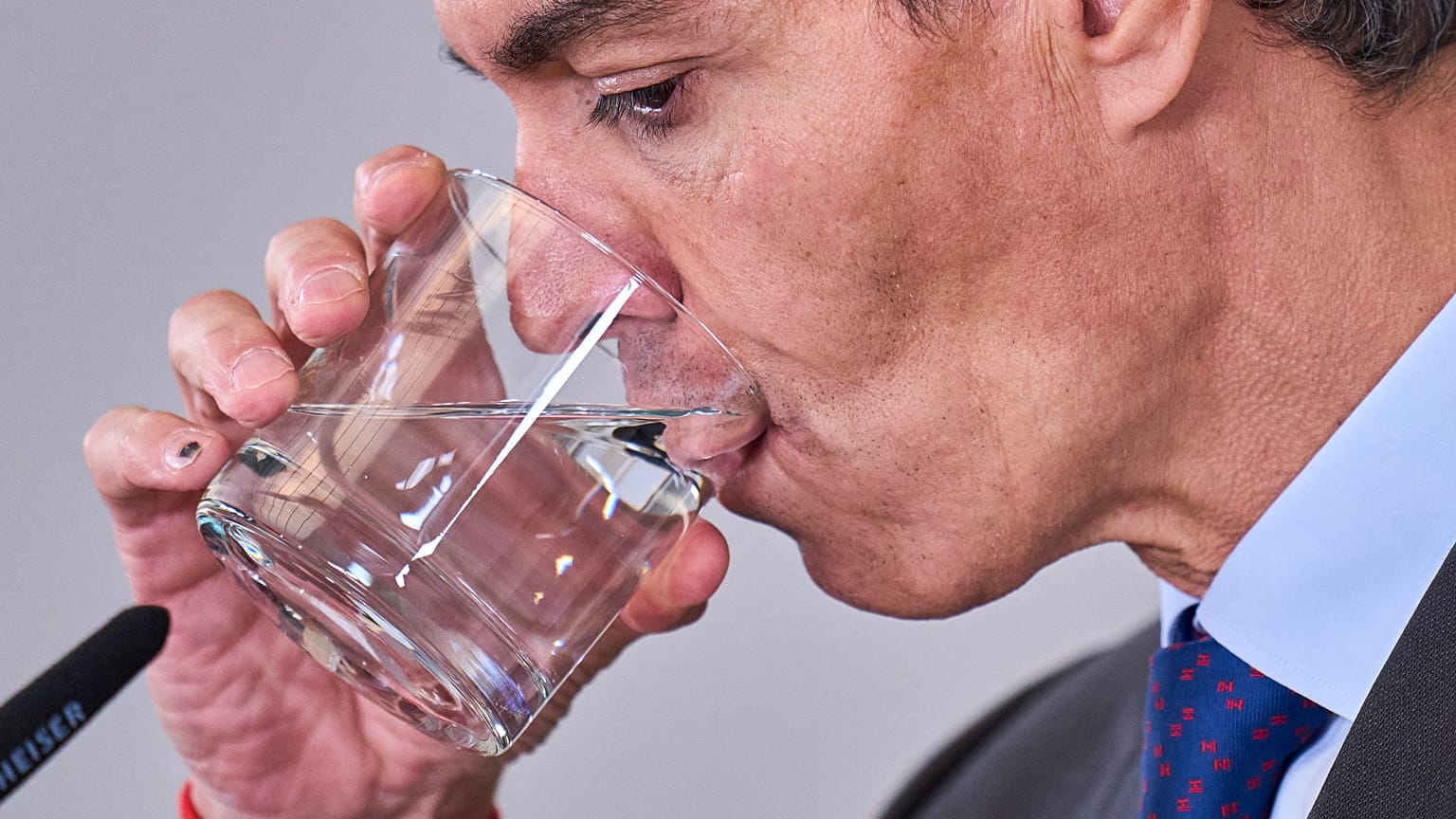













On the back foot since the Ceuta crisis, Sánchez is taking his biggest gamble yet with a snap election. He thrives on main-character energy, but the momentum has shifted and reality is catching up with his carefully crafted image.
Pedro Sánchez has lost control of the narrative – and that’s why he’s calling a snap election.
 ADVERTISEMENT
ADVERTISEMENT
ADVERTISEMENT
In eight years in office, the Spanish prime minister has survived every obstacle thrown his way, proving himself as cunning as he is ruthless. He has reshaped Spanish politics, transformed his party and remade the left.
He is the ultimate political operator. But that only works if you control the conversation.
Since the Ceuta crisis broke – a stampede that saw more than 70,000 migrants cross into the enclave in what became the worst national security breach in modern Spanish history – Sánchez has lost his grip on what the Spanish political world calls el relato.
Literally, el relato means “the story”.
But it often has little to do with reality. It is about perception: a carefully constructed narrative that the Spanish premier has shifted, reshaped and flipped whenever necessary to stay ahead.
Time after time, he has outmanoeuvred his rivals, proving himself the better politician.
Along the way, he has cast himself as the last progressive standing in a reactionary Europe increasingly willing to bend to Trump and close its borders. The one man standing against the internationale réactionnaire – led by the US president, the Muskian tech lords and the new digital oligarchy.
And as he announced a snap election for November 29, Sánchez made sure Spain heard his message: throughout his time in office, he had fought “very powerful elites”.
The problem is that the story is wearing thin. Reality has come crashing in.
For the first time, Sánchez cannot simply flip the script.
Ceuta remains unresolved. Migrants are stranded. Minors remain unaccompanied. And Sánchez’s humane migration policy is no longer resonating with a public increasingly viewing the crisis as a matter of national security.
His government is paralysed – incapable of passing a budget, presiding over a fractious coalition and increasingly at the mercy of Catalan separatists. The Spanish Socialists have also lost large swathes of regional government, testament to the difficulties Sánchez faces at home even as his standing abroad has soared.
In politics, the details matter – and they can be hard to see from Brussels, where national agendas are often swept up in the larger currents of European politics.
Sánchez is the last progressive leader around the European Council table, while the Spanish delegation leads the progressive faction in the European Parliament. That has given him an outsized role in Europe compared with his weaker position at home.
And he has played that role very well.
But in Spain, the picture is far more complicated.
His left-wing partners, Sumar and Podemos, have all but disappeared – which, for Sánchez, is not necessarily bad news. The weaker the space to his left, the greater the dominance of his Socialist Party. But it also complicates any future coalition: fewer partners mean fewer seats.
Meanwhile, his conservative rivals are tapping into a broader European zeitgeist: a hardening stance on migration and growing resistance to progressive social attitudes.
A tie-up between the mainstream conservative People's Party (PP) and the far-right Vox would no longer come as a shock. Similar alliances are already taking shape across Europe. And if the PP was once hesitant, few doubt it would enter government with Vox if that were the price of power come November.
Sánchez has shown he can take punches, but only if he can dictate the terms.
With a snap vote, he hopes to push Ceuta aside, mobilise his base around social justice and return to his winning formula: either he wins, or Spain ends up on the wrong side of history.
A touch populist? Certainly. But Sánchez has always been one. To win, he has to.
The timing is no coincidence. He wants to harness growing public anger over the housing crisis, turning public squares into spaces of mass protest over an issue affecting millions of Spaniards.
Maricarmen, an 87-year-old woman evicted from her apartment last month, became a symbol of that movement – a spark for a wider mobilisation that Sánchez now sees as his last chance to change el relato.
It’s smart. It’s bold. It’s Sánchez being Sánchez.
Back in 2016, as a much younger reporter, I covered one of the most hallucinatory episodes I had encountered in politics.
A far less well-known and successful Sánchez had been forced out as leader of the Socialist Party after a series of poor election results. What followed was an extraordinary psychodrama, broadcast live on television, complete with accusations of mutiny, fake ballots and fraud.
In the end, Sánchez announced he would step aside.
I remember telling one of my colleagues: este tío va a volver.
This guy will be back.
And he was.
What followed was one of the most spectacular comebacks in modern Spanish political history. He became prime minister after a successful vote of no confidence, survived crisis after crisis and, with Trump’s return, found another opportunity to position himself on the European stage.
Sánchez has always defied political gravity – as long as he is running the show.
And that is why this crisis feels different.
For the first time, the story is being written for him, not by him.
For a man who has spent his political career making himself the main protagonist, that is uncharted territory.