





























The IRGC said the weekend US strikes violated the framework deal and warned that violating vessels would face a "crushing response," as Euronews journalists in Doha observed US refuelling aircraft taking off towards Hormuz in the same formation as the previous night's strikes.
US-Iran negotiations to end the war came under severe additional pressure on Sunday after the IRGC announced that Washington's strikes over the previous two days had "violated Clause 1 of the Islamabad Memorandum of Understanding" and "will result in a total halt of all processes."
 ADVERTISEMENT
ADVERTISEMENT
ADVERTISEMENT
"From now on, violating vessels will be dealt with more strongly than in the past and will face a crushing response," the IRGC added in a statement shared by Iranian state-run media.
The immediate trigger for the weekend's escalation was the drone attack that the US attributed to Iran on Saturday on the M/T Kiku, a Panama-flagged crude oil tanker that was heading to the port of Fujairah in the UAE.
US Central Command (CENTCOM) responded by striking 10 Iranian military targets in and near the Strait of Hormuz, including surveillance infrastructure, air defence sites, drone storage facilities and minelaying capabilities.
Tehran then launched ballistic missiles and drones at the US Fifth Fleet headquarters at Salman Port in Bahrain and the Ali Al Salem Air Base in Kuwait. Bahrain's Interior Ministry said Iranian strikes damaged a residential building near Bahrain International Airport. No fatalities were reported.
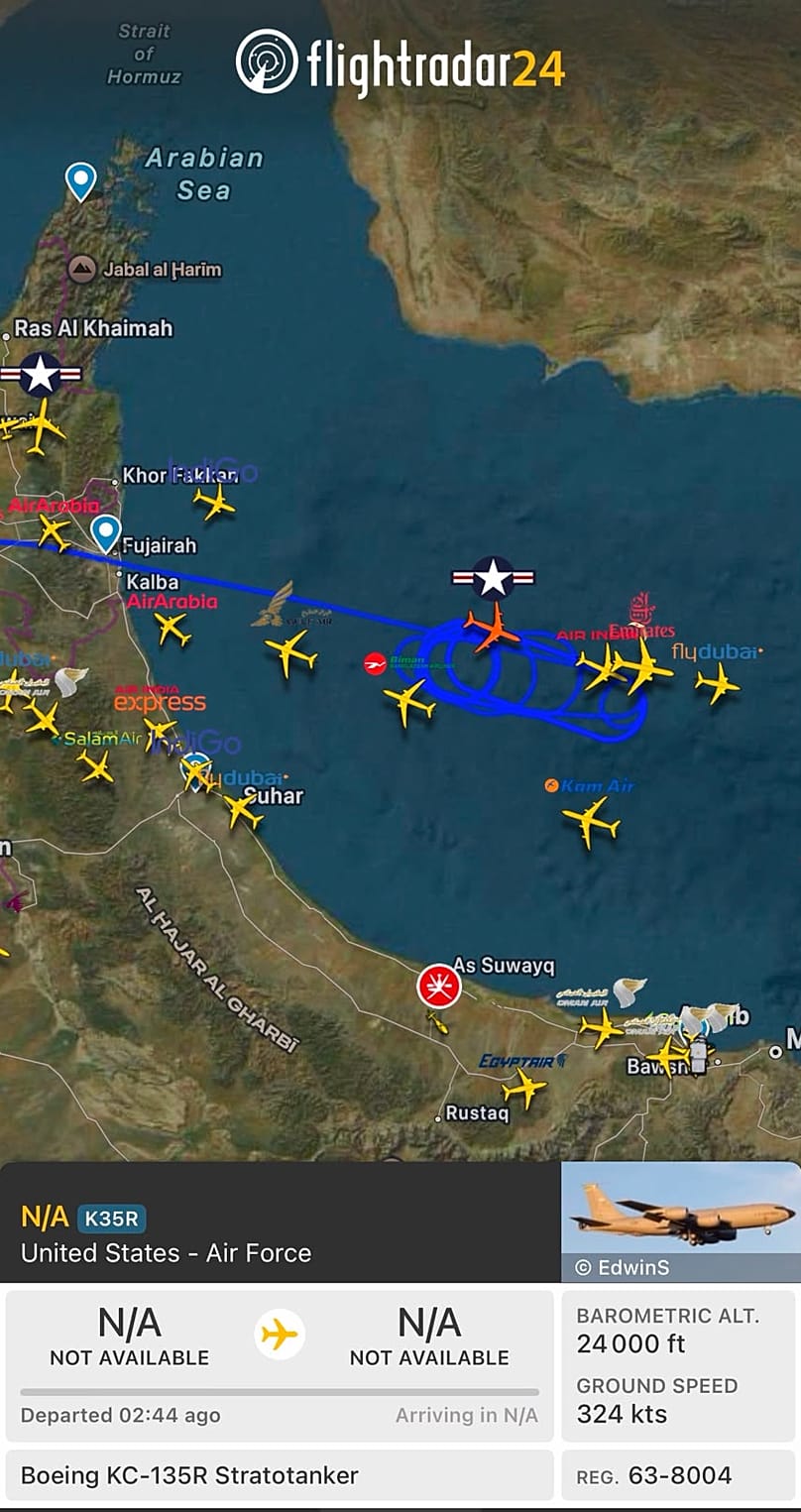
Intensive US military flight activity above the Strait of Hormuz on Sunday evening appeared to signal preparations for a new wave of strikes on Iranian military installations, following Saturday’s US strikes, and further escalation, putting to the test the fragile US-Iran ceasefire and the ongoing negotiations on the framework deal to end the war.
Euronews journalists in Doha observed US Air Force Boeing KC-135R Stratotanker aerial refuelling aircraft taking off from the Qatari capital on Sunday evening, joining a number of US Air Force aircraft circling over the Gulf region near the Strait of Hormuz, as shown by the air traffic-tracking portal Flightradar24.
Their flight pattern resembled that of the US air strikes on Iranian targets on Saturday night.
US will not stand by, UN ambassador says
The tit-for-tat exchange of fire further brought into question the ongoing talks between the two sides, with the negotiations stalled by Sunday, according to a Wall Street Journal report, citing a person familiar with the matter.
US Ambassador to the UN Mike Waltz said on Sunday afternoon that “if the Iranian regime thinks for a second that President Trump is going to sit by, stand by, while Iran continues to attack international shipping without a response, or our bases without a response, they’re sadly mistaken.”
In an interview with Fox News Sunday, the US ambassador said Washington would “continue to, militarily, if needed, take down their infrastructure” used to “illegally control an international waterway.”
“Don’t think for a second that President (Donald) Trump isn’t going to leave every option on the table, to achieve not just our aim, the entire world's aim that Iran never has a nuke,” Waltz said.
Waltz further clarified that US-Iran talks were continuing as of Sunday afternoon and that Trump “will always give diplomacy a chance,” but warned that “the president’s patience isn’t going to last forever.”
IRGC spokesman Hossein Mohebi countered on Sunday, stating that "each time the enemy violates agreements or a ceasefire, it will receive a response more severe than before," adding that Washington is "deceitful and unreliable."
Iranian Foreign Minister Abbas Araghchi, speaking at a press conference in Baghdad, said the strait would remain under Iran's full oversight for the next 30 days and that Tehran had sole responsibility for administering the waterway under the framework deal.
Iran's state television announced designated safe transit routes: inbound ships were directed south of Hormuz Island and outbound vessels south of Larak Island.
The UKMTO separately raised its threat level in the Strait of Hormuz from "moderate" to "substantial" following what it described as "attacks on merchant vessels," advising mariners of mines and naval clearance operations under way.
Ayatollah accuses Washington of 'war crimes'
Meanwhile, on Sunday, a statement purported to be issued by Iran’s Ayatollah Mojtaba Khamenei called for US and Israeli leaders to be tried for what it called “war crimes”.
“International criminals, global arrogant powers and agressors” must be pursued in domestic and international courts for the “imposed wars” on Iranians, the statement said, listing “child killings and war crimes in Minab and Lamerd,” as well as other “damage”.
Mojtaba Khamenei has not been seen in public since the initial salvo of the war on 28 February, when his father, the late Ayatollah Ali Khamenei, was killed in strikes on Tehran.
The younger Khamenei has since addressed the nation solely through written statements read on state-run television. His whereabouts and condition remain unknown.
The new wave of reciprocal strikes between Iran and the US and Tehran digging its heels in on Hormuz are putting significant pressure on the ceasefire framework. Yet both sides appear to exercise restraint in the scale of their military engagement as negotiations continue.
Also on Sunday, Mojtaba Khamenei's adviser Mohammad Mokhber warned the US that any attempt at control in the Strait of Hormuz would be “a mistake”.
"Trampling the latest memorandum of understanding and returning to an aggressive posture only strengthen our resolve to stand firm,” Mokhber stated.
“As long as the Strait of Hormuz remains under our undisputed control, the (US’) hegemonic dreams in the region will not be realised," he added.
In a further development on Sunday, Qatar’s Interior Ministry announced in a statement that a Qatari national was killed in an incident at sea “after sustaining injuries from shrapnel resulting from the military operations in the area.”
"An Arab resident was injured” and transferred to hospital, and the ministry "prays for the swift recovery of the injured individual," the statement added.
On Saturday, the US Navy's Joint Maritime Information Center announced a widened shipping route through the Strait of Hormuz near the Omani coast, allowing increased traffic in both directions, in a direct challenge to Iran's assertion of sole authority over navigation in the waterway.