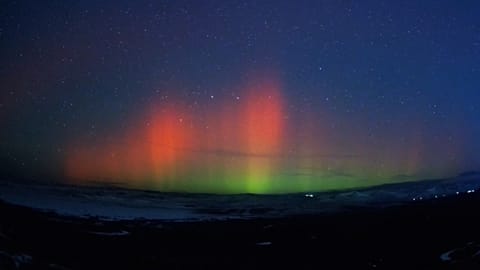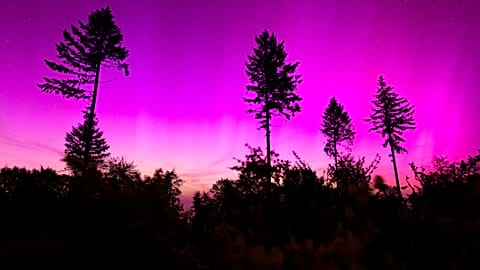





























According to the US weather agency NOAA, solar storms are forecast for the weekend that could produce vivid auroras, or northern lights, across North America and Canada.
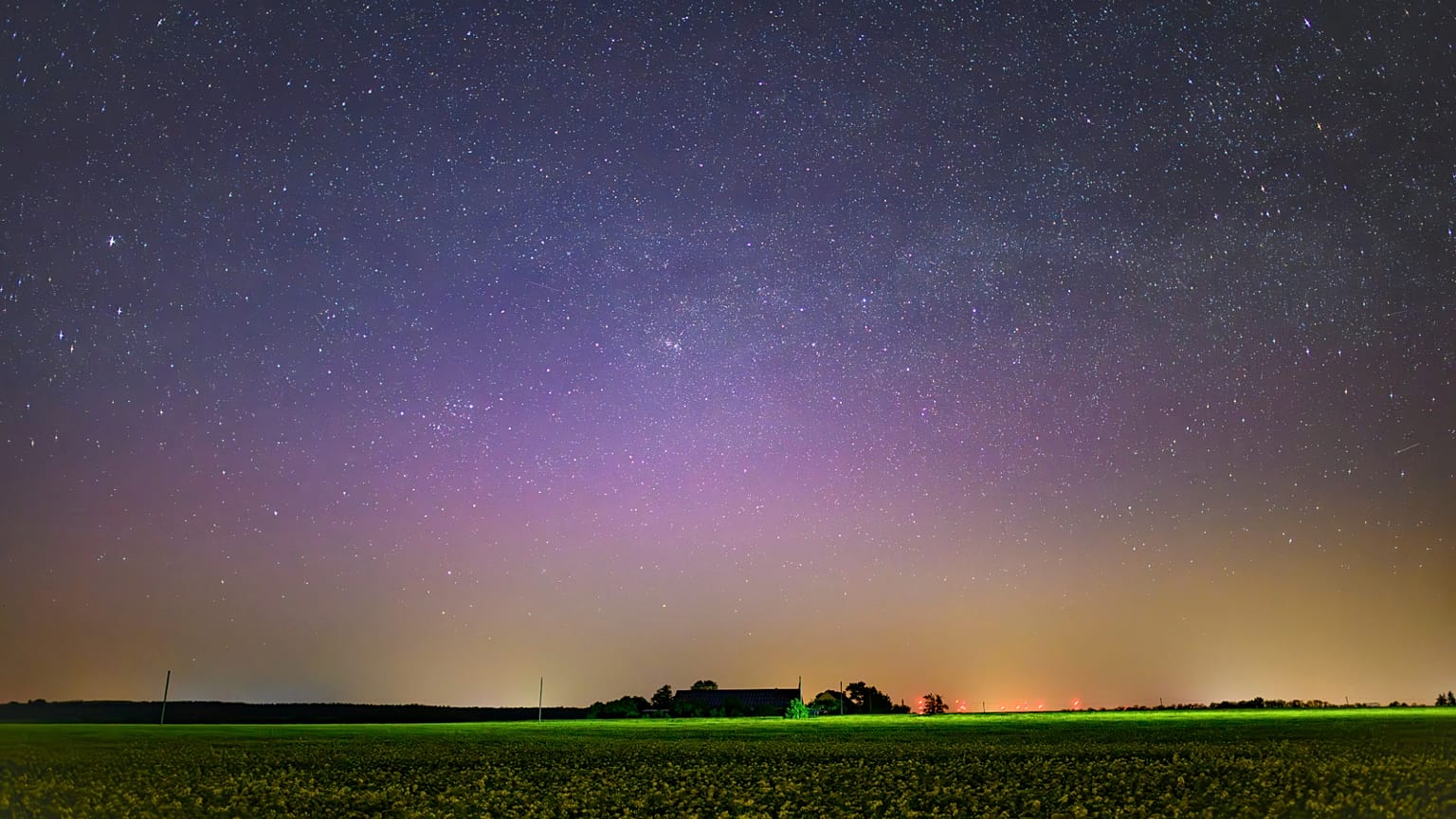
In the United States, the weather monitoring agency has announced that the northern lights could be visible in the northern United States and Canada, as strong geomagnetic storms are expected. These could also light up the skies over Germany, especially in the north and along the coasts, during the night of 5 to 6 June.
 ADVERTISEMENT
ADVERTISEMENT
ADVERTISEMENT
With hardly any cloud cover forecast for Saturday night, the chances of catching a glimpse of the impressive aurora borealis are good.
The US National Oceanic and Atmospheric Administration (NOAA) has issued a warning of a G3 (strong) geomagnetic storm. Individual phases could even reach G4 (severe) level. As a result, the aurora should be visible in a total of 23 US states in the Northeast, Midwest and West, the Washington Times reports.
The last time spectacular northern lights were visible over Germany was in January.
Numerous websites that monitor solar storms currently rate the likelihood as high – including for northern Germany.
Geomagnetic storms are disturbances in the Earth’s magnetic field caused by solar activity. They produce colourful bands of green, red and violet light. In the northern hemisphere they are known as polar lights, northern lights or aurora borealis.
Northern lights are best seen with a smartphone
So what is the best way to see the impressive aurora borealis?
When you are hunting for northern lights, you should always look towards the north.
And as astronomy experts explain, the colours are often easier to see on a camera or smartphone. Smartphones use a special night mode and longer exposure times. This allows the camera sensors to capture more image information than the human eye can process in real time.
Solar storms can be dangerous
The solar storms that paint the colourful aurora borealis across the sky are part of a complex space-weather pattern between Earth and Sun, and they can certainly become dangerous. In 2022, 40 satellites from Elon Musk’s Starlink network were caught in a solar storm and burned up.
Even before solar storms melt anything, they can cause disruptions – especially to navigation systems. Speaking to MDR, expert Jens Berdermann from the German Aerospace Centre (DLR) explains: “Satellites can be affected, power grids can be affected. And services we depend on every day, such as navigation and communication. These are essential for many professions. There are also indirect effects: software, stock-market trading, medical devices, the economy.”
However, disruptions of this kind are still relatively rare.