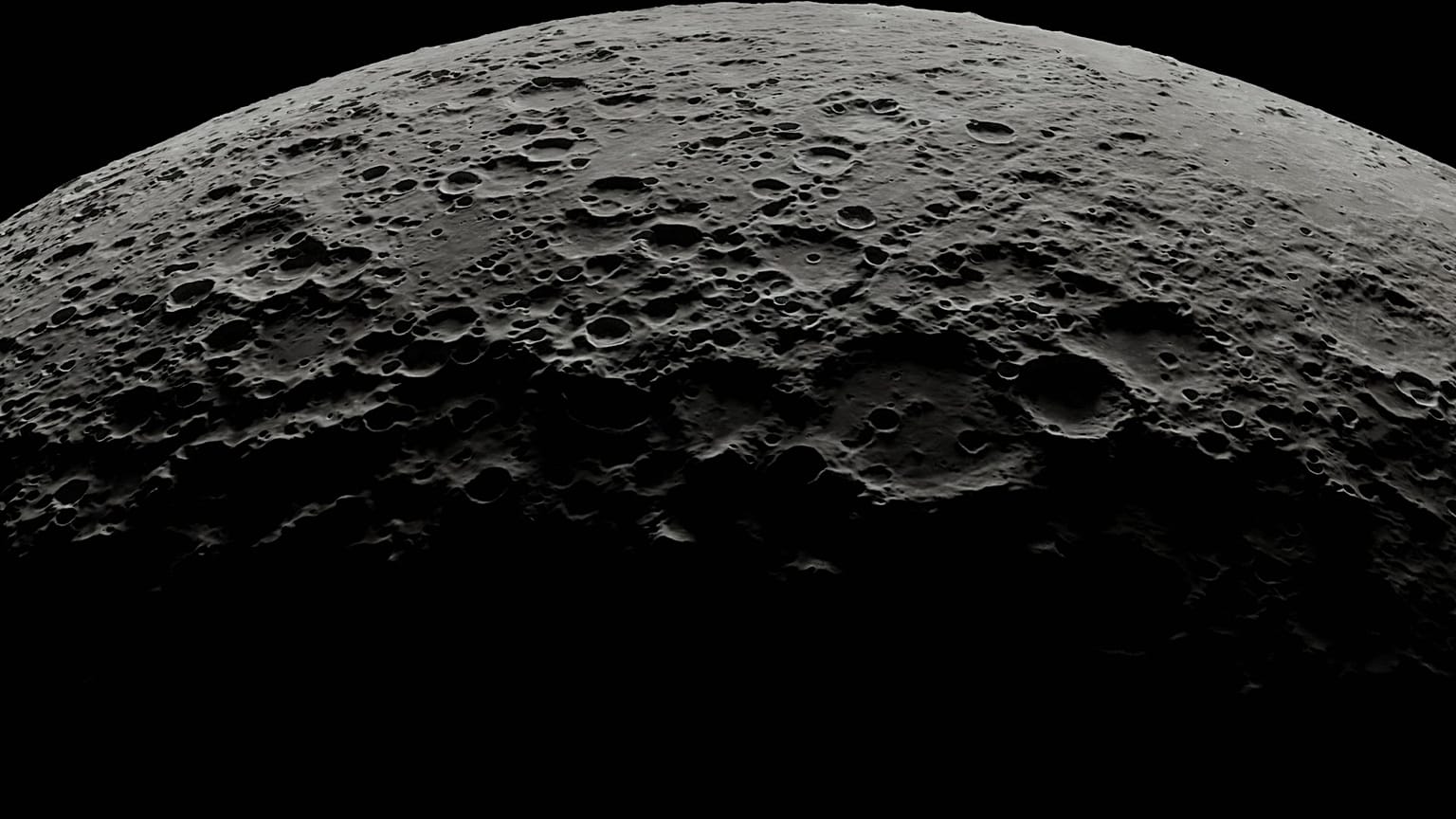













Permanently shadowed craters have long interested scientists. Could a new laser system help future spacecraft navigate the Moon more safely?
Scientists have proposed building extremely stable lasers in the Moon’s darkest craters to help future spacecraft navigate and keep time more accurately, according to a new study.
 ADVERTISEMENT
ADVERTISEMENT
ADVERTISEMENT
Researchers at NASA’s Jet Propulsion Laboratory and the National Institute of Standards and Technology, in the United States, proposed in a peer-reviewed study placing a small silicon device inside one of the Moon’s permanently shadowed craters to stabilise laser light.
Once stabilised, the laser could be used as a timing and navigation signal for future lunar missions.
Scientists say it could help spacecraft land safely, support a GPS-like system on the Moon and improve communication between satellites.
Why the Moon’s darkest craters?
Permanently shadowed craters have long interested scientists because they may contain water ice and other resources needed for future lunar missions.
But they are also difficult to study because they receive little or no sunlight, making landing, movement and direct observation challenging.
The study suggests lowering a small silicon device, called an optical cavity, into one of these craters to stabilise a laser by controlling the light passing through it.
The device works by reflecting light between two mirrors. For the laser beam to remain stable, the distance between those mirrors must stay almost perfectly constant.
Researchers say the deep cold inside the craters would help achieve this.
Because the silicon would barely expand or shrink in such low temperatures, the laser signal could remain far steadier than on Earth.
Researchers also believe a network of these lasers could help detect tiny changes in distance between objects on the Moon, potentially opening new ways to study gravity and space-time.
The team says the technology could first be tested in low Earth orbit before being deployed on the lunar surface within the next few years.