















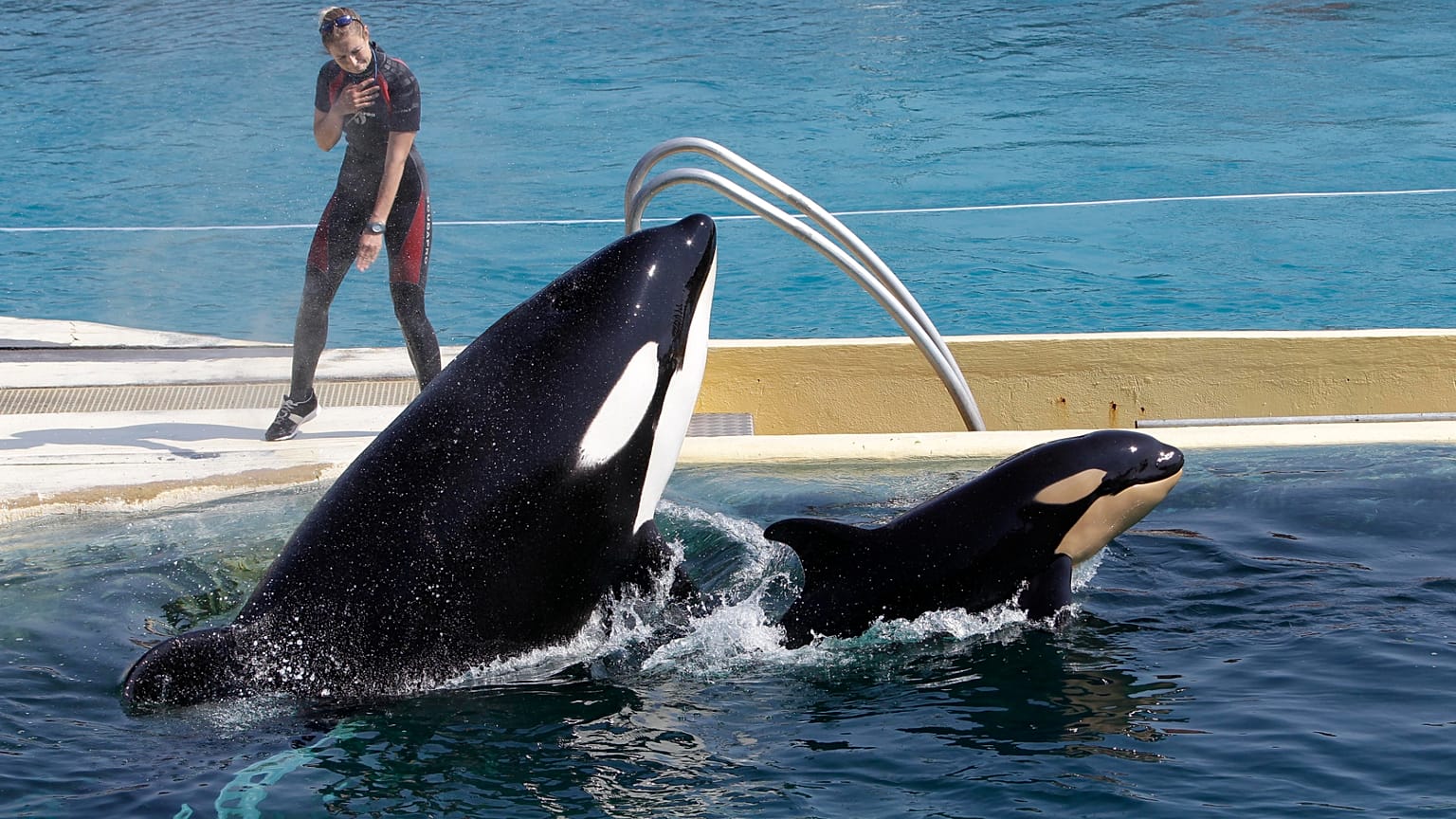













Wildlife charity Born Free say that at Loro Parque the captive orcas “would likely continue to be exploited for public entertainment and potentially for breeding”.
Two orca whales from a French theme park that was closed down to protect them are destined for a Spanish zoo where they would likely have to perform in shows. Animal welfare groups have expressed “deep concern” over the plans.
 ADVERTISEMENT
ADVERTISEMENT
ADVERTISEMENT
Mother and son Wikie and Keijo did tricks for visitors at Marineland in Antibes, France, until it was closed in 2025 following the country’s ban on animals as performers. They are still housed in a tank there, with 12 bottlenose dolphins in other tanks. There has been much debate about where they should be moved to, with euthanasia being discussed before the French government stepped in.
While the government had previously rejected plans to move them to Loro Parque zoo in Puerto de la Cruz in Tenerife, it appears to have reversed its stance.
Last week Mathieu Lefèvre, the French Minister for Ecological Transition, announced they would be moved “in the coming weeks, before the end of June”.
Twelve European environmental organisations have written to Spanish authorities expressing their “deep concern” about Wikie and Keijo being moved to Loro Parque.
UK wildlife charity Born Free says that at Loro Parque the orcas “would likely continue to be exploited for public entertainment, and potentially for breeding”. It claims “Spanish authorities have deemed conditions at the dolphinarium to be unfit to house Wikie and Keijo. Four orcas are reported to have died prematurely at Loro Parque between 2021 and 2024.”
Experts say whales and dolphins raised in captivity can’t be returned to the wild because they lack the necessary survival skills.
Marineland was closed to comply with a 2021 French law that bans keeping whales and dolphins captive for entertainment purposes.
Tanks at Marineland are unsafe for Wikie and Keijo
The fate of 24-year-old Wikie and 12-year-old Keijo ultimately rests with Mathieu Lefèvre, the French Minister for Ecological Transition. He previously approved a plan to send the whales to Canada to live in a seaside refuge being built for whales retired from marine theme parks. As large as 50 football pitches, the sanctuary would include a ring of floating nets extending from the land. But this plan was halted after some experts said the water in Nova Scotia, Canada, would be too cold for the whales.
When Loro Parque was raised as a destination for the whales, the French government said that a scientific agency in Spain, whose task it is to evaluate the suitability of facilities, “refuses the transfer”. The agency said the tanks at Loro Parque “did not meet minimum standards in terms of area, volume and depth” for the cetaceans, according to news agency AFP. Loro Parque representatives say they “play a recognised role in biodiversity conservation, research, and education
During a surprise visit to Marineland on Friday (15 May), as reported by French newspaper Le Figaro, Lefèvre said he could “observe the progressive deterioration” of the pools, which house Wikie and Keijo and 12 dolphins.
He defended his decision to send the animals to Loro Parque saying: “I remind you that two cetaceans have already died here. So I'm not going to take the risk of this happening again.”
Standing behind a ruined section of the pool, where large windows occasionally allow glimpses of the giant whales, he added: “Everyone who cares about the wellbeing of these cetaceans must understand that we need to break the deadlock and act as quickly as possible. The status quo is not a solution.”
In a statement, Loro Parque President Wolfgang Kiessling said the zoo has “the willingness and firm commitment to collaborate with public authorities, assisting and rescuing Wikie and Keijo and providing all its resources so that these animals do not die and can be hosted permanently in conditions that ensure their protection and welfare; however, this requires the explicit approval of the Spanish Government.”
According to Marineland management, the orca transfer, which is expected to cost several hundred thousand euros, will be carried out by cargo plane and must take place before the end of June, otherwise it will have to be postponed due to the summer heat.
Move to Loro Parque would be ‘devastating for Wikie and Keijo’
Charles Vinick, CEO of the Canadian Whale Sanctuary Project which was previously approved to accept the mammals, says the decision to send the whales to Loro Parque would be “devastating for Wikie and Keijo”.
He said the 2021 French law was intended to end the use of whales and dolphins for entertainment and captive breeding. “The law explicitly prohibits these practices,” he said. “However, Loro Parque continues to rely on performance-based programming and breeding, particularly following the deaths of four orcas at the facility since 2019. Transferring Wikie and Keijo into that environment risks perpetuating the very system the law was designed to phase out.”
In response, Martin Böye, scientific director at the Loro Parque Fundacion, said that when orcas have died at Loro Parque,“thorough investigations have been conducted by top experts with full transparency toward authorities and stakeholders, including organisations critical of our approach. The causes have always been clearly identified and were not related to habitat conditions and never point against our high standard veterinary care and husbandry.”
Europe’s six remaining captive orcas face cramped conditions
Inherently Wild is an “archive dedicated to the untold stories of captive orcas - beautiful, sentient animals who remain inherently wild at heart”. It describes Wikie as “the youngest whale to be successfully artificially inseminated at the age of just eight years old. She gave birth to her first calf, Moana, in 2011. She mated with her half-brother, Valentin, soon after. This led to the birth of her second calf, Keijo, in 2013.” In 2012, Wikie measured about 5.2 metres long and weighed 2,041kg, while Keijo weighed about 150kg in 2014.
There are currently six orca whales in captivity in Europe. This includes Wikie and Keijo, plus Morgan, Teno, Adán and Tekoa who already live at Loro Parque.
Inherently Wild’s database gives details of the risks faced by orcas in captivity. It raises the issue of the size of tanks that captive orcas are kept in: “An underlying issue with captivity is confining large, long-ranging predators in small, cramped tanks. In the wild, orcas are capable of swimming up to 100 miles [161 km] a day and diving to depths of 850 feet [260 metres]. With no current orca tank measuring longer than 220ft, or deeper than 50ft, the restrictions forcefully imposed upon orcas are drastic.”
In response, Martin Böye, scientific director at the Loro Parque Fundacion, said: “At Loro Parque, environmental enrichment, social complexity, and voluntary participation in activities provide both physical and cognitive stimulation. Importantly, behavioural research conducted on our animals shows that, for example, their social interactions are consistent with those observed in wild populations, indicating that key aspects of their behavioural needs are being met.”
In response to claims made by Born Free, Loro Parque said that rather than being exploited for entertainment, orcas are used in “educational presentations” which “are designed to inform the public about the species, their biology, and the threats they face in the wild, with the aim of promoting conservation awareness and action.” Böye went on to say that breeding “refers to allowing animals to express natural reproductive and social behaviours within stable social groups, which is considered an important component of welfare. In that sense, restricting such behaviours would mean preventing animals from expressing a fundamental natural aspect of their biology.”