















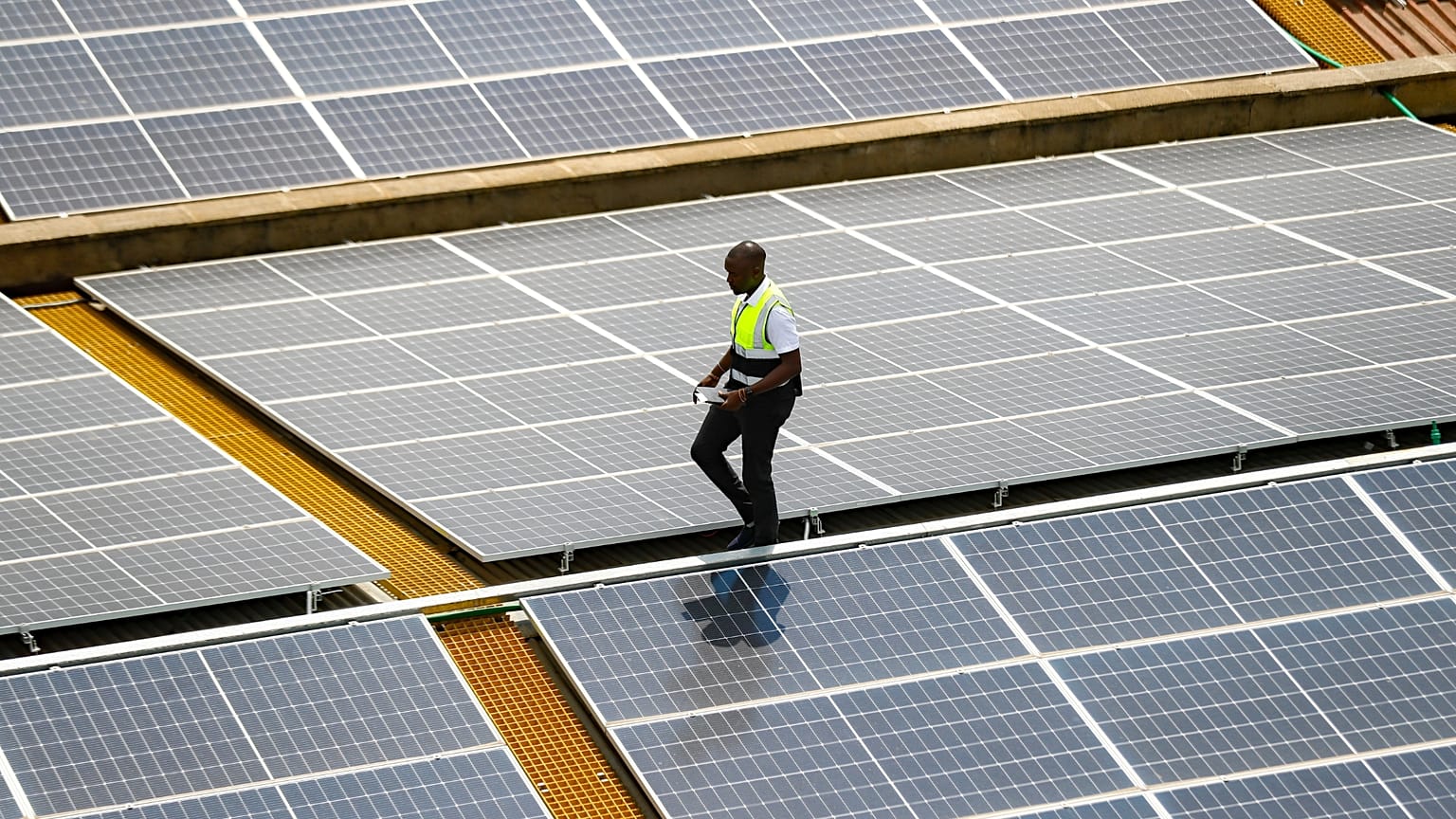













Solar is Africa’s cheapest energy source. Changes to price incentives on Chinese imports could push prices up.
Solar installations in Africa are expected to get more expensive next month as China ends discount schemes.
 ADVERTISEMENT
ADVERTISEMENT
ADVERTISEMENT
China’s decision to end value-added tax rebates on solar panel exports is expected to take effect on 1 April. At the beginning of next year, the country will also phase out incentives for making battery storage equipment.
It may complicate efforts to expand renewable energy to close vast electricity gaps across Africa, which relies heavily on imported Chinese technology, though experts say the impact likely will be manageable.
“We are likely to see solar panel prices increase in Africa because most of the inputs come from China,” says Wangari Muchiri, an energy analyst focused on Africa’s clean energy sector. “Removing the rebate will add to existing costs, especially when you consider shipping, logistics, and other import fees.”
Africa already pays significantly more for solar equipment than other regions because of transport costs, smaller import volumes and tariffs.
Why is China ending solar tax rebates?
China's policy change reflects broader shifts after fierce competition among Chinese manufacturers pushed solar module prices to as little as €0.06 per watt in 2025, from €0.22 in 2022. That helped drive global adoption of solar energy, but left many companies with heavy losses.
Some Chinese companies built VAT rebates into their export pricing, effectively transferring those subsidies to their overseas buyers. But Beijing has cut back on those payments as it reins in overcapacity and shifts toward more advanced technologies.
Rather than a sharp price shock, the loss of such rebates will likely gradually raise prices, setting a firmer global price floor.
“The changes are significant, but not catastrophic,” says John van Zuylen, CEO of the Africa Solar Industry Association.
“The entire recent solar boom was built on artificially cheap Chinese pricing,” van Zuylen says. “That era is now ending.”
“When a structural rebate is removed, exporters typically either absorb the cost, raise prices, or reduce discounting,” van Zuylen says. “African countries will likely feel this as a gradual upward shift in pricing rather than a single dramatic spike.”
Solar is the cheapest source of energy in Africa
Even with modest price increases, solar is expected to remain competitive across much of the continent since it's the cheapest source of energy in Africa, Muchiri says.
“Even with higher panel prices, it will still be significantly cheaper than alternatives like diesel,” she says.
"It will increase project costs slightly and might delay the project construction pipeline due to supply chain shortages and contractual changes, stockpiling rush, congestion in shipment for the countries heavily reliant on Chinese imports," says Sonia Dunlop, CEO of the Global Solar Council, an industry association.
Battery storage, critical for providing electricity after sunset, may face a bigger challenge as incentives are phased out through 2027. Higher costs may affect smaller users the most, van Zuylen says.
'Batteries matter more than panels for Africa'
“Batteries matter more than panels for Africa because storage is what makes solar reliable for off-grid and backup users," he says.
Basil Abia, co-founder of the Nigerian energy research firm Truva Intelligence, says that “batteries have historically been expensive, and many solar installations in Africa were built without them.”
“Only recently have we started seeing more systems combining solar with battery storage," Abia says.
He says that even without rebates, solar modules remain relatively affordable. Through 2024 and early 2025, module prices fell sharply from around €0.22 per watt in previous years to as low as €0.06 per watt.
Demand for solar, which now supplies 3 per cent of power generation in Africa, is expected to continue growing as storage improves reliability. Meanwhile, the heavy dependence on Chinese equipment is drawing attention to limited local manufacturing capacity.
“The VAT removal will slow, but not reverse Africa’s clean energy transition,” Abia says. “Countries that use this moment to accelerate local manufacturing will emerge stronger. Those that do not will remain exposed to Beijing’s next industrial policy adjustment.”