




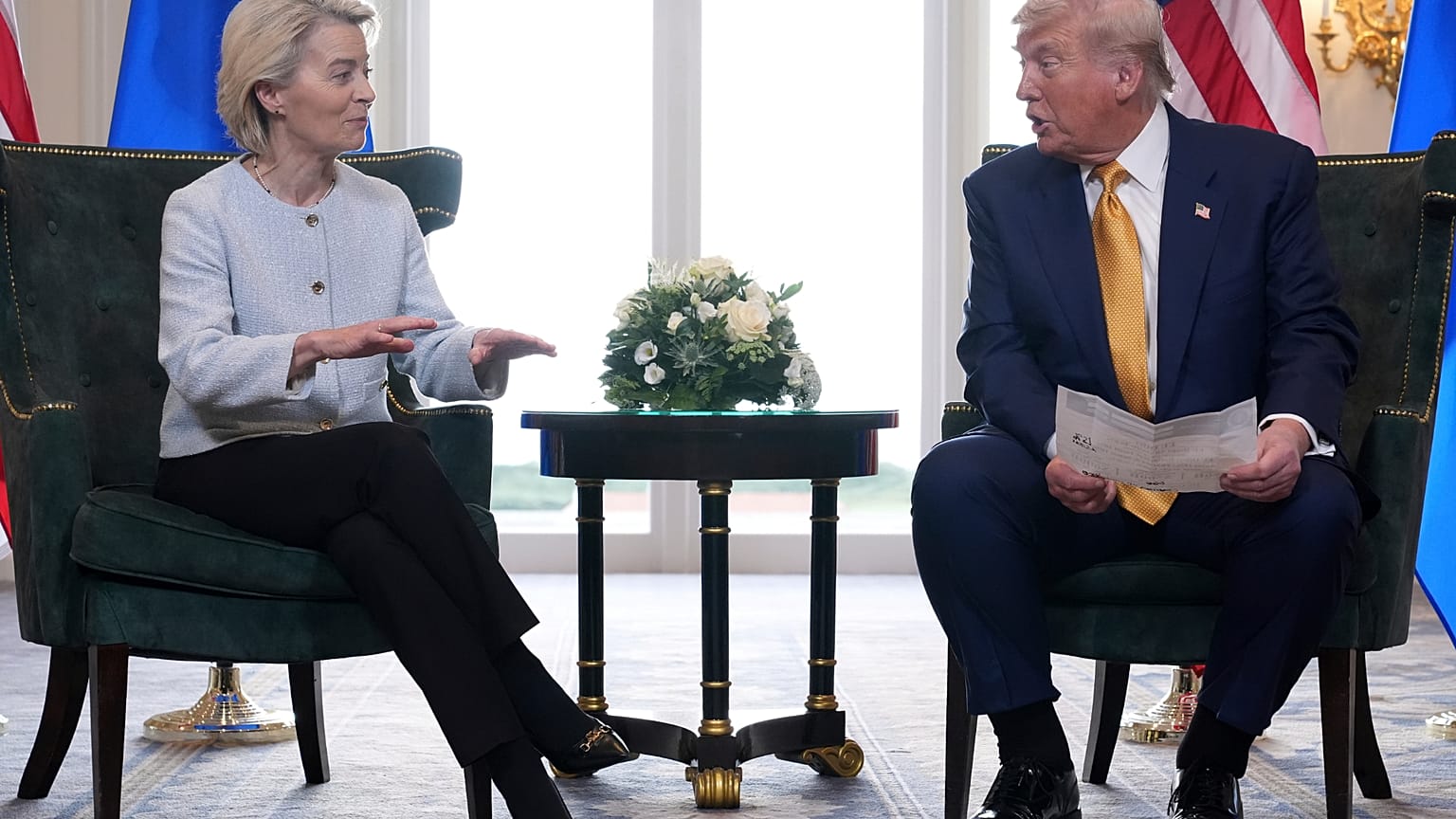













Rome warned against a trade clash and urged continuity, with Foreign Minister Antonio Tajani stressing the need to protect export-heavy Italy.
The European Union is holding off on ratifying its tariff arrangement with Washington after fresh legal and political uncertainty surrounding Donald Trump’s trade policy prompted lawmakers to pause the process, officials and analysts say.
 ADVERTISEMENT
ADVERTISEMENT
ADVERTISEMENT
The ratification concerns the EU–US agreement reached last summer, under which the US would apply a 15% tariff rate on most EU exports while the EU would scrap duties on many US goods.
“For the European Union,” said Matteo Villa, an analyst at the Institute for International Political Studies (ISPI), “the increase in duties does not change things much”.
A weakening of Trump domestically could even work to the bloc’s advantage, he argued, as Brussels maintains a cautious line.
Waiting to ratify the EU-US tariff agreement, Villa added, puts the European Parliament in a more credible negotiating position, even if the move “does not erase a certain weakness shown by Europe,” which he said appeared overly deferential to Washington last year.
Brussels is proceeding with what officials describe as “utmost caution,” delaying ratification of the tariff agreement with the United States and keeping duties within the already agreed 15% ceiling.
The European Parliament’s trade committee has postponed its planned vote after new uncertainties emerged around Washington’s latest move.
The Trump administration’s new tariff step — based on Section 122 of the 1974 Trade Act — is expected to have significant implications for European exporters.
Because the measure may be layered on top of existing duties in some cases, total effective tariffs on certain goods could rise toward or above 20%, depending on the product mix.
Bernd Lange, the European Parliament’s rapporteur on the EU-US tariffs file, said lawmakers needed more time. “There are new elements, many uncertainties, so we decided not to vote tomorrow, but to hold another meeting of the rapporteurs next week,” he said, adding that a new vote could still take place on 11 March.
German Chancellor Friedrich Merz echoed the concerns, calling uncertainty “the biggest poison of the economies of Europe and the United States,” and signalling he is planning a trip to Washington to discuss tariffs directly with Trump.
Italy urges calm and continuity
Italy has struck a more conciliatory tone. Foreign Minister Antonio Tajani said Rome had received reassurances from the US administration and stressed the need to preserve transatlantic economic ties.
“From the American side we have obtained reassurances on the will not to create instability for our companies,” Tajani wrote on X, adding that it was important to “continue to work constructively with Washington for a rapid transition to the new system”.
Speaking on the sidelines of the EU Foreign Affairs Council in Brussels, Tajani underlined that the existing agreement with Washington must be respected. The United States, he said, remains Europe’s main ally and, together with the European Union, Italy’s top export market.
“Approximately 40% of our GDP is based on exports, so it is not a question of making controversy, but of protecting our entrepreneurial system. We made an agreement and we want it to be respected,” he said.
Tajani also ruled out escalation after chairing a “Duties Task Force” meeting with 40 companies and about 80 trade associations, concluding with a clear message: “No trade war with the US.”
Meloni under pressure at home
Within the EU, Berlin may take the lead in contacts with Washington. Merz said duty policy is an EU competence and pledged to travel to the US capital with a coordinated European position.
Villa suggested Italian Prime Minister Giorgia Meloni is treading carefully. “Meloni has to play cautiously because, given the various open issues, she does not want to have problems with Trump,” he said, noting she adopted a similarly pragmatic stance in last year’s tariff talks.
Domestic critics, however, say Rome has been too quiet. Riccardo Magi, secretary of the Più Europa party, called Meloni’s silence “embarrassing,” arguing she has yet to clarify Italy’s position following the US Supreme Court ruling on tariffs.
Italia Viva leader Matteo Renzi also criticised Tajani, calling his recent moves “increasingly embarrassing” and warning against Italy’s participation in initiatives linked to Trump.
For now, Brussels appears content to wait. But with tariff uncertainty persisting and political pressure building on both sides of the Atlantic, the EU’s cautious strategy may soon face a sterner test.