




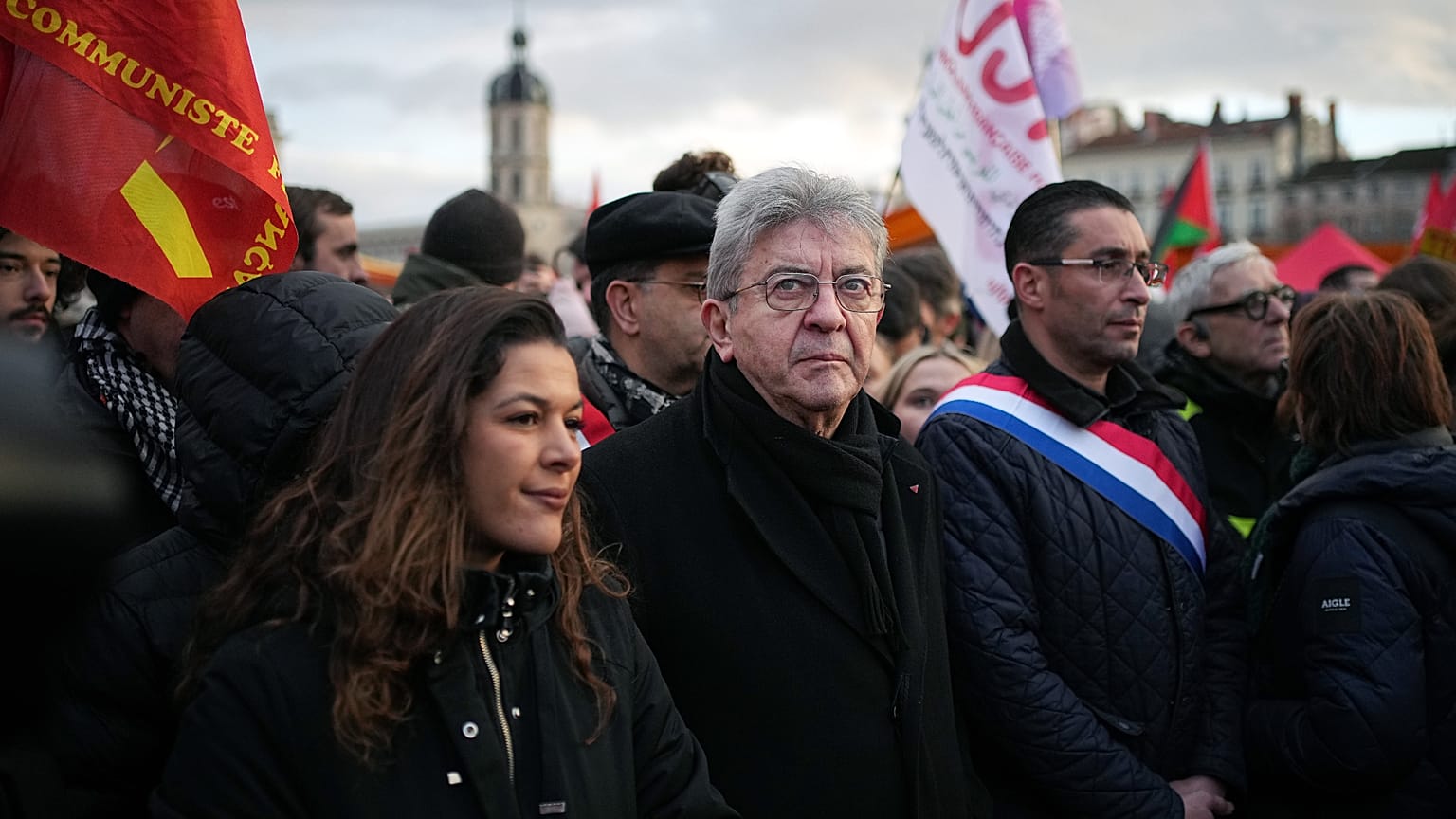













The death of 23-year-old far-right activist Quentin Deranque has weakened the left-wing France Unbowed, divided the left and given new momentum to the National Rally before crucial elections.
With one month to go before the municipal elections and one year before the presidential election, the partisan landscape in France seems to be reshaping itself around an unprecedented paradox: the "cordon sanitaire" long applied to the far right is now being applied to hard-left France Unbowed (LFI).
 ADVERTISEMENT
ADVERTISEMENT
ADVERTISEMENT
In France, the “cordon sanitaire” has traditionally meant excluding the far right from political alliances and power-sharing arrangements during elections. For decades, mainstream parties refused to cooperate with the National Rally (RN).
But the violent beating resulting in the death of the young far-right activist Quentin Deranque in Lyon caused a political upheaval.
Deranque, 23, was attacked last Thursday while attending a demonstration over LFI MEP Rima Hassan's participation at an event at a Lyon university.
He was beaten by several masked individuals on the sidelines of the protest and died two days later from severe head injuries.
Eleven people have been taken in for questioning so far, including two parliamentary aides connected to an LFI lawmaker.
The RN party President Jordan Bardella seized the opportunity to harden his tone. "The far left has killed", he stated on CNews-Europe 1.
He accused LFI leader Jean-Luc Mélenchon and his movement of being an "ideological incubator for violent movements" that are "creating a climate of tension and disorder in the streets and in the National Assembly".
The RN leader is now calling for the dominant political logic of recent years to be reversed.
"I am therefore calling for a real 'cordon sanitaire' to be formed to isolate La France insoumise and keep it out of the institutions, whether in the National Assembly, where its MPs sit on numerous bodies, or with a view to the forthcoming municipal elections", Bardella said.
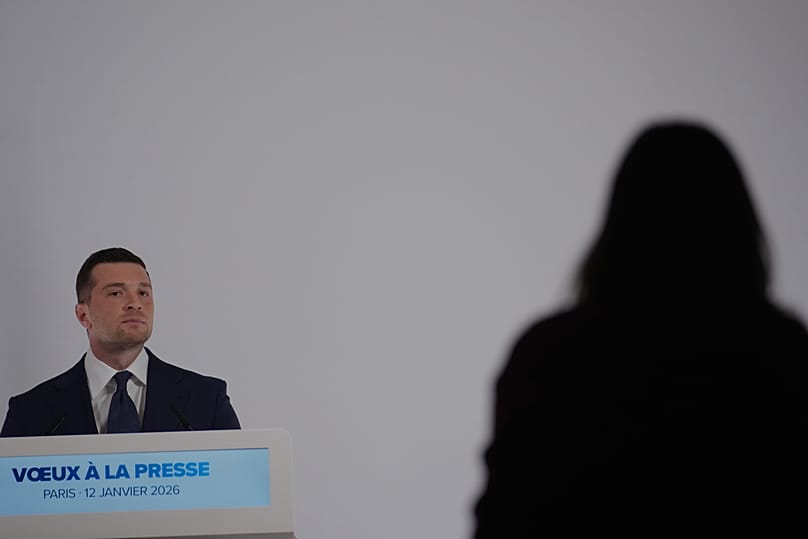
For the RN, which has been trying for years to shed the xenophobic legacy of Jean-Marie Le Pen, the sequence represents a strategic opportunity: to present itself as an institutional force in the face of a left increasingly presented as radicalised.
For Philippe Moreau-Chevrolet, an expert in political communication and professor at Sciences Po Paris, this dynamic has been gradually building for several years.
"Since the last legislative elections in 2024, we have seen the RN normalise, largely in contrast to the agitation of LFI, so we really have two strategies that practically feed off each other," Moreau-Chevrolet explained in an interview with Euronews.
The analyst believes that Marine Le Pen's party has entered a new phase.
"Today, the RN has turned a corner: we are no longer in the process of de-demonisation but rather in the process of normalisation, in other words, a form of acceptance of the RN as a French political force that is here to stay, with a significant presence that is part of the landscape," Moreau-Chevrolet said.
By contrast, LFI appears locked into a far riskier trajectory.
A fractured left
The affair has also shaken the balance on the left, where the idea of a united front is increasingly fragile.
Raphaël Glucksmann, MEP for the centre-left Public Square party, has ruled out any ambiguity.
"It is unthinkable, I tell you, unthinkable that, on the left, we continue to cultivate the slightest doubt about a possible electoral alliance with France Unbowed," Glucksmann said.
Former Socialist president François Hollande has also ruled out any municipal alliances with LFI, signalling a lasting break with past strategies of left-wing unity.
For Philippe Marlière, a political scientist and professor at UCL, the current sequence marks a historic shift: "It's an absolutely unheard-of turnaround. A cordon sanitaire to counter a left-wing party would have been unthinkable just a few years ago."
In his view, this reversal is part of a wider context of polarisation that extends beyond France alone. "I think there is a fairly general and international phenomenon of radicalisation and polarisation," Marlière told Euronews.
For Arnaud Benedetti, editor-in-chief of the Revue politique et parlementaire, this situation marks "the first time that pressure on the question of alliances will be exerted more on the left than on the right".
"There is a kind of moral ban that is being put in place in the public debate and in the political debate on the question of an alliance with LFI," Benedetti said.
Municipal elections under high tension
For Marlière, the fallout over Deranque's death is also fuelling a "hysterisation of the debate" and contributing to an increasingly simplified interpretation of responsibilities.
He points out that political violence in France is part of a longer and complex history.
According to sociologist Isabelle Sommier, who co-edited the book "Political violence in France from 1986 to our times," out of 53 ideologically motivated murders committed between 1986 and 2021, nearly nine out of 10 were perpetrated by far-right militants.
This violence is part of a longer historical pattern, including the murder of Ibrahim Ali in Marseille in 1995 by a National Front activist, and the killing of Clément Méric in Paris in 2013 by a member of a neo-fascist group.
With just a few weeks to go to the polls, Benedetti believes that the municipal elections will be a key test for LFI and the RN.
"We're going to measure because the municipal elections will be a very good barometer," he told Euronews.
Meanwhile, according to Moreau-Chevrolet, France Unbowed must quickly correct its strategy. "They're going to have to refocus and change strategy (...) to avoid being permanently marginalised."
But for Benedetti, the effects on the elections remain difficult to anticipate. "It's difficult to measure, but it could go one way or the other. We'll have to look at the local situations in the various municipalities to measure the gains and losses associated with either an alliance or a non-alliance with LFI," he explained.
On the ground, tensions are already visible, with demonstrations, vandalised party offices and, most recently, a false bomb alert at France Unbowed’s national headquarters on Wednesday.