




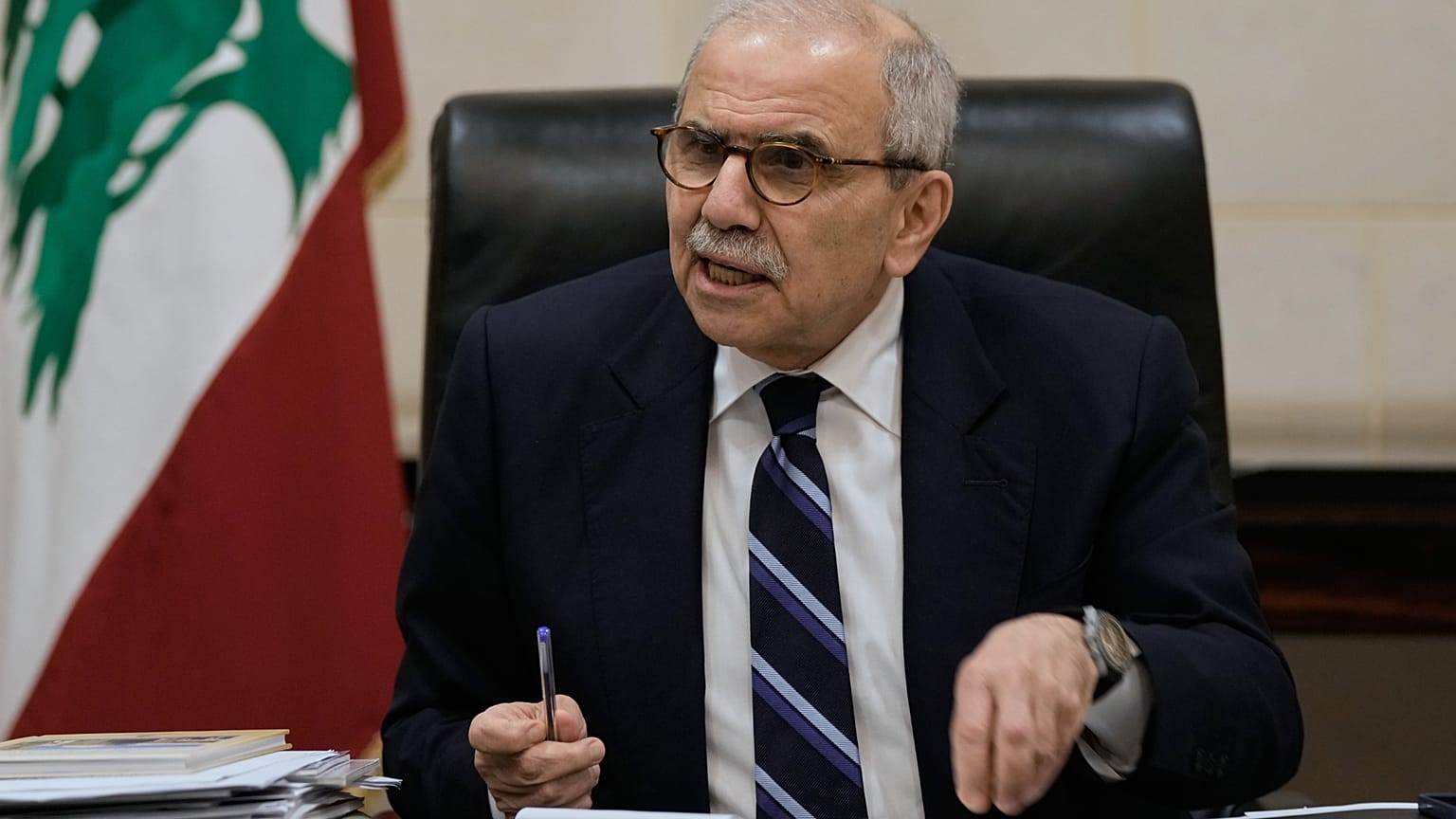














Lebanese Prime Minister Nawaf Salam said he welcomed renewed US-Iran talks set for this Friday, as well as efforts to promote stability and avoid “all-out” war in the Middle East.
Lebanese Prime Minister Nawaf Salam said on Wednesday he would welcome any effort to avoid an "all-out war" in the Middle East as tensions between Iran and the United States escalate.
 ADVERTISEMENT
ADVERTISEMENT
ADVERTISEMENT
"I want to emphasise that the question of war and peace is in the hands of the government and solely of the government," Salam told Euronews' EU editor Maria Tadeo at the World Governments Summit in Dubai, in a reference to the relations between Beirut and Hezbollah.
His remarks came as it was revealed the US and Iran are to meet on Friday in Oman's capital Muscat for nuclear talks following intense lobbying by Arab leaders.
Iranian Foreign Minister Abbas Araghchi confirmed the Friday meeting in a post on X, saying, "I'm grateful to our Omani brothers for making all necessary arrangements." A White House official confirmed the talks would proceed at 10 am Muscat time.
Hezbollah Secretary-General Naim Qassem said in late January the group would not remain neutral if Iran was attacked, declaring "we are not neutral" in response to US threats of military action. The Iran-backed group is widely seen as Tehran's key proxy in Lebanon.
Salam said Israel was undermining his government's authority and fuelling instability in southern Lebanon. "Unfortunately, we must address the issue of Israel's occupation of parts of the south, the daily violations of its sovereignty, and the detention of a number of our citizens," he explained.
Israel said its military actions in southern Lebanon are defensive measures necessary to enforce the November 2024 ceasefire agreement, which it claims Hezbollah and Lebanon are failing to uphold.
Under the UN-backed agreement, Israel is due to carry out a phased withdrawal of its troops from southern Lebanon, though it retains the right to strike if Hezbollah violates the deal. Hezbollah is supposed to disarm and the Lebanese army is to become the only military entity in the country.
Lebanon began implementing a phased disarmament plan in January. The army said it completed the first phase covering the area between the Israeli border and the Litani river, about 35 kilometres from the frontier.
Salam said Lebanon needs help from Europe and Arab partners, pointing to an upcoming conference in Paris in March to provide financial and logistical support to the Lebanese Armed Forces.
"We will need their help, because the army is our main tool to enforce our goal to have the monopoly over arms and to restore state authority over all the Lebanese territory," he explained.
European Commission President Ursula von der Leyen and European Council President António Costa visited Lebanon on 9 January, where they met with President Joseph Aoun.
Von der Leyen then reaffirmed a €1 billion support package announced in May 2024.
She also welcomed the judicial and economic reforms Lebanon has undertaken, including banking reforms aimed at stabilising the economy and attracting investment.
Von der Leyen stressed the ceasefire between Lebanon and Israel must be fully implemented and that non-state armed groups must be disarmed across Lebanese territory.