




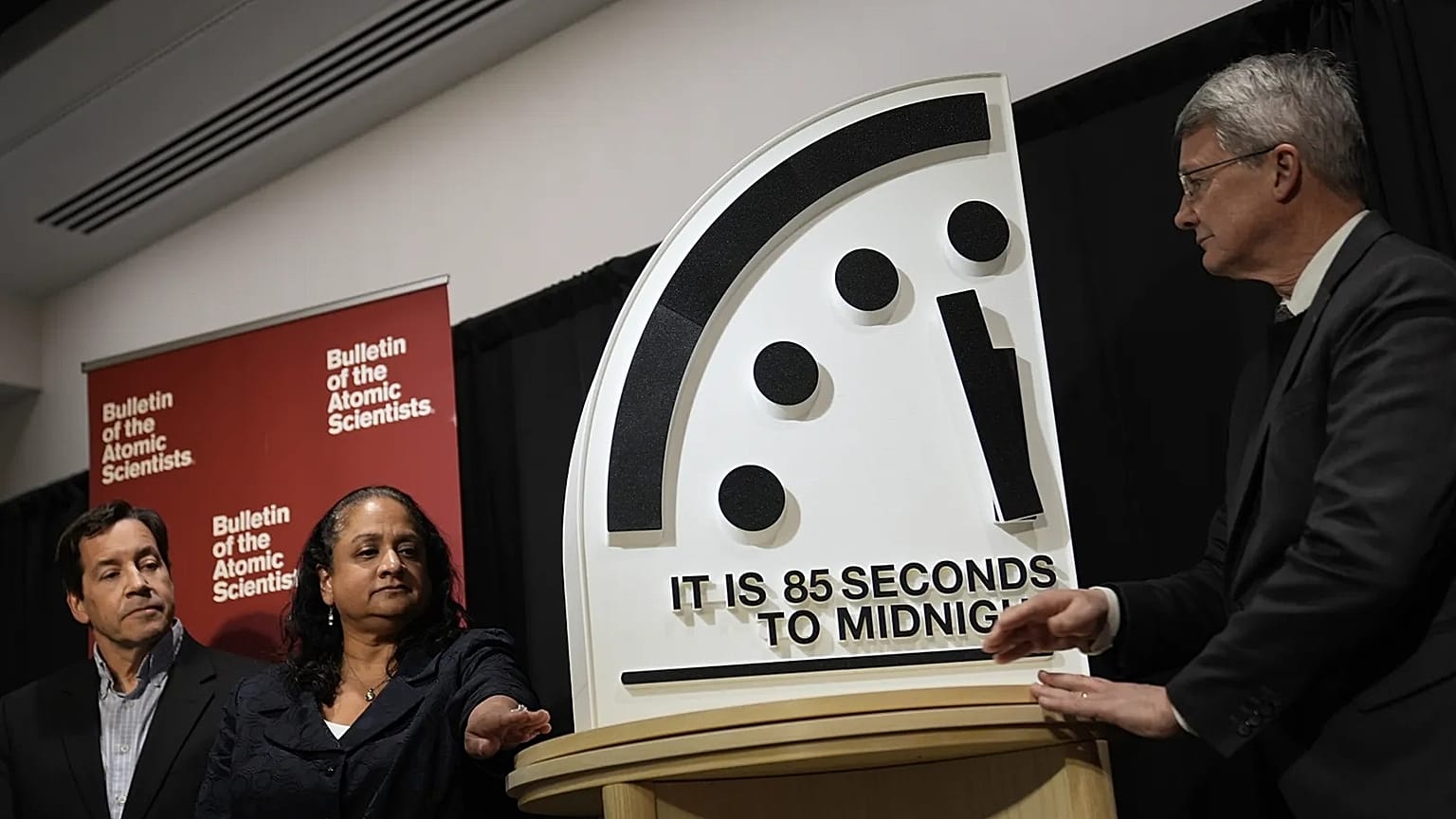













The Doomsday Clock moved to 85 seconds to midnight, the closest ever, due to rising threats from nuclear weapons, climate change and disinformation.
The "Doomsday Clock" which represents how near humanity is to catastrophe moved closer than ever to midnight on Tuesday as concerns grow over nuclear weapons, climate change and disinformation.
 ADVERTISEMENT
ADVERTISEMENT
ADVERTISEMENT
The Bulletin of the Atomic Scientists, which set up the metaphorical clock at the start of the Cold War, moved its time to 85 seconds to midnight, four seconds closer than a year ago.
The announcement comes a year into US President Donald Trump's second term in which he has shattered global norms including by ordering unilateral attacks and withdrawing from a slew of international organisations.
Russia, China, the US and other major countries have "become increasingly aggressive, adversarial and nationalistic," said a statement announcing the clock shift, determined after consultations with a board that includes eight Nobel laureates.
"Hard-won global understandings are collapsing, accelerating a winner-takes-all great power competition and undermining the international cooperation critical to reducing the risks of nuclear war, climate change, the misuse of biotechnology, the potential threat of artificial intelligence and other apocalyptic dangers."
The Doomsday Clock board warned of heightened risks of a nuclear arms race, with the New START arms reduction treaty between Washington and Moscow set to expire next week and Trump pushing a costly "Golden Dome" missile defence system that would further militarise space.
The group also highlighted droughts, heat waves, and floods linked to global warming, as well as the failure of nations to adopt meaningful agreements to address it.
"We are living through an information Armageddon - the crisis beneath all crises - driven by extractive and predatory technology that spreads lies faster than facts and profits from our division," said Maria Ressa, the Filipino investigative journalist and Nobel Peace Prize winner.
Board members have further warned of fracturing global trust. "If the world splinters into an us-versus-them, zero-sum approach, it increases the likelihood that we all lose,” said Daniel Holz, chair of the group’s science and security board.
The Bulletin of Atomic Scientists was founded by the likes of Albert Einstein, Robert Oppenheimer and other Manhattan Project nuclear scientists such as Eugene Rabinowitch and Hyman Goldsmith in late 1945.
Starting in 1947, the advocacy group used a clock to symbolise the potential and even likelihood of people doing something to end humanity.
At the end of the Cold War in 1991, it was at its farthest point ever, at 17 minutes to midnight. Over the past few years, to address rapid global changes, the group has shifted from counting down the minutes until midnight to the seconds.
The group said the clock could be turned back if leaders and nations worked together to address existential risks.