




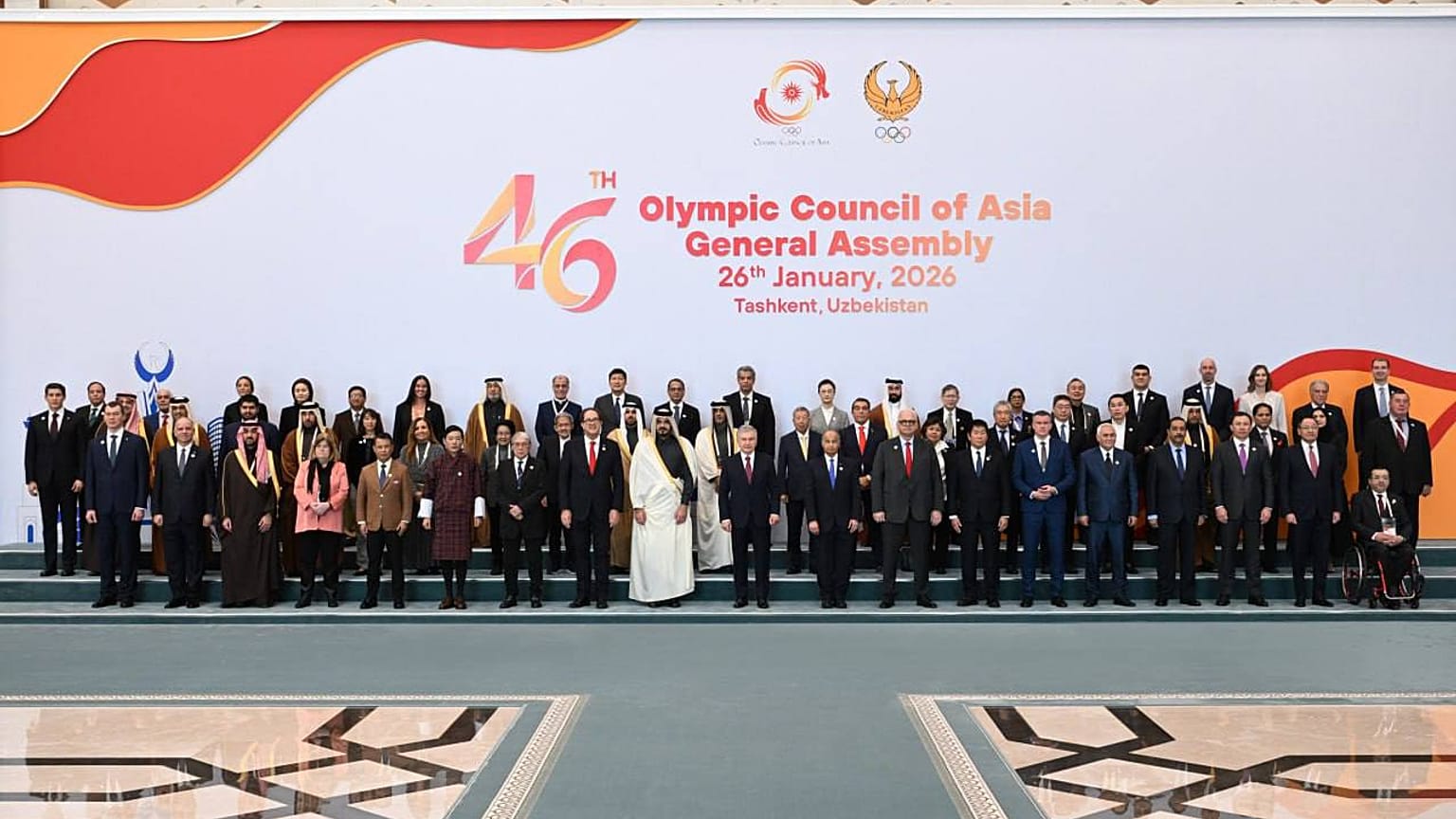













More than 360 senior sports officials visited Tashkent as Asia’s Olympic leadership changed hands, new cooperation agreements were signed, and international federations inspected cutting-edge facilities, signalling rising confidence in Uzbekistan’s sporting infrastructure and organisation.
Uzbekistan is hosting a series of high-level international sports meetings in Tashkent, bringing together more than 360 officials from global sporting bodies and underlining the country’s ambition to position itself as a regional hub for major international events.
 ADVERTISEMENT
ADVERTISEMENT
ADVERTISEMENT
The meetings, which began on Saturday, included sessions of World Aquatics Federation, the 46th General Assembly of the Olympic Council of Asia (OCA), and an international forum organised by the World Anti-Doping Agency (WADA).
Participants included senior representatives of the International Olympic Committee, heads of international sports federations, and officials from the National Olympic Committees of 45 Asian countries. Government delegations from the United States, Russia, Saudi Arabia and Qatar also attended.
The OCA Assembly drew senior figures from a broad range of international sports organisations, including the presidents of WADA, World Boxing, the International Gymnastics Federation, the International Weightlifting Federation, the International Hockey Federation and the Asian Paralympic Committee.
Nenad Lalovic, President of United World Wrestling, said the scale of the gatherings reflected growing confidence in Uzbekistan’s sports reforms.
“This shows the President’s strong interest in sport and in hosting major international events,” Lalovic told Euronews, adding that Uzbekistan’s approach linked public health, youth engagement and elite competition.
Sheikh Joaan bin Hamad Al Thani new OCA President
A key outcome of the Assembly was the unanimous election of Sheikh Joaan bin Hamad Al Thani, President of the Qatar Olympic Committee, as the new OCA President.
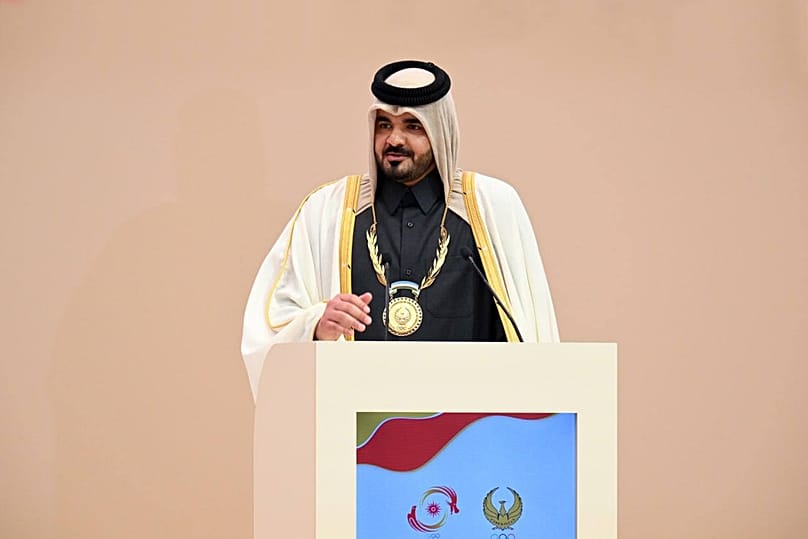
Founded in 1982 and headquartered in Kuwait, the Olympic Council of Asia coordinates the Olympic movement across the continent and oversees major events such as the Asian Games. Uzbekistan has been a member since 1991 and has recorded strong results in disciplines including boxing, wrestling, judo and weightlifting.
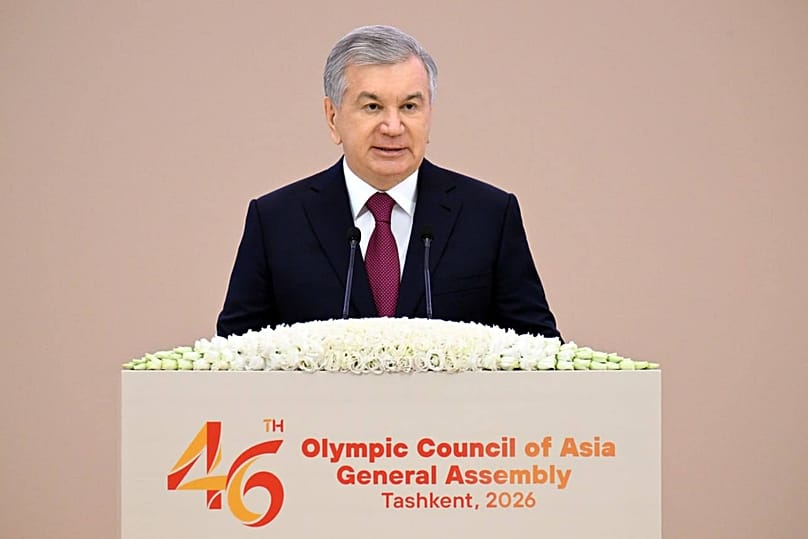
Addressing delegates, Uzbek President Shavkat Mirziyoyev described sport as a platform for cooperation and dialogue, calling it a “true ambassador of peace and friendship.” in an increasingly fragmented global environment.
He highlighted Uzbekistan’s expanding cooperation with the OCA, noting that the country hosted an OCA Executive Committee session in 2022 and that an Uzbek representative was elected Vice President for Central Asia. He also pointed to Uzbekistan’s selection as host of the 2029 Asian Youth Games as recognition of its organisational capacity.
Ibrahim Eshaq, a board member of the Bahrain Olympic Committee, said Uzbekistan had emerged as a regional centre for sport due to consistent leadership and long-term planning.
Achievements and investment in sport
According to President Mirziyoyev, mass sports participation in Uzbekistan has reached 15 million people, a key priority in a country where around 60% of the population is under the age of 30. Reforms include a nationwide talent-identification system known as the “Presidential Olympics” and the construction of a new Olympic Village covering 100 hectares.
Uzbekistan’s progress has also been reflected in competitive results. The country finished 13th at the Paris 2024 Olympic and Paralympic Games, while more than 50 young athletes achieved record performances at world and continental competitions last year.
Youth teams placed second at the 2025 Asian Youth Games in Bahrain and at the Islamic Solidarity Games in Saudi Arabia. At the 5th Asian Youth Para Games in Dubai in December 2025, Uzbekistan topped the medal table.
The country has also hosted world championships and World Cup events in more than ten disciplines in recent years, including boxing, judo, gymnastics, weightlifting, volleyball and futsal.
Eshaq cited the 2021 World Weightlifting Championships in Tashkent as an example of Uzbekistan’s organisational capacity. “We are now looking forward to returning in 2027, when Uzbekistan will host qualification events for the Los Angeles 2028 Olympics. Uzbekistan is a leader both on and off the field, and every visit here feels like coming home thanks to the hospitality and excellent organisation.”, he added.
Cooperation agreements and future plans
During the Assembly, more than 20 cooperation agreements were signed between international sports organisations and Uzbek federations.
Projects include plans for a weightlifting centre in Bostanlyk District, a regional wrestling academy, the expansion of volleyball clubs nationwide, and the construction of hockey stadiums in Tashkent and Khorezm.
Gunilla Lindberg, Secretary General of the Association of National Olympic Committees, said Uzbekistan had strong potential for future growth. “Many new programmes are being introduced, and the country has favourable conditions for both summer and winter sports. If you continue to work with this level of commitment, the opportunities are enormous, especially in Asia, where the diversity of sporting events continues to grow”, she noted.
At the close of the Assembly, Sheikh Joaan bin Hamad Al Thani was awarded Uzbekistan’s “Shon-Sharaf” Order for his contribution to the Olympic movement and international sports cooperation.
President Mirziyoyev reaffirmed Uzbekistan’s openness to international collaboration in sport, describing it as a pathway to trust, dialogue and regional integration.
Aquatic sports development
Uzbekistan’s growing international profile was also highlighted during a visit by World Aquatics officials to Tashkent, where they toured the new Aquatic Sports Complex in the Olympic City.
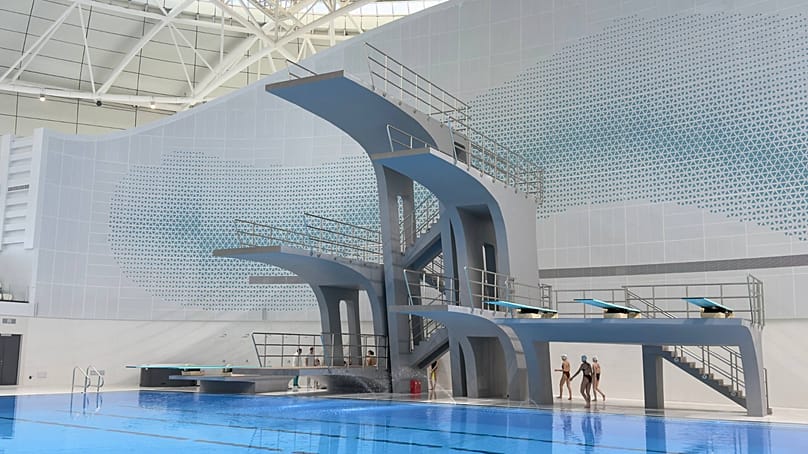
Guests were introduced to the venue’s training and performance spaces and watched a choreographed underwater performance by national synchronised swimmers, a showcase of both athletic talent and technical capacity.
World Aquatics President Husain Al Musallam said the facilities met international technical standards and could serve as a development centre for Uzbekistan and Central Asia.
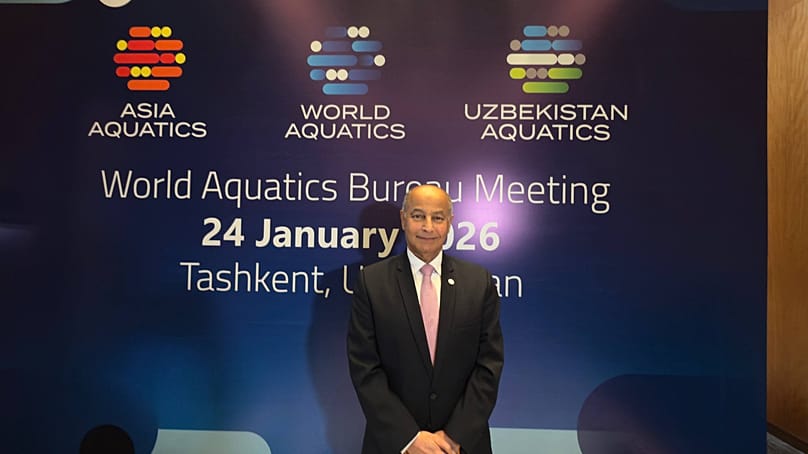
“All construction has been carried out according to international standards. Uzbekistan worked closely with international sports federations, and today all our technical requirements are met”, he added.