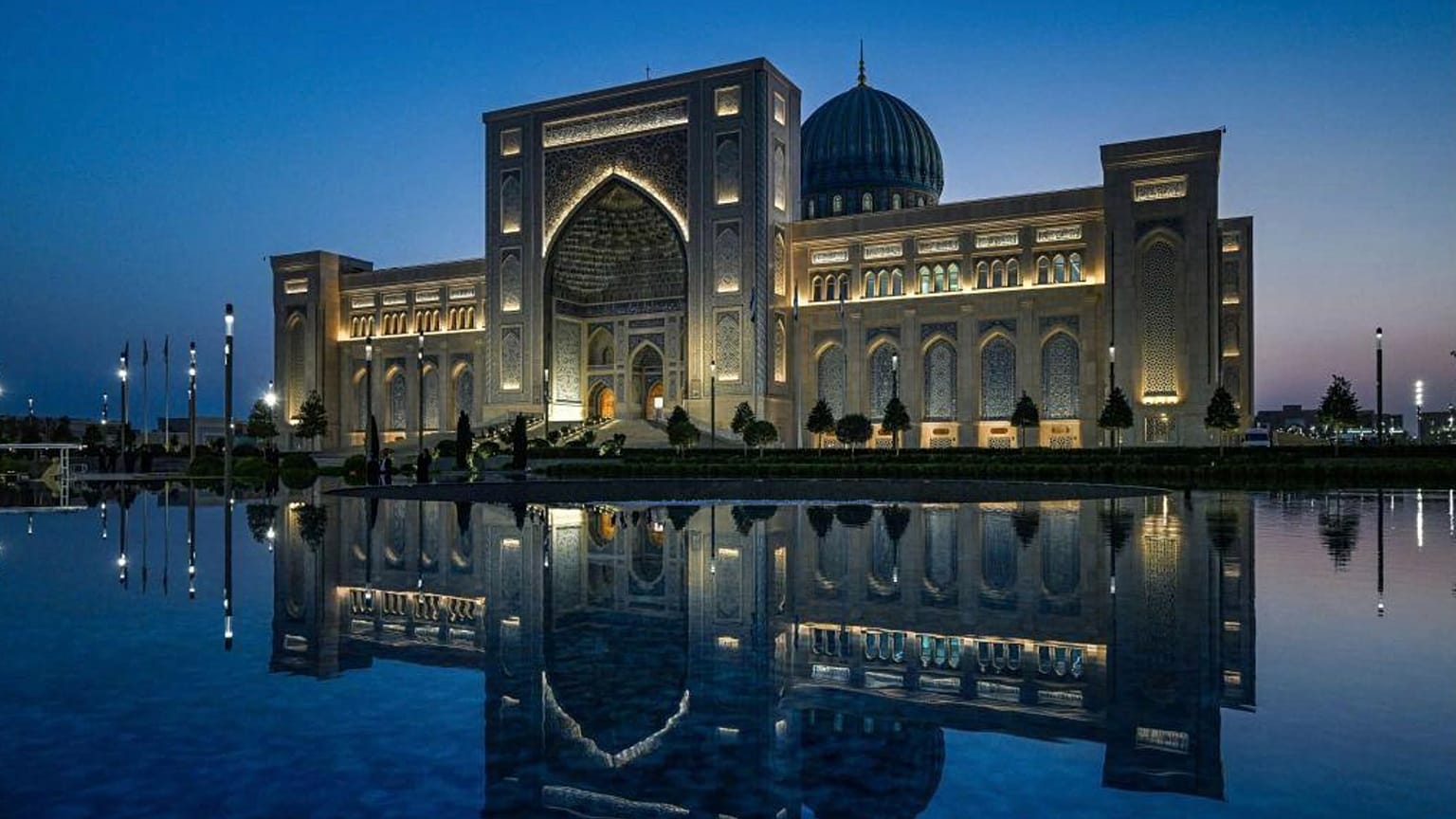













In central Tashkent, a bold new landmark symbolises Uzbekistan’s spiritual revival.
 ADVERTISEMENT
ADVERTISEMENT
ADVERTISEMENT
The Center of Islamic Civilization, set to open in March 2026, is the country’s most ambitious cultural project to date – a space designed to showcase centuries of intellectual exchange, artistic refinement and religious scholarship.
When Uzbekistan President Shavkat Mirziyoyev shared his initiative with the UN General Assembly in 2017, he stressed the importance of revealing the humanistic foundations of Islam, combating ignorance through knowledge and enlightenment.
At the UN’s 80th session last September he confirmed the project was nearing completion, and Uzbekistan was preparing to open the doors of this spiritual and cultural centre to the world.
A space shaped by history
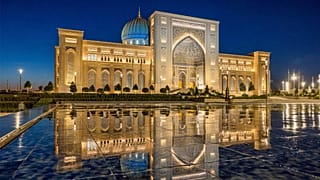
The Center of Islamic Civilization sits on 10 hectares, its architecture blending restored artistic traditions with contemporary engineering. The grand 65-metre dome is flanked by four monumental portals representing Uzbekistan’s regional and national unity, while ornate design features reflect back to the Timurid era when cities such as Samarkand and Bukhara were major centres of science and creativity.
Inside, the galleries are curated under the concept of ‘Civilisation, Personality and Discoveries’. Exhibitions trace periods from the pre-Islamic era and the First and Second Renaissances to the modern emergence of the ‘New Uzbekistan’. Alongside manuscripts, ceramics and rare metalwork, the centre’s most precious object is the 7th-century Quran of Uthman, listed by UNESCO in the Memory of the World Register.
The scale of the institution is expansive. A 200,000-volume library, digital archive, restoration laboratories and a dedicated children’s museum sit under one roof. Young visitors can experiment with astronomy, medicine and the arts through VR, AR and AI installations, while a calligraphy school and printing house offer a more tactile entry point into the region’s scholarly heritage.
During a recent tour, Finland’s President Alexander Stubb remarked that the centre offers a ‘whirlpool of incredible impressions’, noting the level of detail and artistry involved in translating centuries of history to inspire contemporary audiences.
Returning what was lost
The centre is also reshaping Uzbekistan’s approach to cultural diplomacy. President Mirziyoyev has repeatedly emphasised that national identity is sustained through memory and cultural roots. As such, he has called for rare artefacts of national heritage held overseas to be brought home, in order to preserve the spirit and history of the Uzbek people.
To achieve this, the director of the centre and a specialist commission – including scientists, orientalists and art historians – carried out extensive research in the UK and other countries. Their work involved cataloguing manuscripts, objects and artworks linked to Central Asia that had entered international collections over centuries of trade, scholarship and private dealing. Meetings with auction houses, galleries and collectors enabled the team to track and authenticate rare items related to the history of Uzbekistan and to the Islamic civilisation.
The Oxford Centre for Islamic Studies signalled its interest in long-term collaboration, including scientific research, academic exchanges and joint exhibitions. Its director, Farhan Ahmad Nizami, described the Tashkent project as a symbol of ‘spiritual and scientific revival’, noting its wider relevance beyond Uzbekistan.
Thanks to these efforts, in a short time more than a 1,000 of the rarest exhibits from private collections and international auctions have since returned to Uzbekistan, in what is the most significant repatriation effort in its modern history.
Among the repatriated items are around 600 examples of ceramics, epigraphy, metalwork, calligraphy and miniature art, including fragments of Quranic manuscripts from the 9th century, Timurid ceramics and works by Central Asian thinkers. A set of 300 manuscripts from the Abu Rayhan Beruni Institute of Oriental Studies – a repository listed in the Memory of the World Register – has also been prepared for public presentation in Uzbekistan for the first time.
Today, the artefacts will take their rightful place in Tashkent’s Center for Islamic Civilization, located in the heart of Uzbekistan, on the legendary Silk Road. UNESCO Director-General Khaled Al-Anani, visiting the site in November, said he hoped the centre would serve as a ‘light for the whole world’ and praised Uzbekistan’s role as a crossroads of cultures. “It is a true testimony to cultural diversity, tolerance, openness and the role of Uzbekistan in the development of mankind – a true crossroads of civilisations!”
Building a global network
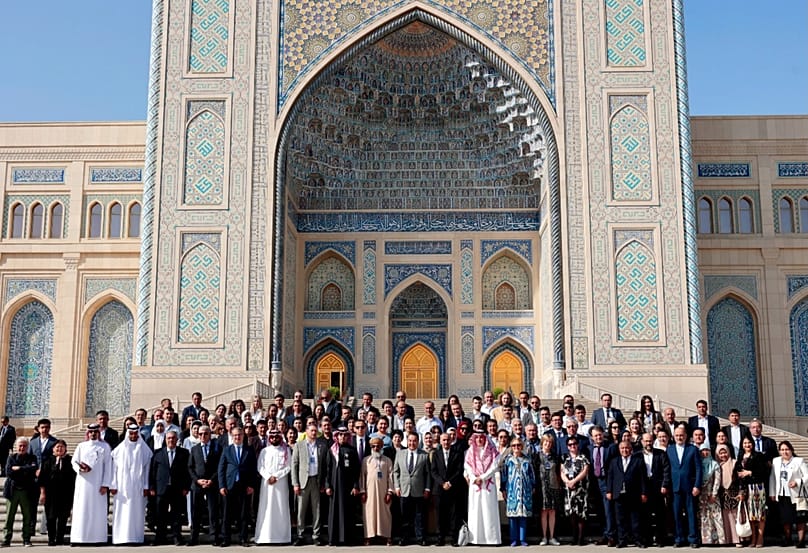
International scholarly engagement has been central to the project. The World Society WOSCU, representing more than 400 researchers across 20 countries, has supported the development of this new cultural and educational institution and donated around 1,000 items, including rare artefacts, manuscripts, applied artworks and museum collections of great historical and spiritual value. Many originate from historical regions including Transoxiana, Khorasan, Iran and India, each tied closely to Uzbekistan’s cultural history.
The centre also works with private collectors and patrons willing to donate artworks and rare objects. The first collections were formally handed over ahead of Tashkent’s International Expert Forum ‘The Great Heritage of the Past – the Basis of an Enlightened Future’ in 2025.
More than 1,500 specialists from 40 countries have contributed to research, architectural planning and conservation tasks, underpinning over 800 individual scientific and museum projects linked to the centre’s scientific, architectural and cultural development.
Dr Firdavs Abdukhalikov, Director of the Center for Islamic Civilization and Chairman of WOSCU, said the initiative represents an attempt to gather dispersed fragments of history into one place. In his words, the Center aims to frame Islamic civilisation as one rooted in ‘peace, goodness, science, enlightenment and spiritual culture’, offering visitors a route into the ideas that once shaped the region.
The Center of Islamic Civilization is set to open in March 2026 in Tashkent, Uzbekistan. As the opening date nears, the centre is positioning itself as a cultural gateway for Uzbekistan – a project designed not only to preserve heritage, but to spark new research, new exchanges and a renewed sense of intellectual curiosity.