




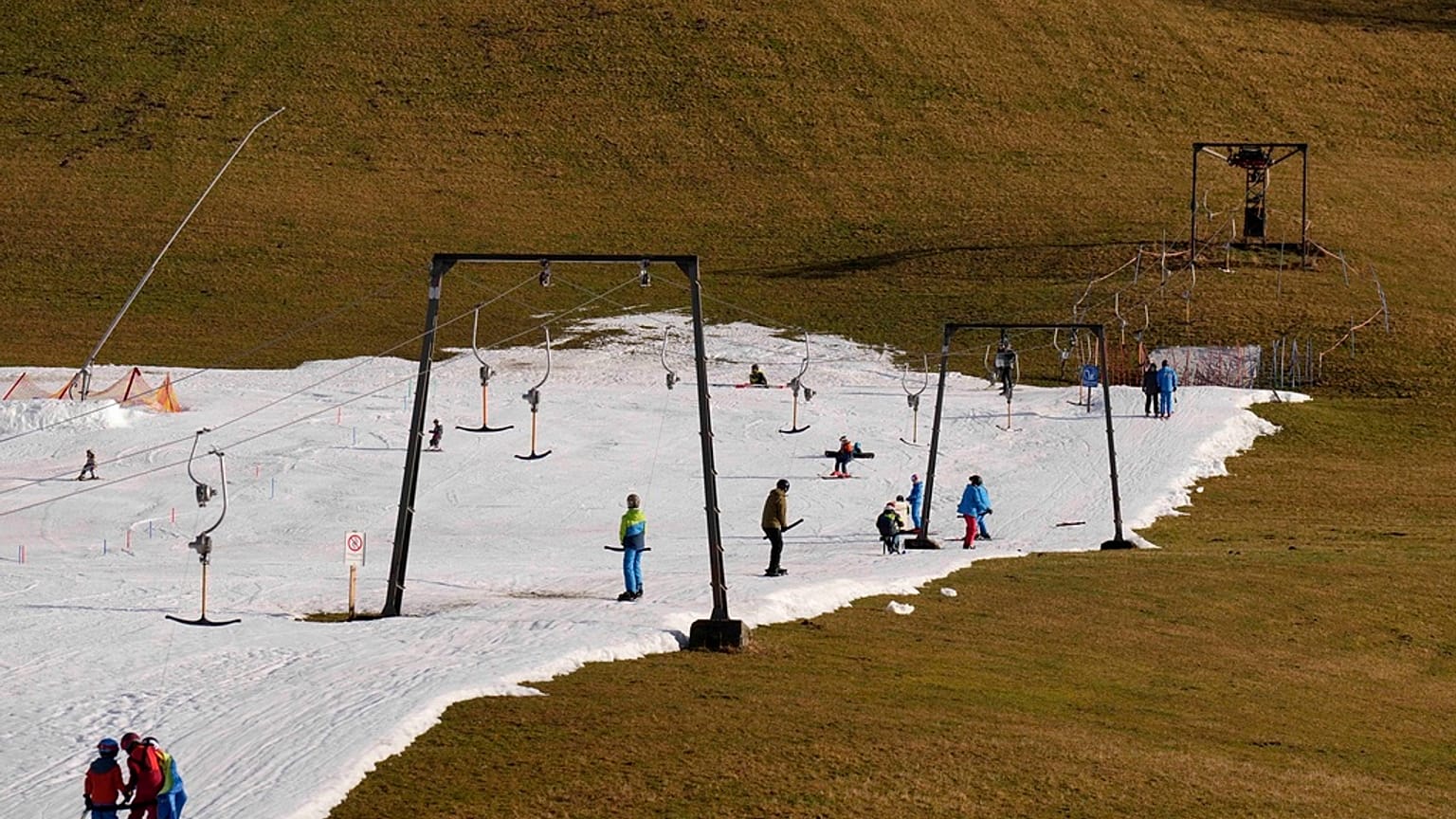













Higher temperatures and a lack of snow are forcing Europe's ski resorts to rethink their business model.
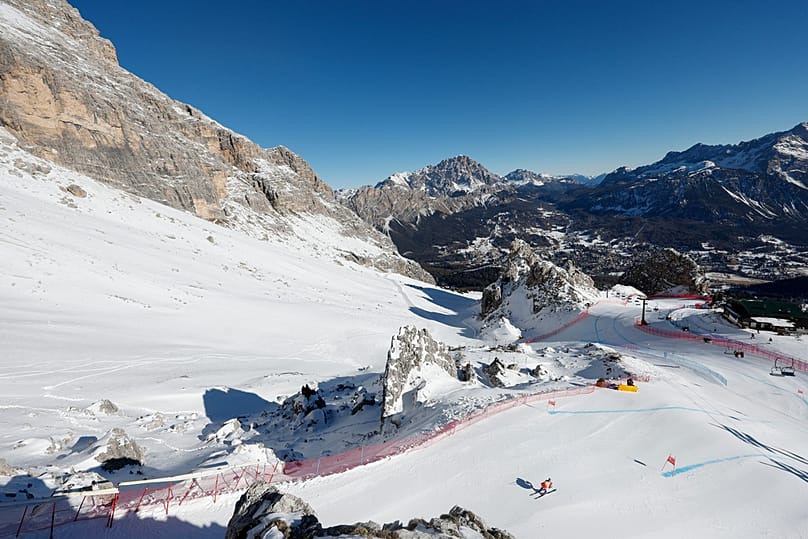
With only a few weeks to go until the opening ceremony of the Winter Olympics in Milan-Cortina on 6 February, the slopes around the 'pearl of the Dolomites' are covered in snow. But tourists and skiers aren't always lucky enough to experience this.
 ADVERTISEMENT
ADVERTISEMENT
ADVERTISEMENT
With the climate warming up, snow is often limited to the slopes. Even there, it is only guaranteed by artificial snowmaking, with associated economic and environmental costs that often trickle down into ski pass prices. For many Europeans, this is pushing snow sports increasingly out of reach.
How climate change is shaping the Winter Olympics
Even in Italy's renowned ski resort in the province of Belluno, climate change is making snowfall rarer and temperatures higher - a problem that afflicts the entire Alpine arc. The International Olympic Committee (IOC) itself has recognised the impact of global warming, caused mainly by the burning of coal, oil and gas.
Inevitably, the very geography of the Olympics will be affected. Since 1924, 21 locations have hosted the Winter Games. Without rapid and drastic action to combat climate change, only four of those locations will still be suitable by mid-century, according to a 2021 study published in the scientific journal Taylor & Francis by researchers at the University of Waterloo, Canada.
These are Lake Placid (United States), Lillehammer and Oslo (Norway) and Sapporo (Japan). If the average global temperature rises by 4 degrees Celsius over pre-industrial levels by 2050 - a worst-case scenario - the study reveals that heat and lack of snow will make it impossible for the other locations to host the Olympics again. And, by 2080, only the Japanese ski resort could do so.
Not only that: even if the Paris Agreement is respected, by limiting global warming to a maximum of 2 degrees Celsius, only nine 'Olympic' locations would be able to host the sporting event again in 2050 (and just eight in 2080).
Which European countries are most reliant on winter sports?
The Games, however, are only scheduled every four years, and for only a few weeks. For those who live off the ski economy, these problems are a daily reality.
Europe's winter tourism sector turned over roughly €180 billion in 2022. The Alps are the nerve-centre of this, as well as being home to some of Europe's most important water resources and invaluable biodiversity.
According to the EU Action Plan for the Alpine region, the area is home to 80 million people (about 15 per cent of the entire EU population). It encompasses 48 regions in five EU Member States (Germany, France, Italy, Austria and Slovenia) along with Liechtenstein and Switzerland.
Germany is the European country with the most ski resorts, according to 2020/21 data published by the Statista portal - 498, compared to 349 in Italy and 317 in France. Completing the top 10 nations are Austria (253 ski areas), Sweden (228), Norway (213), Switzerland (181), Finland (76), Slovenia (44) and Spain (32).
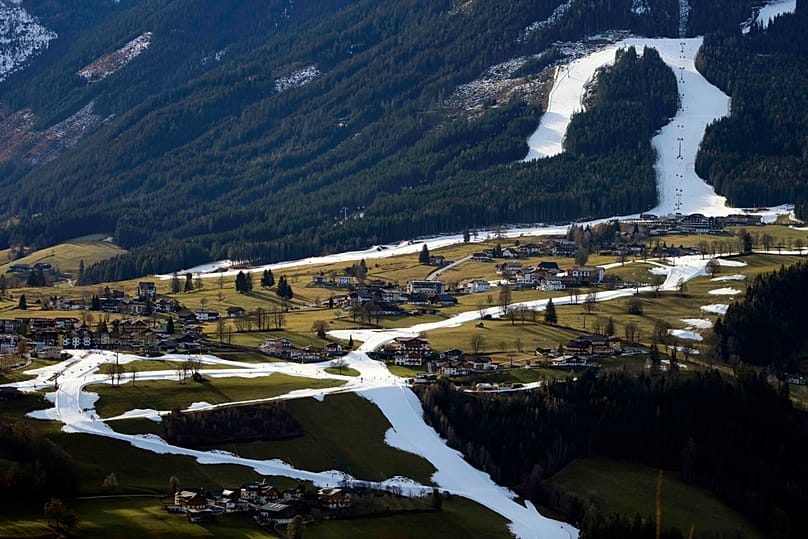
A study published in 2023 in the scientific journal Nature Climate Change predicts that, out of a total of 2,234 existing ski resorts in Europe, 53 per cent will be at very high risk of low snow under a climate warming scenario of 2°C compared to pre-industrial levels.
In particular, one third of the ski resorts in the French Alps will be doomed, while in the Pyrenees it will be as much as 89 per cent.
Should the global average temperature increase by 4°C, almost all European resorts will be unable to count on a sufficient amount of snow: as much as 98 per cent.
Climate change will disrupt mountain ecosystems and economies
"There is variability from region to region, but we can identify three broad categories of mountain massifs in Europe," François Hugues, a researcher at Inrae (the French National Institute for Agriculture, Food and the Environment), tells Euronews Green.
"One group has rather favourable altitudes and conditions - the inland Alps, mainly in France, Switzerland and Austria," he explains. "A second group includes situations in between, which are much more vulnerable to climatic conditions, as in the case of the Slovenian Alps or the Pyrenees.
"Finally, there are territories that the climate crisis has already pushed to the limit: the mountains of the Iberian Peninsula or the Apennines in Italy. If the second group still has some room for manoeuvre, for the latter, subject to local choices designed to support certain areas, it is difficult to envisage positive economic returns by still focusing on winter sports," he concludes.
In many resorts, attempts are already being made to buffer the problem with artificial snow. However, back in 2007, an OECD study had already highlighted what was called the 'one hundred days rule' - the idea that an area must be able to count on 100 days per year of opening, with at least 30 centimetres of natural snow. Otherwise, it is difficult to achieve the hoped-for profitability.
Artificial snow is a risky and costly solution
Snow shot from cannons can therefore be a support, but not a substitute. And the price must be taken into consideration: "To make snow on a slope that is one kilometre long, about 50 metres wide and 40 centimetres thick, the cost ranges from 30 to 40 thousand euros,' explains the AGI agency.
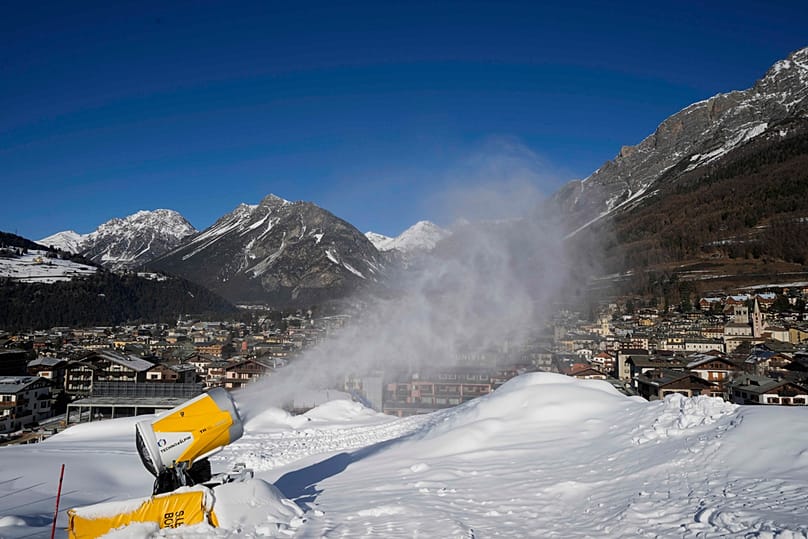
"The cost of producing artificial snow varies from €2 to €3.8 per cubic metre depending on the temperature and air humidity. With these values, the production is 2.5 metres of snow per cubic metre of water. The cost of snow per hectare is €15,000," according to AGI.
"The costs associated with the production of [artificial] snow itself are in any case relatively marginal compared to the overall costs of running a ski resort," Hugues points out.
"But there is also an environmental factor to take into account, which is linked to water resources and their availability," he continues.
"In fact, it is often necessary to create artificial lakes in order to be able to have the necessary water available, and these works represent a not inconsiderable cost burden. In general, therefore, even for resorts that are less impacted by climate change, we need to rethink business models and adapt them to the consequences of global warming."
The EU: Coordinated management of resources is needed
The strain of snowmaking on water resources should not be underestimated: "For basic snowmaking (about 30 centimetres of snow, often more) of a one-hectare slope, at least one million litres of water, i.e. one thousand cubic metres, are needed," explains WWF. "While subsequent snowmaking requires, depending on the situation, considerably more water consumption, which roughly corresponds to the annual consumption of a city of 1.5 million inhabitants."
This is why the European Union, in the revision of its action plan for the Alpine region, communicated on 11 December 2025, emphasised that, in the face of pressure from the climate crisis, "Common and well-coordinated management of transboundary watercourses is essential to ensure the integrated protection, improvement and restoration of water resources and their ecosystems, and is fundamental to Europe's water resilience and security."
Electricity is also needed to operate the cannons and lances, which leads to increased consumption and consequent greenhouse gas emissions, contributing to the vicious circle that fuels the climate crisis.
To supply the entirety of Europe's Alpine resorts with artificial snow, it is calculated that some 600 GWh would be needed, equivalent to the annual consumption of 130,000 four-person households, Reuters reported in 2023.
Ski pass costs on the rise in Europe: +34.8 per cent in 10 years
These spiralling costs in turn affect skiers: spending on skiing in Europe has risen by an average of 34.8 per cent, well above inflation, since 2015, with the highest increases in Switzerland, Austria and Italy. So much so that many major resorts have now become unaffordable for most tourists.
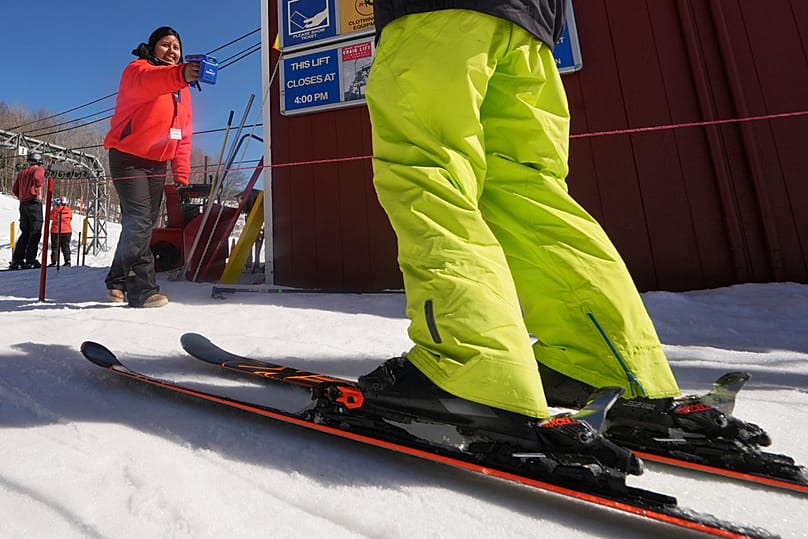
"Skiing will become a sport for the rich," Christophe Clivaz, lecturer at the University of Lausanne, explained to Valori.it. "It already is, but it will be more and more so because the costs of maintaining the slopes will grow. Not to mention that skiing requires buying or renting skis and boots. And then jackets, trousers, gloves, goggles. Already today, in a country like Switzerland, a large part of the population cannot afford to ski, especially large families."
According to the consumer protection association Assoutenti, a daily ski pass for the 'Dolomiti Superski', which guarantees access to all 12 resorts in the Dolomites, costs up to €86 per day today, compared to €67 in 2021.
In Roccaraso, Abruzzo, the price of a similar ticket reaches €60. The same ticket in 2021 cost €47 and last year €58. In Livigno, on the Swiss border, there was the highest increase: from €52 in 2021 to €72 in 2025 (38 per cent more).
"The operators of Alpine ski resorts where skiing will remain possible will attract wealthy tourists from further afield, customers coming for example from the United Kingdom, but also from Spain or Greece, countries where it will be increasingly difficult to ski," Hugues concludes.
"This may be positive from an economic point of view, but it will complicate things from an environmental and climate point of view, as this will increase greenhouse gas emissions linked to tourist travel, fuelling climate change even more."