

















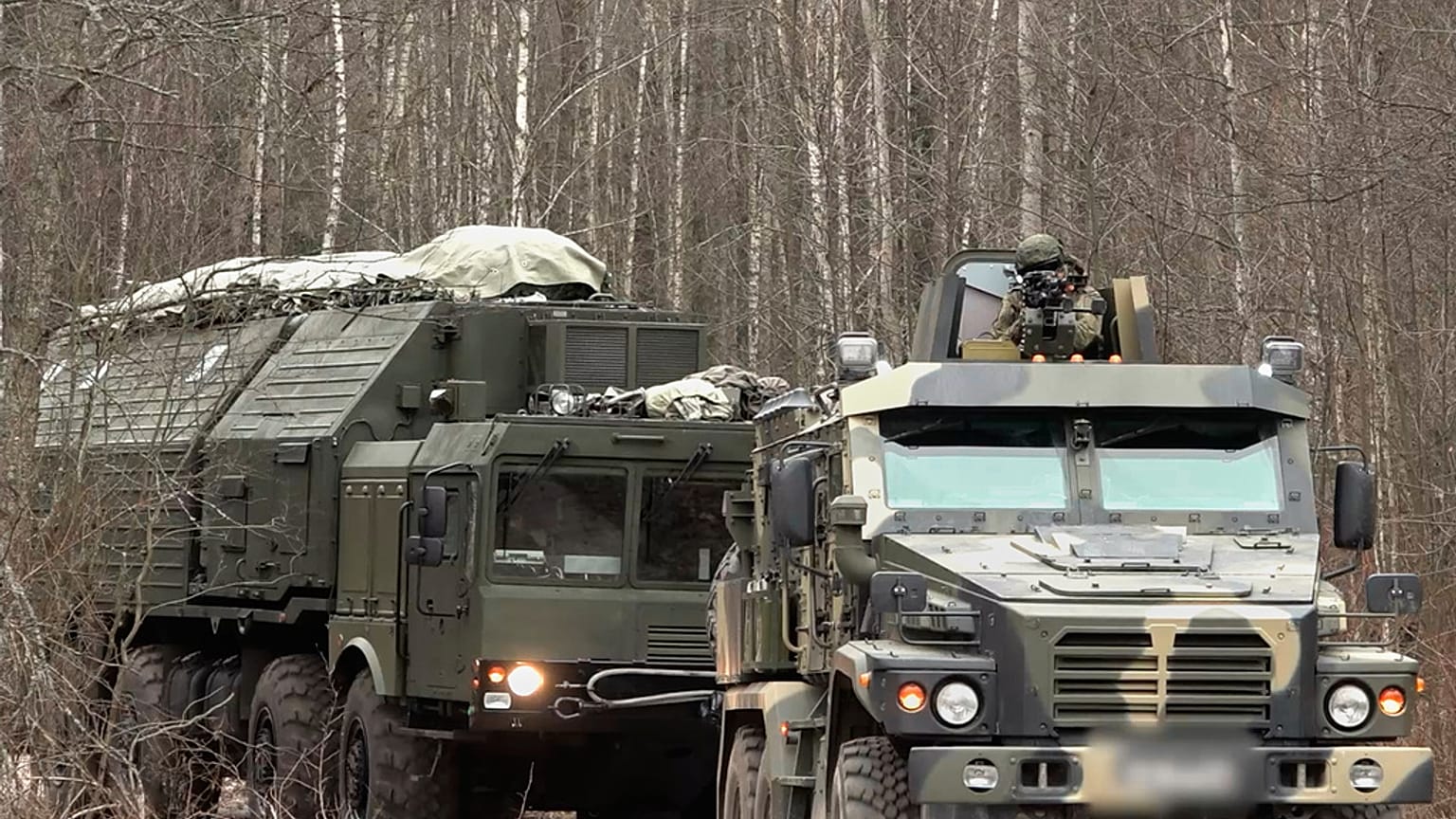














Russia's Defence Ministry released the first images of an intermediate-range weapon entering service. Analysts identified a former airfield near the Russian border as a likely site.
Russia deployed its intermediate-range ballistic missile system Oreshnik to Belarus, Russia's Defence Ministry announced Tuesday, releasing first images of the nuclear-capable weapon system entering active service.
 ADVERTISEMENT
ADVERTISEMENT
ADVERTISEMENT
The ministry released footage showing mobile combat vehicles carrying the missile system driving through a forest during combat training exercises.
The announcement followed Belarusian President Aliaksandr Lukashenka's statement on 18 December that the Oreshnik had arrived in the country the previous day. Lukashenka said up to 10 such missile systems would be stationed in Belarus.
In a series of updates on its nuclear-capable arsenal in recent weeks, Russia's President Vladimir Putin said 17 December that Oreshnik would enter combat duty before year's end.
His statement contradicted Russian Chief of the General Staff Valery Gerasimov who said Moscow already equipped a brigade with the missiles in 2025.
The deployment comes as US-led peace talks reach a critical phase.
US President Donald Trump hosted Ukrainian President Volodymyr Zelenskyy at his Florida resort on Sunday, claiming Kyiv and Moscow were "closer than ever before" to a peace settlement.
However, Moscow and Kyiv remain deeply split on key issues including Russia's maximalist demands over Ukraine's eastern region of the Donbas and the fate of Russian-occupied Zaporizhzhia nuclear power plant.
What is Oreshnik?
Oreshnik, Russian for "hazelnut tree", is an intermediate-range ballistic missile that the US Department of Defence identifies as a variant of the RS-26 Rubezh.
The Pentagon describes it as "experimental" and based on Russia's RS-26 intercontinental ballistic missile programme, which was reportedly mothballed in 2018.
Western experts believe Oreshnik is derived from RS-26 by removing a booster stage, reducing its range. The RS-26 itself is a shortened version of the RS-24 Yars intercontinental ballistic missile with one fewer stage.
The missile is estimated to be 15 to 18.5 metres long, with a diameter of some 1.9 metres, and is mounted on a mobile transporter and launcher for rapid deployment and concealment.
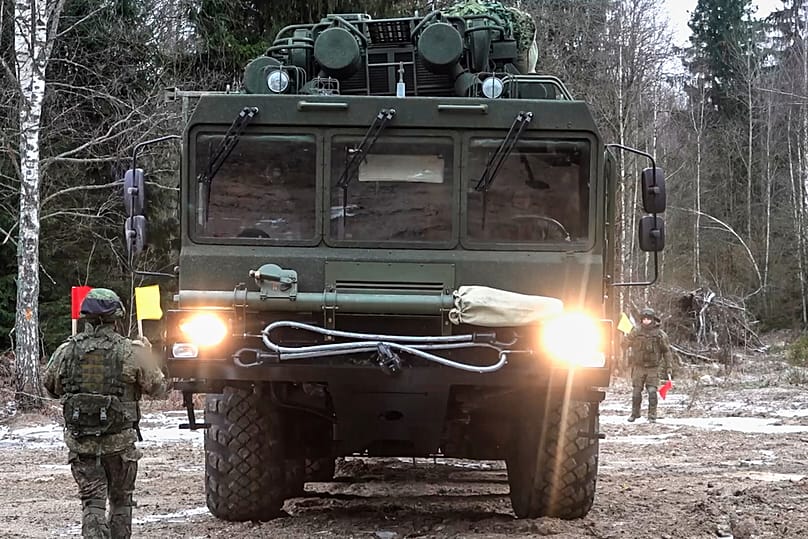
Belarus' Defence Ministry said Tuesday that Oreshnik has a range up to 5,000 kilometres, placing most of Europe within striking distance. Russian state-run media claimed the missile could reach an air base in Poland in 11 minutes and NATO headquarters in Brussels in 17 minutes. These claims could not be independently verified.
Intermediate-range missiles have a range of between 500 and 5,500 kilometres. Similar weapons were banned under the Intermediate-Range Nuclear Forces Treaty (INF), which Washington and Moscow abandoned in 2019.
Putin claimed Oreshnik's warheads "can't be intercepted" and that several used in a conventional strike could be "as devastating as a nuclear attack".
Western experts expressed scepticism towards these claims, saying it is likely repackaged old technology touted as cutting-edge "superweapon".
Combat use
Russia first used Oreshnik on 21 November 2024, striking the PA Pivdenmash facility in Dnipro, in Ukraine's east. The missile was launched from Kapustin Yar training ground in Astrakhan Oblast, approximately 800 kilometres from the target.
Senior Ukrainian officials said the missile carried "dummy" warheads lacking explosives.
US experts described the method as "an expensive way to deliver not that much destruction." However, Oreshnik's warheads, even inert, can cause significant damage because of kinetic energy created by hypersonic speed.
Satellite imagery revealed minimal damage to Pivdenmash building roofs and nearby private sector. Experts noted the accuracy demonstrated in the Dnipro strike is sufficient for delivering a nuclear payload but not for a conventional one.
Putin described the attack as a "successful test" and warning to the US and the UK as they considered providing Ukraine with long-range weapons capable of striking deep inside Russia. Moscow warned Washington of the strike beforehand.
On 31 October, Ukrainian military intelligence, security service and armed forces claimed to have destroyed one Oreshnik system at Kapustin Yar testing site, leaving two operational.
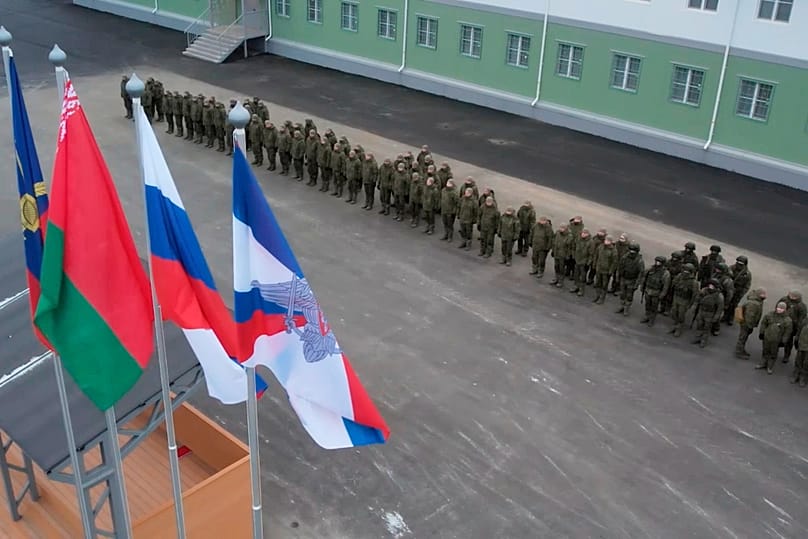
While signing a security pact with Lukashenka in December 2024, Putin said that even with Russia controlling the Oreshniks, Moscow would allow Minsk to select targets. He noted that if missiles are used against targets closer to Belarus, they could carry a significantly heavier payload.
In 2024, the Kremlin released a revised nuclear doctrine stating that any nation's conventional attack on Russia supported by a nuclear power will be considered a joint attack. The doctrine also placed Belarus under the Russian nuclear umbrella.
Russia previously deployed tactical nuclear weapons to Belarus, whose territory it used to launch its full-scale invasion of Ukraine in February 2022. Lukashenka said Minsk has several dozen Russian tactical nuclear weapons.
Lukashenka's government has been repeatedly sanctioned by the West for human rights crackdowns and for allowing Moscow to use its territory for the full-scale invasion of Ukraine.