































Dozens of Russian nationals deported from the United States received military summonses immediately after landing in Moscow, according to human rights activists. Others faced separation from loved ones and FSB threats, family members of deportees told Euronews.
The United States deported around 60 Russian nationals to Moscow on Tuesday, with men on the flight receiving military draft notices immediately after landing, according to human rights activist Dmitry Valuev.
 ADVERTISEMENT
ADVERTISEMENT
ADVERTISEMENT
The deportation flight departed Arizona on 7 December and stopped in Cairo before arriving at Moscow's Domodedovo Airport at 2:39 am local time on 9 December, Valuev, president of Russian America for Democracy in Russia, revealed to Euronews.
Passengers on the flight flew in shackles and handcuffs attached to chains across their stomachs, according to relatives of deportees.
The Russian Prosecutor General's Office confirmed the detention of Zair Syamiullin, 70, who is wanted in Russia for fraud involving 123 million roubles. The rest of the deportees included rejected asylum seekers and those who overstayed visas, Valuev said.
Russia's federal security agency FSB interrogated deportees for several hours before releasing them, according to domestic outlets. Previous deportation cases have seen draft dodgers and activists face imprisonment after being returned to Russia.
'We did not know families could be detained'
One deportee, whose husband Egor* spoke to Euronews on condition of anonymity, fled Russia with her family in 2023 after opposing the war in Ukraine. The couple applied for asylum through the CBP One app at the US-Mexico border.
"We are not strong public oppositionists, but we are not apolitical and we have always opposed (Russian President Vladimir) Putin," Egor told Euronews.
"And when the war started, (we saw that) our relatives were sitting under bombing raids and children in (Russian) schools were being taught to assemble machine guns," he explained his family's motives for leaving Russia.
According to him, his son started having problems in kindergarten because he was "broadcasting" his parents' anti-war stance. Egor and his wife Daria lost their jobs.
The family entered the US legally through a border appointment after travelling via Cuba, Peru and Mexico. At the border crossing, they were offered to wait for "an answer from Washington" at an asylum-seeker detention centre.
"We didn't know that families could be detained and signed all the documents," Egor said.
His wife spent nearly two years in Immigration and Customs Enforcement detention centres before deportation, while he and their eight-year-old son were released in January and remain in the US awaiting an asylum decision.
Around May 2024, an internal directive prohibited ICE from releasing Russians while they waited for asylum hearings, according to Russian activists and lawyers.
Daria's dual citizenship with Ukraine complicated the case. "It is impossible to consider our cases together," US immigration authorities told Egor.
"I've been out on my own with my son for almost a year now," he said. For six months, the parents could call their son once a day while he stayed with Mexican host families.
A court ruled Daria could be deported to either Russia or Ukraine. The Board of Immigration Appeals upheld the deportation.
"We filed a motion in federal court, but the second appeal does not give us the right to stop the deportation," Egor said.
On 3 December, he learned "a big deportation was being prepared" when Daria disappeared from the prison's GTL Getting Out messenger service.
"So we're lucky," Egor said, as his wife was expected to make eight stops in the US. He tracked the plane via Flightradar24: "The last leg: Phoenix - New York - Cairo - Moscow."
In Cairo, around 50 security personnel escorted deportees. Daria "did not have the opportunity to transfer and fly to a third country," Egor said.
Her arrival at Domodedovo was immediately followed by FSB interrogation. "She was interrogated with relish: how does she feel about the war? Why did she leave? Where is her husband?" Egor said.
"I asked her in advance to calm her pride, it was necessary to save herself and get out of these cithers healthy and unharmed," he said.
According to Daria, all men without exception received summonses to the military enlistment centre, even the 68-year-old deportee, with the wording "for clarification of data".
Law enforcement also issued surveillance threats, telling Daria they would track her phone once she registered a SIM card in Russia.
Deportation patterns
This marks the fourth mass deportation of Russian nationals from the US in the past six months. Previous flights occurred in June, August and September.
The US established a single deportation route through Egypt in recent months and began coordinating with Egyptian authorities, human rights activists said. Deportees have been unable to transfer to third countries during the layover in Cairo.
One previous deportee, Artyom Vovchenko, 26, who abandoned his military post in Russia, was arrested by security officers at a Russian airport after deportation in August.
"Russians there are a drop in the ocean of immigrants in reality," Valuev said, noting Venezuela has conducted 75 deportation flights this year, returning nearly 14,000 Venezuelan citizens since February.
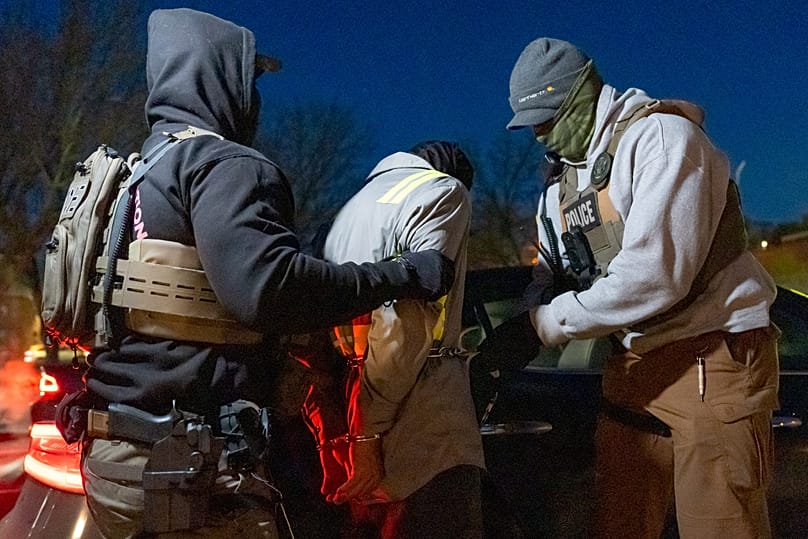
Valuev said deportation requires "a green light" from the Russian authorities and that deportation lists were submitted in advance to the Russian consulate. However, he does not believe the two sides negotiated to prevent mass detentions on arrival.
"I think this is not in the competence of the American authorities. What the American authorities could really do is to give deportable refugees the opportunity to buy tickets to third countries on connecting flights. Moreover, there are such willing persons," he said.
"We do not see any special dynamics in the communication between the American authorities and the Russian consulate, except that there was information - we heard from refugees in detention centres - that employees of the Russian consulate visited some immigration prisons personally," Valuev said.
"I hope that Russian agents will be exchanged and not just deported. There are still about a dozen American citizens sitting in Russian prisons, by the way," he added, noting that Moscow has stepped up covert operations in Mexico according to The New York Times.
Future plans
Egor said his wife plans to leave Russia for a third country in the near future. "She won't be able to return to the States - the ban is for 10 years," he said.
"You can appeal, but I've already spent so much money on lawyers that the whole cushion has already dried up."
His court hearing, scheduled for 19 November, has been postponed until 2027. He will try to "self-deport" by requesting ICE to release him so he can buy tickets to leave.
"Beyond that we don't know where to go. I don't really know what the next step is," Egor said.
US President Donald Trump's administration is conducting mass deportation campaigns as part of expanded immigration enforcement. As of late August, around 200,000 people had been deported from the US during Trump's second term.
The Biden administration quietly resumed deportations to Russia in March 2023 after pausing them in 2022 due to the humanitarian crisis in Ukraine.
US Customs and Border Protection reported around 26,580 Russians tried to cross the southern border since October 2022, compared to 467 in fiscal year 2020.
Extradition complication
A separate case has emerged where Yana Leonova, 33, a Belarusian citizen extradited from France to face charges of smuggling US aviation equipment to Russia, now faces deportation before her trial.
Federal prosecutors spent more than a year securing her extradition, but Immigration and Customs Enforcement issued a detention order for her removal shortly after she arrived in November.
US Magistrate Judge Zia M Faruqui called the situation "Kafkaesque" in a hearing on Monday. In a written order, he said: "It is both preposterous and offensive for the government to bring someone into the United States against their will and then turn around and seek ICE detention because that person is here 'illegally'."
"The government needs to decide what its priorities are: ginning up deportation stats or prosecuting alleged criminals," Faruqui wrote.
Neither Belarus nor Russia has extradition agreements with the US, making it virtually impossible to return Leonova if she is deported.
Prosecutors have requested that the US Department of Homeland Security grant her temporary legal authorisation to remain in the US while facing charges.
"I haven't been in this predicament before, your honour," one prosecutor said at Monday's hearing, according to The Washington Post.
"Me, either," Faruqui responded.