





























The Troodos region is home to 10 UNESCO-listed churches, which draw religious tourists from across the globe.
Religion is a driving force of tourism in Cyprus. As one of the first places Christianity spread outside of Judea, the island has a long history with the Gospel.
Every year, thousands of pilgrims, both Orthodox Christians and other denominations, come to the island to visit its churches and monasteries - 10 of which, all in the Troodos area, have been designated as UNESCO World Heritage Sites since 1985.
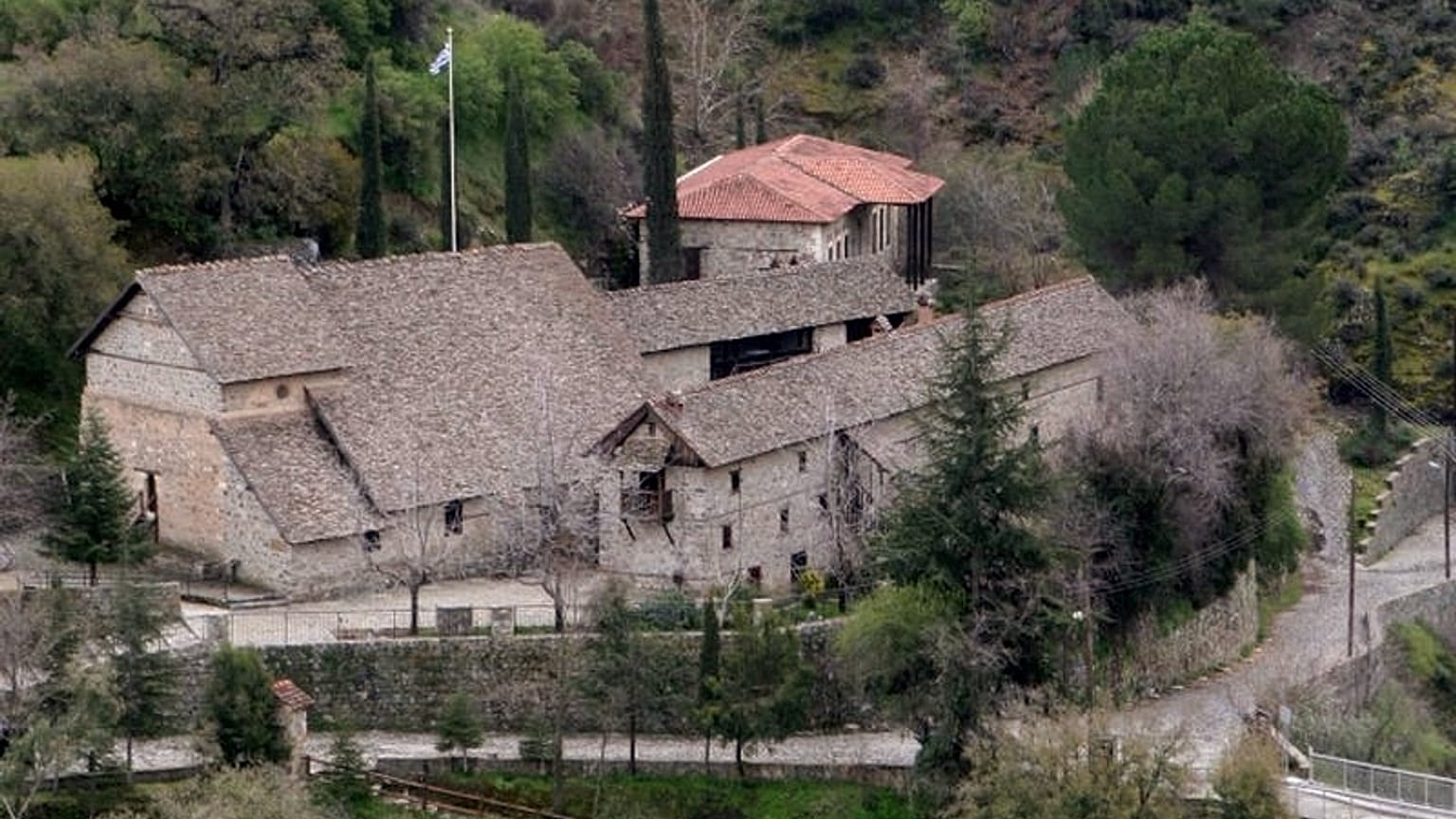
One of the oldest is the monastery of St John the Lampadistis, just outside the village of Kalopanagiotis in the Nicosia district.
Perched on a hillside on the eastern bank of the river Setracho, in the valley of Marathasa, the complex is now home to three churches - Agios Ioannis Lampadistis, Agios Heraclidios and a Latin chapel.
United under a single wooden roof, this complex was originally a monastery, and has undergone extensive reconstruction and restoration at different times.
Three churches under a single wooden roof
"The monastery of St John Lampadistis is one of the most important places in Cyprus and is a place full of grace, history and culture," Romanian-born Father Theodore Ivana, parish priest of the Kalopanayiotis community and guardian of the monastery, tells Euronews.
"The first church, as we enter, is dedicated to a 1st century Cypriot saint, Agios Heraklidios. He was a guide to the Apostles Paul, Barnabas and Mark in 45 AD and was baptised in the same year by the Apostles in the river Shetrachos, which runs through the village," he explains.
Built at the start of the 11th century, the church is a Byzantine basilica with a dome, featuring frescoes preserved from the 12th to the 16th centuries.
"Also in the first church we have a [unique] iconostasis representing the ancient order of the Church before Iconoclasm. This is the oldest one that survives in Cyprus and dates back to the late 13th and early 14th century," adds Father Theodore.
The middle church is dedicated to the local St John Lampadistis, who lived towards the end of the 11th century. The chapel was added towards the end of the 12th century.
"Unfortunately, no frescoes survive here, because according to some reports, in the early 18th century the church was burnt down and the existing frescoes were probably destroyed at that time," says Father Theodore.
The third church in the complex, the Chapel of the Blessed Hymn, also known as the Latin Chapel, was added towards the end of the 15th century, during Cyprus' early Venetian period.
"Here we have very fine frescoes from the early 16th century. We have a different style, a different Italian-Byzantine mentality with Renaissance influences," explains Father Theodore.
Cyprus' churches draw visitors from around the world
Full of grace, history and culture, the monastery of St John the Lampadistis is one of the most important places in Cyprus. The site houses holy relics, including the Holy Kara of St John Lampadistis, while the wall between the second and third churches has the saint's tomb built into it.
"We don't know exactly when the monastery was built, probably in the years of the Ottoman occupation. But we do know that the last monk passed away towards the end of the 19th century," says Father Theodore.
No longer home to an active monastery, the site now draws pilgrims paying homage to the tomb of the Saint and the holy relics, as well as culture-seekers drawn by its UNESCO status.
"In this particular monastery we have visitors not only from Cyprus but pilgrims from all Orthodox countries," says Father Theodore. "We have many visitors who come from all over the world, from Japan to Chile."
Visits by foreign pilgrims as early as the 16th century
The monastery of St John Lampadistis was an attraction for foreigners as early as the 16th and 17th centuries, as is shown by the inscriptions on the walls left by dozens of pilgrims from Asia Minor.
"These walls functioned somewhat like a guestbook we could comment on. Thanks to this we have information about the origins of the people who came here at that time," Father Theodore says.
"We have information, for example, about a large group for that time: 29 people who were from Asia Minor, men, women and children. Imagine we're talking about the 1700s and 1800s, it was the trip of a lifetime and they had to arrange everything – a house to stay in, they had to save up to have money with them for five to eight months."
These were mostly Turkish-speaking crypto-Christians, the so-called 'Karamanlides', who tried to keep their faith alive by speaking Turkish but writing in Greek. These people, as Father Theodore explains, had made it their life's mission to make this journey to the heart of Cyprus, which in some cases was the last one for some who never reached their destination or died on the way back.
The monastery of St John Lampadistis also bears the seal of Vasil Grigorovich-Barsky, a scholarly traveller of the time who spoke eight languages.
"We have valuable information from Vasil Barsky not only about the monastery here but about all the churches and monasteries of Cyprus. Because in the period of the Turkish occupation, the Church unfortunately did not manage to keep much information," Father Theodore says.
Finally, in the Latin church, there is a miraculous icon of the Virgin Mary which is considered a copy of the Virgin of Cyclades, where people come and leave vows, pray and ask for help to overcome their problems.
Religious tourism has long been a key driver of Cyprus tourism but in recent years it has flourished even further, thanks to the close cooperation between the State Ministry of Tourism and the Holy Archdiocese.