















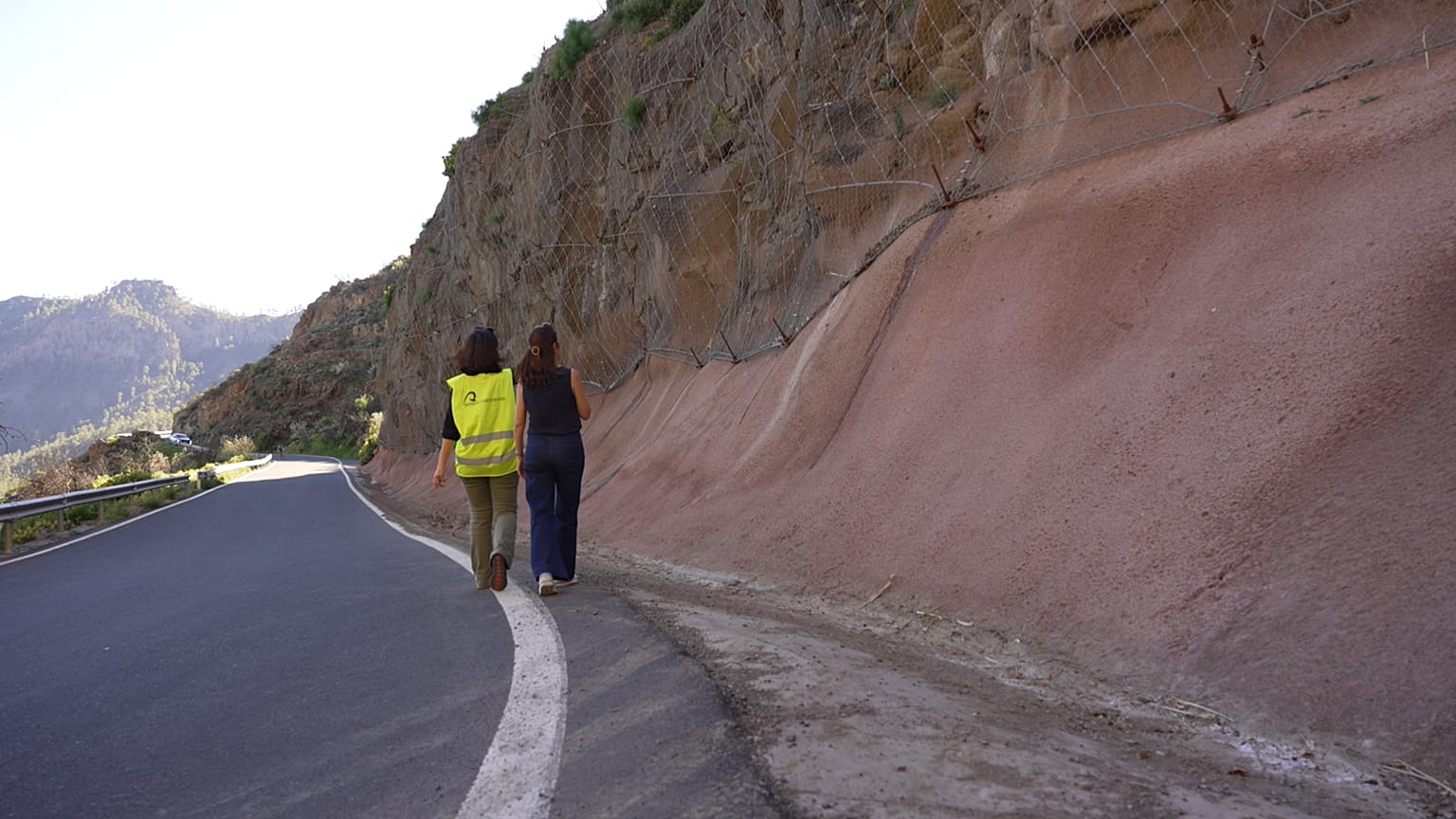














In Gran Canaria, the risk of rockfalls and road closures is highest during the weeks of the wet season. But this is not the only factor that promotes them, as explained by researcher Isabel Montoya Montes.
“In Gran Canaria, what happens to us? We get a lot of rain very often in a very short time and this is usually a trigger for those dangers or risks immediately, or in a period of time after those rains, three or four days," says Benito García Henríquez, a professor of geology and biology, after a class on the project AGEO with his students at the institute IES Faro de Maspalomas. This is one of the facts that has the biggest impact on the students.
 ADVERTISEMENT
ADVERTISEMENT
ADVERTISEMENT
On this island, landslides and road closures are frequent, "Most of the time they are simply material damage. But there have also been cases of damage to infrastructure and the population," says Isabel Montoya Montes, a researcher at the IGME and a university professor who participated in AGEO. "You have a series of factors that are conditioning factors: the structure of that material, the slope of the terrain. Here in the Canary Islands, we have very, very steep topography that causes the rocks to fall by gravity. Then, in addition, the vegetation that holds the terrain; but as the size of those roots increases, it also causes the size of the cracks to grow, and then we have a series of triggering factors. And that's where climate, precipitation, seismic events and the anthropic factor come in: constructions or certain uses can cause risk situations."
They both agree that participatory science is a key to preventing geological risks. “We can protect ourselves by knowing. This is what AGEO has allowed us to do, to bring that knowledge closer to citizens and for them to be able to generate knowledge in turn, which seems a bit difficult. Gravitational movements, rain, precipitation, accumulation, the kind of concepts that in a classroom are just words, they are able to see them in reality. That's what AGEO has allowed us to do, to bring them directly to the element that produces danger and risk, and for them to be able to identify and apply it,” adds Benito García Henríquez.