





























A grain being developed in the US could offer farmers a way to improve soil health while making crops more resilient to drought and heavy rainfall.
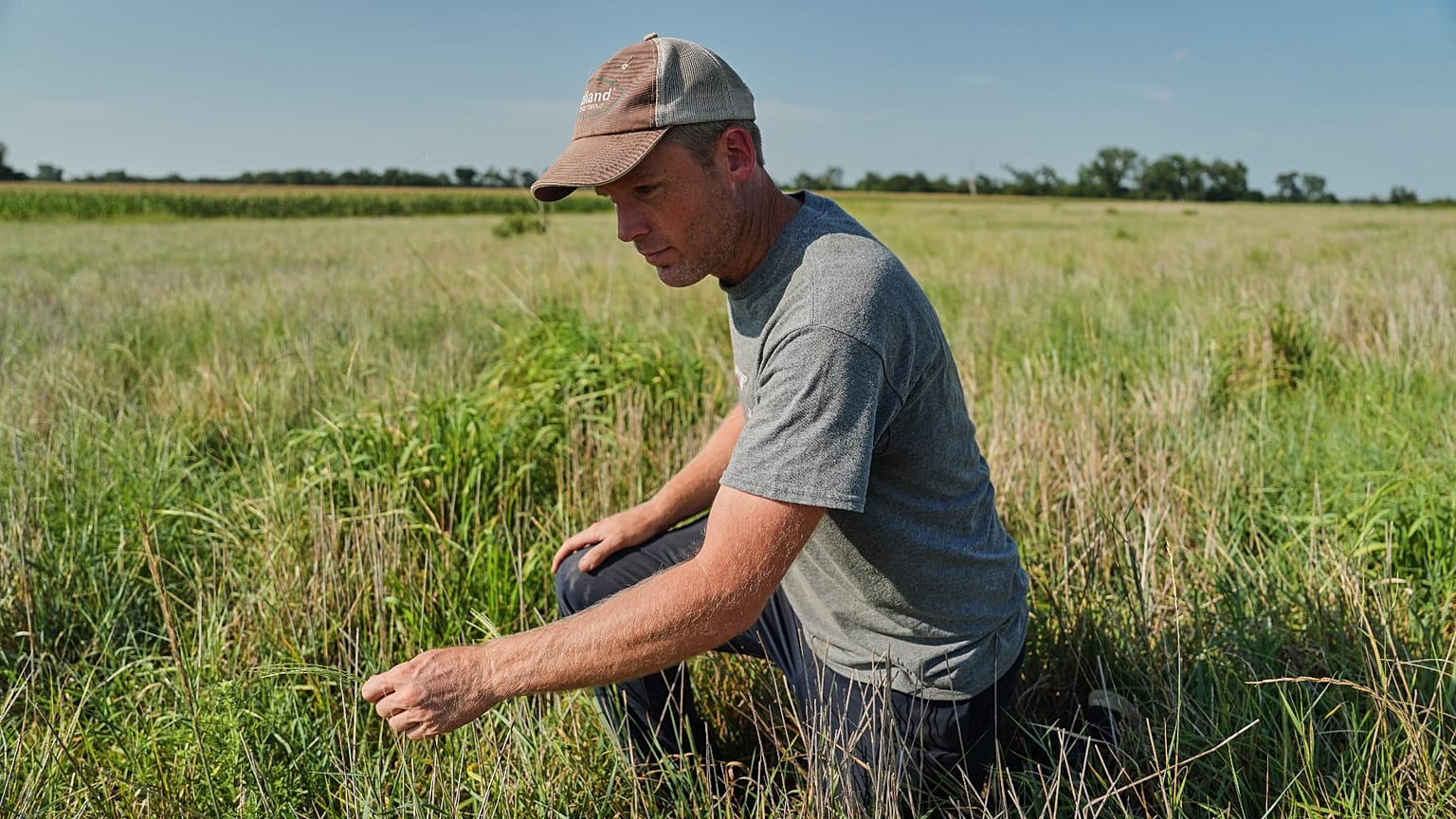
Bryce Black kneels in a wheat field battered by intense drought. He holds two strands, remarking on how small the seed head is compared with what's normal.
 ADVERTISEMENT
ADVERTISEMENT
ADVERTISEMENT
After a late October rain last year, the fourth-generation farmer was optimistic about his 1,800 acres (728 hectares) of winter wheat. But a dry winter and spring brought extreme drought when the wheat needed moisture to establish itself. He ended up harvesting about 1,500 acres (607 hectares), but the yield was the lowest he's had since taking over his family's farm in 2017.
“It was just a grit your teeth and get through it type of deal,” says Black, who also grows corn, soybeans and milo on his family’s 4,500-acre (1,821 hectare) farm. “It is disheartening, you know? And it’s kind of hard to know what to do.”
When these weather events occur, farmers often look for new ways to protect their crops and their bottom line.
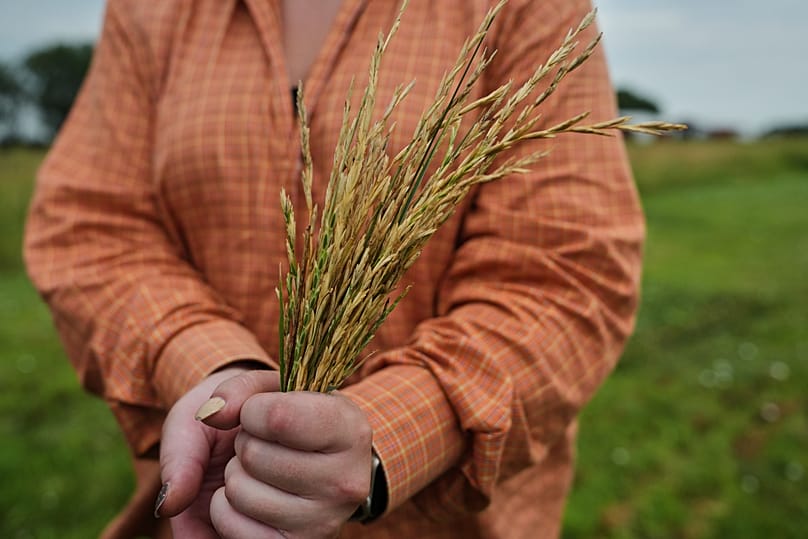
What is a perennial grain?
Some farmers are putting perennial grains in rotation to build resilience against extreme weather like drought and intense rainfall. Researchers are working to develop perennial versions of common annual grains like wheat, sorghum and rice, but the work is slow. And widespread adoption by farmers is challenging because perennial crops don’t yield as much, harvesting can be difficult and the market is still developing.
Despite the challenges, Black is intrigued. “I’m in survival mode,” he says. “If you can plant something and then you don’t have to go back for four or five years … that would save so much money, so much labour, everything. That’s what makes it enticing.”
Five years ago, David Mueller planted a 12-acre (5 hectare) field of Kernza, a perennial grain similar to native grasses found in parts of Europe and western Asia.
Perennial grains don’t require yearly planting, harvesting and replanting. Instead, they are planted once every few years.
Researchers say their root systems, which can reach several feet down, can access water deeper in the ground. That helps them better withstand short-term drought. And when heavy rain hits, the larger root structures can absorb excess water that would otherwise run off and erode the soil. Those deeper roots also sequester more carbon, reducing pollution in the atmosphere.
Inside the institute developing perennial crops
Kernza is one of several perennial grains under development at The Land Institute in Salina, Kansas, about an hour’s drive north of Mueller’s farm. The institute, which formally began domesticating Kernza in 2001, works with researchers and farmers around the world to develop perennial versions of wheat, rice, sorghum and other grain and oil seeds.
Some farmers in Southeast Asia and parts of Africa have started planting and harvesting perennial rice in their fields. Kernza, though, is furthest along and was first harvested on a farm in 2010.
In the US last year, Kernza was cultivated on 3,511 acres (1,421 hectares), compared with 37.2 million acres (15.1 million hectares) of winter, spring and Durum wheat harvested or planted in 2025-26.
Mueller's Kernza field is one of almost 100 acres (40 hectares) he has planted since 2018. He's used the crop to rebuild soil with drainage issues or to reestablish organic matter on his family's farm in Halstead, Kansas, where they also farm about 600 acres (243 hectares) each of corn and soybeans.
He also said Kernza uses about a third of the fertiliser that wheat needs, and because it's planted once every few years, he doesn't have to run gas-burning farm equipment as often.
“Not only are we able to utilise those acres profitably, but then we also build up that soil and work on some benefits to make it hopefully profitable to raise other crops on those fields in the future,” Mueller said.
Soil degradation is a serious threat
A 2024 United Nations report suggests that by 2050, soil degradation could cause more than $20 trillion in losses to the global economy. Farming perennials is less disruptive to that carbon-capturing soil.
Soil serves as a reservoir, capturing planet-warming carbon dioxide from the atmosphere that plays a role in climate change, experts say. Annual cultivation - the plow, plant, harvest and repeat cycle - strains soil formation, which takes thousands of years and rapidly degrades the farmland. Perennial roots can also bring that carbon deeper into soils, where it is less likely to be disturbed, says Laura van der Pol, The Land Institute's lead soil ecologist.
And soil that has more carbon in it tends to be better for plants.
“Incorporating perennials into our agriculture seems like really the only option to have soil for generations if we want to continue to grow food,” van der Pol said. “It’s hard to imagine getting to a place where we could have soil and abundant food without a perennial option.”
Lower yields and harvesting can be challenging
Pilot programs involving perennial grains are in the works around the world, testing how to grow them in different regions, climates and soils, but the research is early and slow-moving.
Chief among the challenges is the crops' grain yield, says Lee DeHaan, who leads the Institute’s Kernza domestication program. Kernza farmers are getting yields of about 20 to 40 per cent of what they might get from a wheat crop in the area. That's because a perennial crop has to use energy not only to grow seeds for grain, but also to grow roots to penetrate the soil so it can survive for more than a year. That contrasts with annual crops, which are engineered to put as much energy as possible into making as much seed as they can in one growing season.
Researchers at Cornell University also have found that establishing a Kernza field can be difficult as it contends with weeds in its first year. Finding the right seeding rate to maximise yield is also still being studied, says Matthew Ryan, a sustainable cropping professor at Cornell University.
Mueller says new varieties of Kernza are yielding more than previous ones, but the yield can decline as the crop ages. Yields on perennial rice are similar to annual ones, officials at The Land Institute say.
Harvesting Kernza specifically can be challenging. The grain is smaller than wheat, for example, and farmers and researchers are still finding the best ways to adapt farm equipment so the kernel isn't damaged during harvest.
Still, Ryan says farmers who experience crop loss due to drought or major flooding may be prompted to think about ways to build more resilience into their operations.
“I think farmers, more than other people, realise that the climate is changing,” he says. “They prompt people to think, and I feel like they are driving farmers to practice this.”