















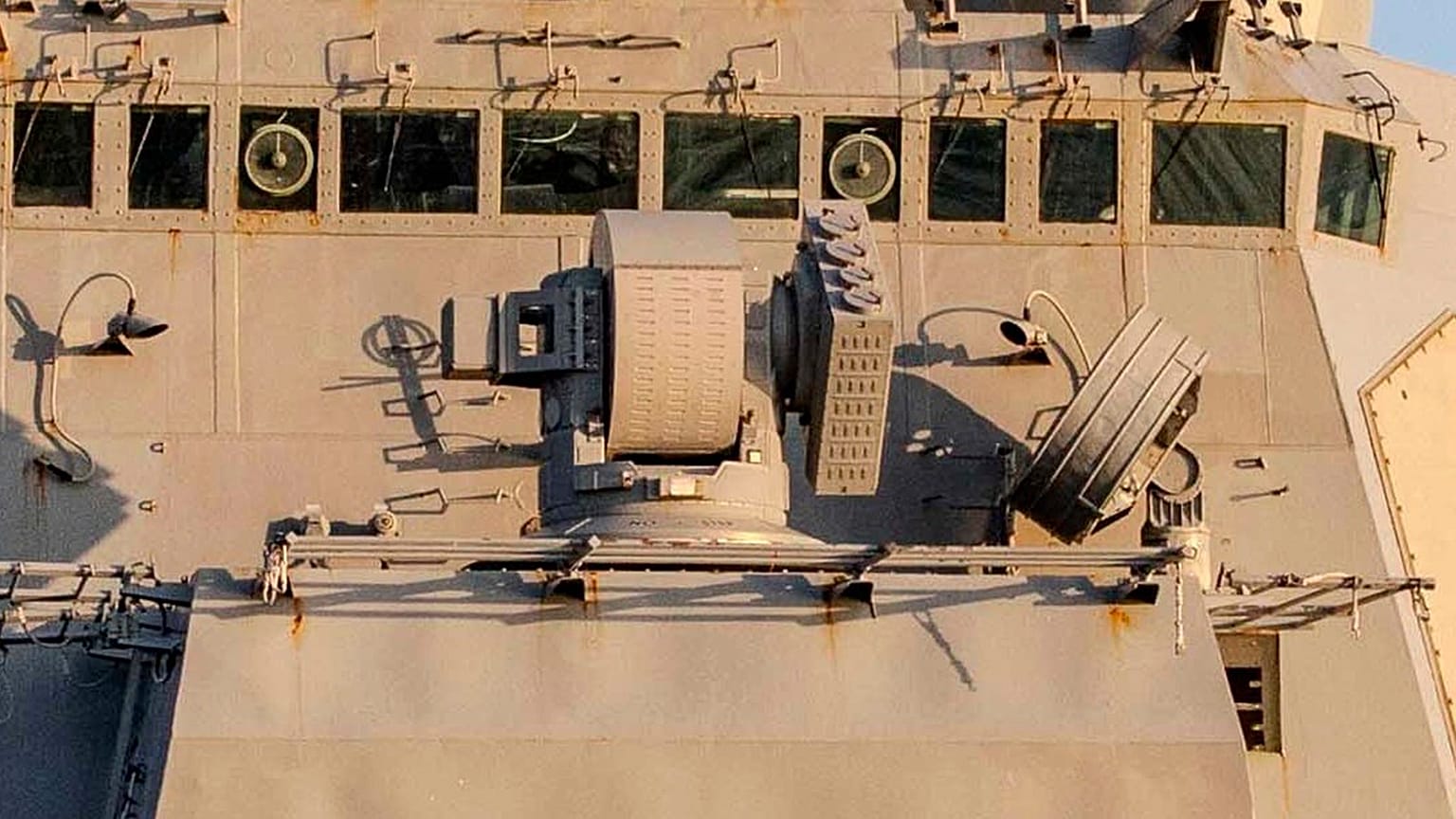













The High Energy Laser with Integrated Optical-dazzler and Surveillance, deployed on a US naval ship, downed several drones last week. Here’s what you need to know about the game-changing technology.
The Iran war, now in its third week, is already proving costly: on Friday, a Trump administration official said the conflict had so far cost $12 billion (€10.4bn), or just under $1 billion a day.
 ADVERTISEMENT
ADVERTISEMENT
ADVERTISEMENT
Iran has reacted to the US-Israeli intervention by launching its own bombardment campaign against its regional neighbours, using cheap drones like the Tehran-designed and made Shahed 136, costing $20,000-50,000 each (€17,400-€43,500).
Meanwhile, the US has been shooting them down with Patriot interceptor missiles, which cost $3 million to $4 million (€2.6m-€3.5m), and THAAD interceptors, which cost $10 million (€8.7m).
Even though Washington’s military budget of $900 billion (€783.8bn) blows Iran’s out of the water, with defence spending in 2025 at roughly $23 billion (€21bn), this is clearly not a cost-effective way for the US to wage war.
However, the US is now deploying technologies that will turn the tables in their favour by bringing the cost of shooting down a drone down from several million to just a few cents: laser weapons.
Last week, it was reported that a US Navy ship, the USS Preble, an Arleigh Burke-class destroyer, downed several Iranian drones using a new laser weapon known as HELIOS.
Dazzling drones on the cheap
HELIOS, also known as the High Energy Laser with Integrated Optical-dazzler and Surveillance, is a 60-kilowatt high-energy laser weapon designed to intercept combat drones, aircraft and missiles. Helios is also the Greek name for the god of the sun.
Designed by US defence giant Lockheed Martin, the weapon system is now being integrated into naval ships and amphibious craft as a defence against drone and missile attacks.
So far, the USS Preble is the only ship equipped with the system and is currently deployed off the coast of Iran.
The US defence contractor won the contract to develop the weapon in January 2018, with development taking place until relatively recently including a successful test in February 2026.
HELIOS can strike targets with a low-energy-intensity to “dazzle”, which ultimately means to confuse the guidance system and force the craft or missile to crash, or a high-energy-intensity to “kill” the target by overheating it.
Lockheed Martin also claims the system is easily scalable, with the current architecture already capable of reaching 120 kilowatts.
The company describes it as “more than a laser, HELIOS is an integrated weapon system”.
As the name suggests, HELIOS can also be used for surveillance and reconnaissance thanks to its thermal imaging, night vision and ultra-high-definition vision, enabling it to identify, track and assess targets up to 8 kilometres away.
HELIOS does have weaknesses: its effectiveness is limited by rain, smoke, dust, clouds, fog and other atmospheric interference which scatter the beam.
The weapon also requires a significant amount of energy to fire and has a limited range.