



























Iran’s war enters a third week as uncertainty over Mojtaba Khamenei's condition and whereabouts, rising tensions over possible unrest around Nowruz and Chaharshanbe Suri and oil market turmoil deepen the crisis.
The Iran war is entering its third week with no clear end in sight, as military strikes intersect with deepening uncertainty over Tehran's leadership and looming cultural celebrations that could spark unrest.
 ADVERTISEMENT
ADVERTISEMENT
ADVERTISEMENT
Conflicting reports continue to circulate about the condition of Mojtaba Khamenei, who was named supreme leader after his father, Ayatollah Ali Khamenei, was killed in the opening US-Israeli strikes on 28 February.
Some sources claim his injuries may prevent him from recording the traditional Nowruz message delivered by Iran's supreme leader each year. Unverified rumours suggest he may have been transferred to Moscow for medical treatment.
US President Donald Trump said Sunday he had heard Mojtaba Khamenei "is not alive", though he offered no evidence. US Defence Secretary Pete Hegseth said Thursday the new supreme leader was wounded and "likely disfigured".
The matter of the new ayatollah's absence while his country is at war is now reaching a hard deadline.
If no Nowruz message appears from Iran's supreme leader on the first day of the Persian New Year — which falls on Friday — it would signal significant shifts within Tehran's power structure.
Pahlavi intervenes as Israel targets security apparatus
Exiled Crown Prince Reza Pahlavi called on Iranians to widely celebrate the fire dance festival, Chaharshanbe Suri, observed on the last days of the year, and to turn it into a symbol of national solidarity.
He urged the US and Israel to support the Iranian people if the Tehran regime attempts to suppress public gatherings.
In a recent interview, Pahlavi said he "might celebrate" Nowruz in Tehran this year, a comment suggesting he may be directly seeking a political role in Iran's future.
Trump has previously appeared to dismiss that possibility in his statements.
Meanwhile, Israeli Prime Minister Benjamin Netanyahu said Thursday that weakening the Islamic Republic's ability to repress domestic dissent is a core goal of the military intervention, alongside targeting nuclear and ballistic missile programmes.
As Euronews previously reported, Israel has employed new tactics to target Basij militia checkpoints across Tehran and other cities, using social media videos posted by Iranians to geolocate and strike its patrols.
The Basij — the Islamic Revolutionary Guard Corps (IRGC) paramilitary wing used to violently suppress protests — has been a primary focus of Israeli drone strikes.
The IRGC-linked Fars news agency published a video showing Basij members standing alongside their children.
Reports suggest volunteers are preparing to join security checkpoints with their children present — a practice that would constitute using minors as human shields against potential Israeli strikes.
Regional escalation and energy markets
Additional aircraft and military forces have been deployed to the region as Trump called on other countries to help secure the Strait of Hormuz, through which roughly one-fifth of the world's oil passes.
Trump demanded Sunday that seven countries join an international coalition to escort oil vessels through the strait, sending warships and other military assets as global crude prices continue to rise.
The crisis has already caused sharp fluctuations in oil prices, with reports that Washington decided on temporary flexibility on Russian oil supplies to prevent market shocks — a move that drew criticism from European allies, as Russian President Vladimir Putin may benefit from the decision.
Scenarios involving US attempts to control Iranian oil infrastructure have circulated more frequently. Kharg Island handles roughly 90% of Iran's oil exports. Control of Abu Musa island would significantly affect maritime traffic in the Strait of Hormuz.
Reports about the possible deployment of US Marines in ground operations have also emerged.
Tehran's asymmetric response
Following Ali Khamenei's death, Tehran's strategy appears to have shifted towards asymmetric warfare, and analysts warn that sabotage-based tactics could increasingly be added to the IRGC's operational toolkit.
Iran continues launching missile and drone strikes on Israel and neighbouring Gulf states. The regime has effectively closed the Strait of Hormuz since the war began.
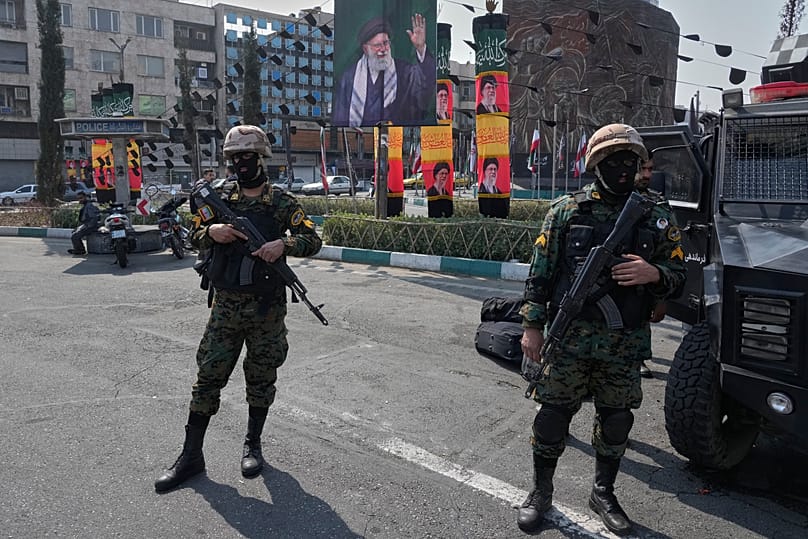
Forces loyal to the regime — including the IRGC and Basij network — maintain a widespread presence across the country, although Israeli strikes have degraded parts of the security infrastructure.
Trump said aboard Air Force One on Sunday that Iran is eager to negotiate but not yet prepared to reach a deal to end the war.
"They are very eager to negotiate, as they should be. We are talking to them, but I don't believe they are ready yet," he said.
Iranian officials confirmed multiple contacts by regional leaders attempting to mediate, though Tehran said it has rejected such proposals.
With Eid al-Fitr approaching and Ramadan's end likely coinciding with Nowruz, diplomatic efforts may intensify as Muslim-majority countries use the occasion to push for at least a temporary ceasefire.
Trump said he "can fully understand" why Iranian citizens have not risen up to overthrow the regime, noting authorities threatened to shoot protesters.
"The protesters have no guns. So I can fully understand why they're not doing it," he said.
Deteriorating conditions inside Iran
Conditions are deteriorating rapidly for ordinary citizens. After Israeli strikes hit fuel storage facilities, local reports described long queues at petrol stations and fuel shortages in several cities.
The internet shutdown has now lasted more than three weeks, severely affecting livelihoods. Many have lost jobs or income sources. Others are reluctant to leave their homes because of security concerns and fear of missile strikes.
Memories of the January crackdown — when Iranian security forces killed thousands of protesters during widespread opposition demonstrations — remain fresh.
Analysts see several potential outcomes.
A prolonged war of attrition remains the most likely short-term scenario. The conflict would continue primarily through air, missile and cyber strikes without a large-scale ground war.
Attacks on Iranian military infrastructure would continue alongside Iranian retaliatory strikes and intensifying economic pressure.
Escalation in the Strait of Hormuz could lead to wider naval confrontation, severe restrictions on Iranian oil exports, and direct attacks on energy infrastructure — with significant consequences for global markets.
If Chaharshanbe Suri or Nowruz gatherings evolve into protests, external war could coincide with an internal political crisis.
Pressure on security forces would rise and opposition figures could attempt larger political roles. Such developments would depend heavily on the regime's security apparatus strength, especially if authorities impose a complete crackdown.
A sudden political decision could also change the trajectory — through ceasefire, renewed negotiations, or sudden military escalation. Trump's record of unpredictable decision-making has led analysts to consider this scenario seriously.
Israeli and US leaders have acknowledged that the war cannot continue indefinitely.
Much may depend on how quickly Tehran's missile and drone stockpiles decline, as US and Israeli assessments say these are already diminishing, as many launch systems have been destroyed.
Some estimates suggest fighting could last at least another three to four weeks, even at current levels of military pressure.