




























French President Emmanuel Macron also said he had "no confirmation" Iran was laying sea mines in the Strait of Hormuz.
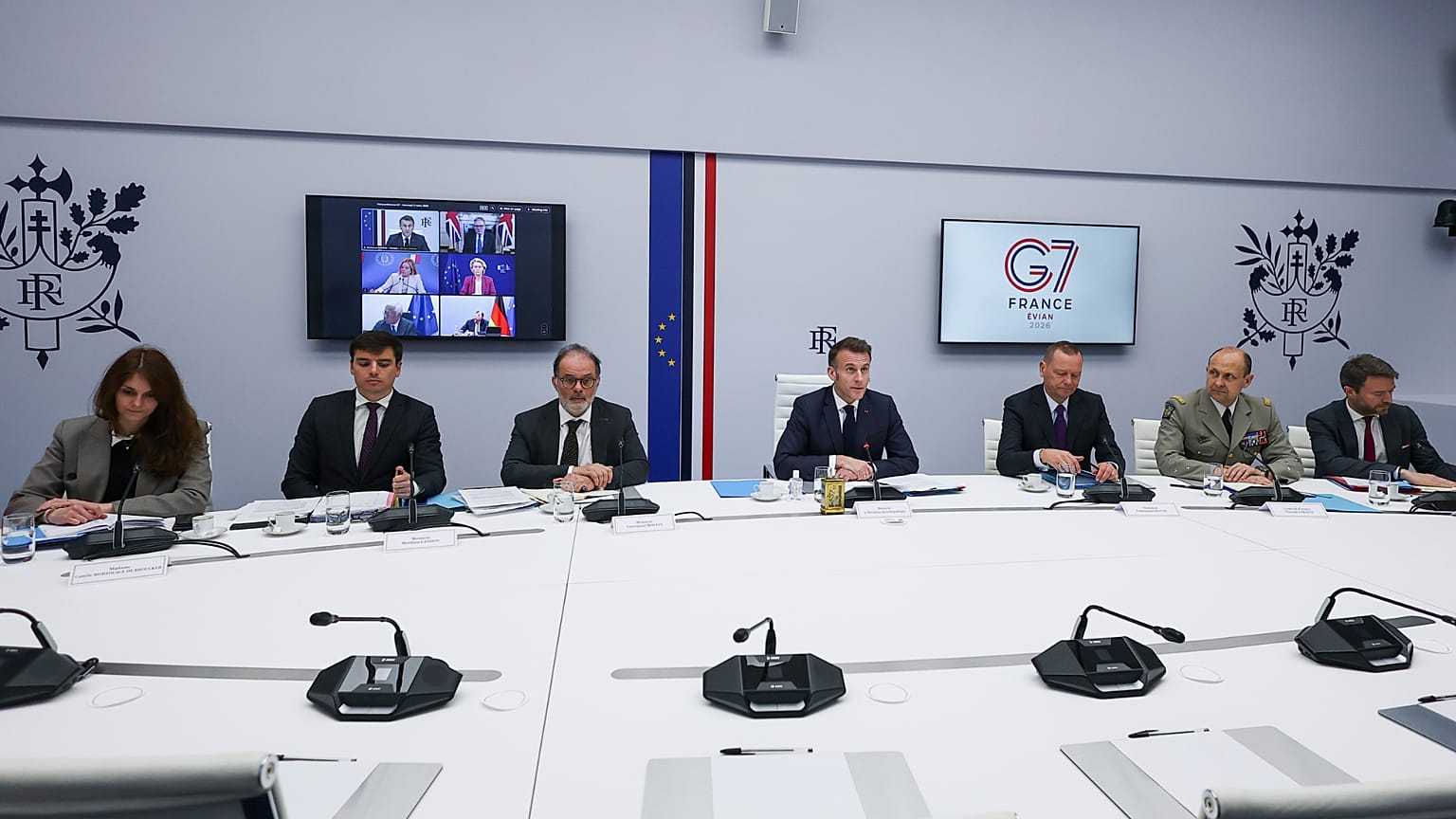
Speaking after a meeting of G7 leaders, French President Emmanuel Macron said the current energy crisis stemming from the Iran war should not lead to a change in sanctions toward Moscow.
 ADVERTISEMENT
ADVERTISEMENT
ADVERTISEMENT
The disruption in the Strait of Hormuz and soaring oil prices “in no way justify lifting the sanctions” imposed on Russia, Macron insisted.
On the military front, Macron also warned against underestimating Iran’s capabilities despite recent US and Israeli strikes on Iranian targets.
“There has already been considerable damage inflicted on Iran’s ballistic military capabilities today (but it) continues to attack several countries in the region and therefore its capabilities have not been reduced to zero,” he said.
Macron also said it was up to US President Donald Trump to clarify the next steps in the conflict, calling on Washington to “clarify both its final objectives and the pace it wants to give to the operations.”
The Group of Seven (G7) brings together the United States, Canada, Japan, Germany, France, the United Kingdom and Italy.
France currently holds the rotating presidency of the group. Macron convened the talks to coordinate a response to the crisis and rising energy prices.
Strait of Hormuz at the centre of tensions
The situation in the Strait of Hormuz, through which roughly a fifth of the world’s oil supply normally passes, remains a major concern for energy markets and the shipping industry.
Macron said he had no confirmation that Iran had deployed naval mines in the area.
His comments came despire the US announcing that it had destroyed 16 Iranian vessels capable of laying mines near the strait.
Trump had warned that Iran would face “unprecedented military consequences” if it mined the waterway.
For Macron, however, conditions are not in place for maritime traffic to return to normal, with the Strait of Hormuz being “a theatre of war.”
Beyond oil markets, the tensions are also disrupting other key global commodities, including fertilisers, whose international supply chains are being affected — a development that could have direct consequences for farmers and global food production.
Amid the escalating crisis, Macron also called for “a ceasefire as soon as possible,” warning that a prolonged conflict would further worsen the global economic and security situation.
IEA releases 400 million barrels from global strategic reserves
Referring to the International Energy Agency's decision to release 400 million oil barrels from its global strategic reserves, Macron stated that France will contribute to the effort, but gradually.
The French president said Paris would release up to 14.5 million barrels of its own strategic reserves, adding that the move would be carried out in stages. He also insisted that France still holds a significant amount of reserves.
The measure aims to bring down international prices at a time when around 20% of global oil production capacity is believed to be disrupted or off the market due to rising tensions in the region.