



























Even if Moscow was never formally banned from the Mecca of contemporary art after its large-scale invasion of Ukraine in 2022 and was simply absent, this return - which coincides with a certain 'rehabilitation' of Russian sportsmen and women - is raising quite a few eyebrows.
The Venice Biennale's decision to allow Russia to take part in its prestigious international art exhibition for the first time since the full-scale invasion of Ukraine in 2022 has been widely denounced as an attempt to rehabilitate the aggressor state through art.
 ADVERTISEMENT
ADVERTISEMENT
ADVERTISEMENT
The government of Italian Prime Minister Giorgia Meloni said it opposed Moscow's presence at the event, while Lithuania's foreign minister described it as "abject".
On Friday, a cross-party group of MEPs published a letter to the Biennale organisers (source in French) condemning Russia's participation as "unacceptable".
"Such a choice risks legitimising a regime responsible for continuing violence and will inevitably damage the reputation and moral integrity of the Biennale itself", they wrote.
In the days following Russia's full-scale invasion of Ukraine in 2022, the Biennale - one of Italy's leading cultural institutions - had banned access to that year's edition to anyone linked to the Russian government, without banning participation from the entire country.
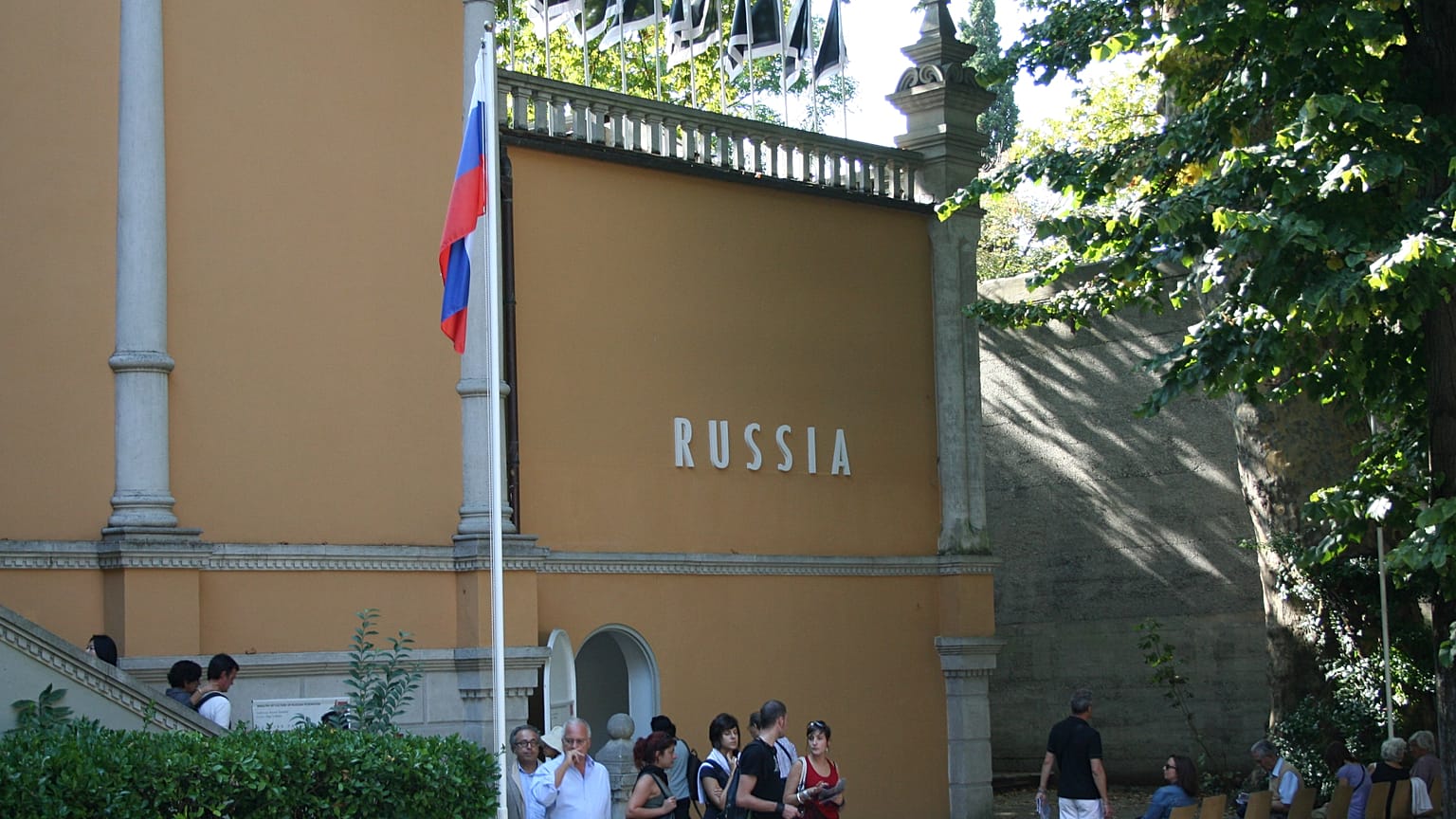
Since then, however, Russia has been conspicuous by its absence, even going so far as to lease its pavilion to Bolivia in 2024.
However, it does appear on the list of participating countries (source in French)for the 2026 exhibition, which will be held from 9 May to 22 November.
What we know about Russia's project
It is not known whether the Russian pavilion will be open for the entire duration of the event. The Russian project, atypical for a biennial, takes the form of a series of sound performances entitled "Tree rooted in the sky", devised by various artists.
At least 38 young musicians, poets and philosophers from different countries are taking part in the project.
The first of these performances is due to be presented during the press days from 5 to 8 May.
The organisers of the Russian project explain that the image evoked in the title, that of a tree rooted in the sky, was inspired by the French philosopher Simone Weil. "This paradox - being rooted in the sky - is at the heart of the project's tension: between the visible and the invisible, between what is considered to be the source of meaning and where that meaning manifests itself", they explain.
What the organiser have to say
"The Biennale, like the city of Venice, continues to be a place of dialogue, openness and artistic freedom, encouraging links between peoples and cultures, with the unshakeable hope of seeing an end to conflict and suffering", said the organisers in a statement released on Wednesday.
Biennale president Pietrangelo Buttafuoco, who will take up his post in March 2024, said he had invited people "from all areas of conflict to share their points of view."
"We believe that where there is art, there is dialogue", he (source in French)told the left-wing daily La Repubblica.
Artists from Russia, Ukraine and Belarus - a close ally of Moscow, which authorised the use of its territory during the invasion - will be present in Venice, along with Iranian, Israeli and American artists.
Buttafuoco has been criticised for his closeness to the far-right government of Meloni, who appointed him.
Rome, which has been a staunch supporter of Ukraine, criticised the decision to reintegrate Russia.
The Ministry of Culture issued a statement saying (source in French)that the decision had been taken "in complete independence by the Biennale Foundation, despite the opposition of the Italian government".
'Cultural whitewash' criticised from all sides
Unsurprisingly, the return was quickly taken up by the Kremlin's official discourse. Mikhail Shvydkoi, Russian President Vladimir Putin's special representative for international cultural cooperation, told the media (source in French)that Russia's participation was "further proof that Russian culture is not isolated and that attempts to silence it - undertaken over the last four years by Western political elites - have failed."
This is the first artistic project taking place in Russian national pavilion in Venice since 2021. The Biennale Foundation, which is organising the main project, does not control the national pavilions and has not banned Russia's participation. However, many now claim that without the management's agreement, Russian participation would have been impossible.
Ksenia Malykh, one of the curators of the Ukrainian pavilion at the Biennale, told Ukrainian public television channel Suspilne that Russia's return to major international art events came as no surprise to the Ukrainian cultural scene.
"Unfortunately, everyone who has been involved in international cultural projects over the past four years is not really surprised, because Russia has always found a way to be present, in one way or another, in major venues," she said.
Lithuania's Minister of Foreign Affairs, Kestutis Budrys, went further, writing on X that the decision to "roll out the red carpet for dark Russian cultural diplomacy is abject".
Opponents of the Kremlin in the arts community feel that the voices of protest should also be heard in Venice. "I think [Russia's return to the Venice Biennale] is an excellent opportunity to make a direct artistic statement against the current Russian government," says (source in French)Russian gallery owner Marat Guelman, now living in exile. "We could simply organise an open-air festival right in front of the Russian pavilion."
Nadejda Tolokonnikova, artist and member of Pussy Riot and the Platform of Russian Democratic Forces at PACE, has already announced a performance at the Biennale. Pussy Riot is going to the Biennale with an alternative and committed stance, so as not to be ashamed," she wrote on X. "We want to express our unconditional support for Pussy Riot. "We want to express our unconditional support for Ukraine, victims of Russian war crimes, Russian political prisoners and Ukrainian detainees."
Without indulging in conspiracy theories and acknowledging mere coincidence, critics note that Russia's return to Venice comes at a time when international sporting bodies are also beginning to reopen their doors to Russia, with athletes competing under the Russian flag at the Winter Paralympics taking place this month in Italy.