















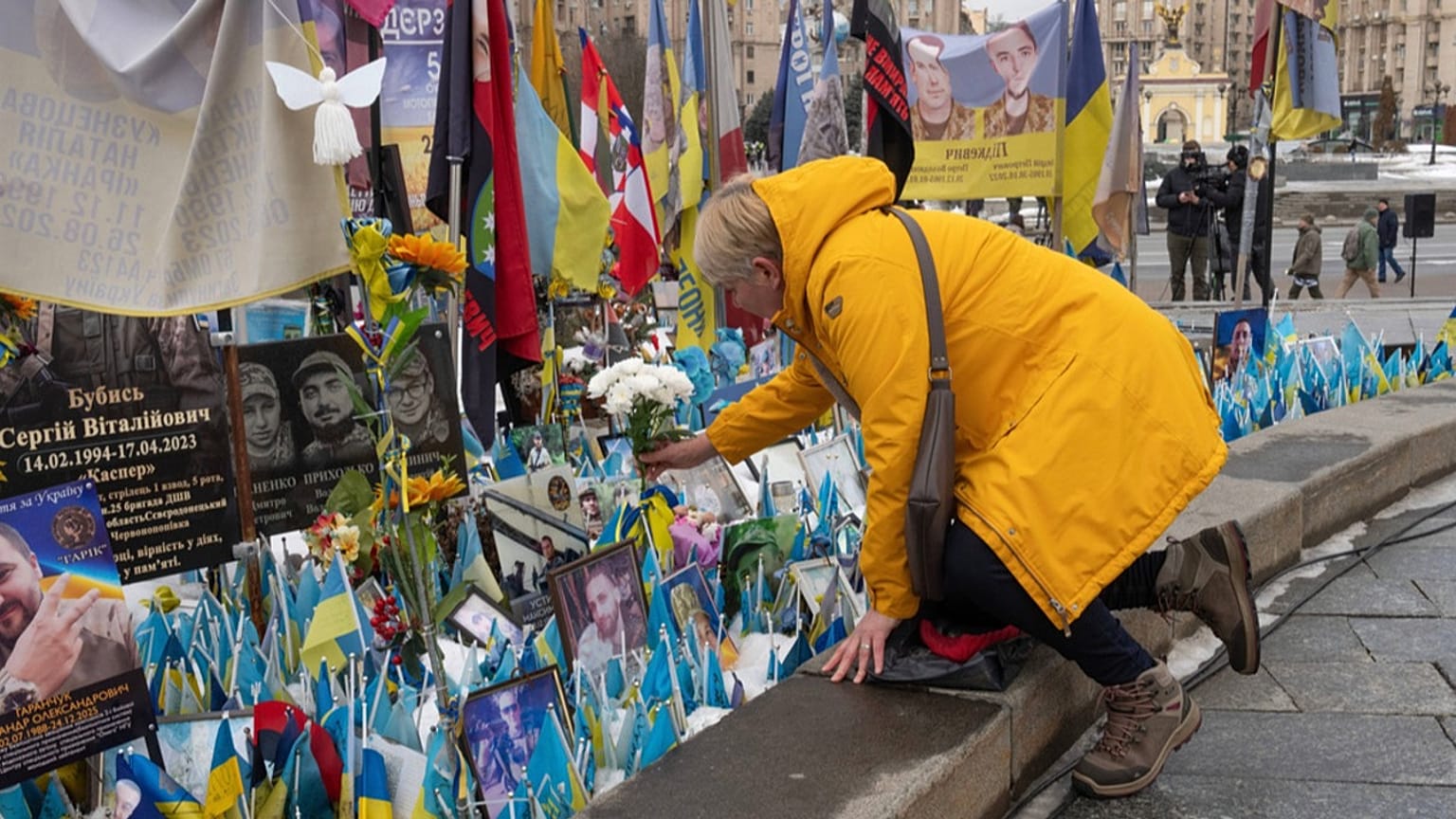













Four years since Russia launched its full-scale invasion of Ukraine, European leaders remain steadfast in support — but does the public feel the same?
European nations have reaffirmed their support for Ukraine and solidarity with its people on Tuesday, as the country marks the fourth anniversary of Russia's full-scale invasion.
 ADVERTISEMENT
ADVERTISEMENT
ADVERTISEMENT
Leaders from across the continent have emphasised that support for Kyiv will continue as long as needed until Russia's war ends.
On Tuesday, European Commission President Ursula von der Leyen and the heads of several EU nations including Denmark, Estonia and Norway visited the Ukrainian capital to mark the occasion.
The leaders met Ukrainian President Volodymyr Zelenskyy to show their support for the war effort and pay their respect to the country's fallen soldiers.
In a post on X, von der Leyen said her visit aims to "reaffirm that Europe stands unwaveringly with Ukraine, financially, militarily, and through this harsh winter".
French President Emmanuel Macron expressed his sympathy for the estimated 15,000 Ukrainian civilians who have been killed during the conflict.
"Four years of shattered lives — violence, rape, torture, war crimes, and terror. Four years, and thousands of Ukrainian children torn from their land and their families,” he wrote on X.
Macron pledged France's continued support for Ukraine, both bilaterally and through European institutions.
As the war enters its fifth year, where do public sentiments in Europe stand?
France
A recent survey conducted for La Tribune du Dimanche indicated that most of the French public still supports their country’s continued backing of Ukraine, although the enthusiasm appears to be waning compared with figures from four years ago.
According to the poll, 47% of respondents supported Paris continuing arms deliveries to Kyiv, while 39% opposed them. By contrast, a March 2022 study found overwhelming support for military assistance, with 65% in favour at that time.
Opinions on deploying troops to Ukraine for peacekeeping in the event of a ceasefire were more divided: 43% opposed the idea, while 40% supported it.
Meanwhile, 53% of French citizens backed Macron's proposal to resume direct negotiations with Russian President Vladimir Putin — a stance that European leaders have largely opposed over the past four years.
Spain
Spanish public opinion appears to be pessimistic about the future of Russia's war in Ukraine, according to official data collected by the Real Instituto Elcano in May 2025.
The survey found that the vast majority of Spaniards believe Ukraine will be unable to recover any of the territory currently occupied by Russia in the event of a peace deal.
Russia is estimated to have occupied around one-fifth of Ukrainian land, with parts of the eastern Donbas region accounting for the bulk of this area.
Only 39% of respondents believed that the war would end this year. Many also expressed doubts that war would not spread outside Ukraine, and voiced concerns about the possibility of it spilling over into other eastern European countries.
Despite this pessimism, about 75% of Spaniards believed that Europe should continue providing military support to Ukraine, while just over half supported sending Spanish troops to help guarantee security in a post-war Ukraine.
Portugal
Meanwhile, half of those surveyed in Portugal supported large-scale EU funding for Ukraine, with Lisbon actively participating in such initiatives.
Just over a third (35%) were in favour of additional state-to-state financial support for Kyiv, albeit on a smaller scale, reflecting the country's more modest economy
Only 11% opposed Lisbon's involvement in EU assistance to Ukraine.
Portuguese respondents were also largely supportive of military engagement: 61% backed the participation of Portuguese troops if NATO became involved in armed conflict or in post-war peacekeeping operations.
In terms of potential concessions, opinions were more divided. Just 15% of Portuguese people said they support a deal requiring Ukraine to accept territorial concessions, as previously proposed by US President Donald Trump.
A larger 43% said their position would depend on the specifics of the agreement and the guarantees offered. Meanwhile, 36% firmly rejected the idea of Ukraine ceding land to Russia in any peace agreement.
Germany
In Germany, a survey conducted in early February by Bild indicated that most people support increasing aid to Ukraine to help it fight back against Russia.
Slightly over half (52%) of respondents believed that the West should provide additional military and financial assistance if Russia continues to undermine peace efforts and avoids meaningful negotiations to end the war.
Most respondents favoured splitting aid equally between weapons and financial support, while 12% preferred increasing financial assistance alone, and another 12% supported boosting arms deliveries exclusively.
Around a third of people (35%) opposed continuing support for Ukraine.