















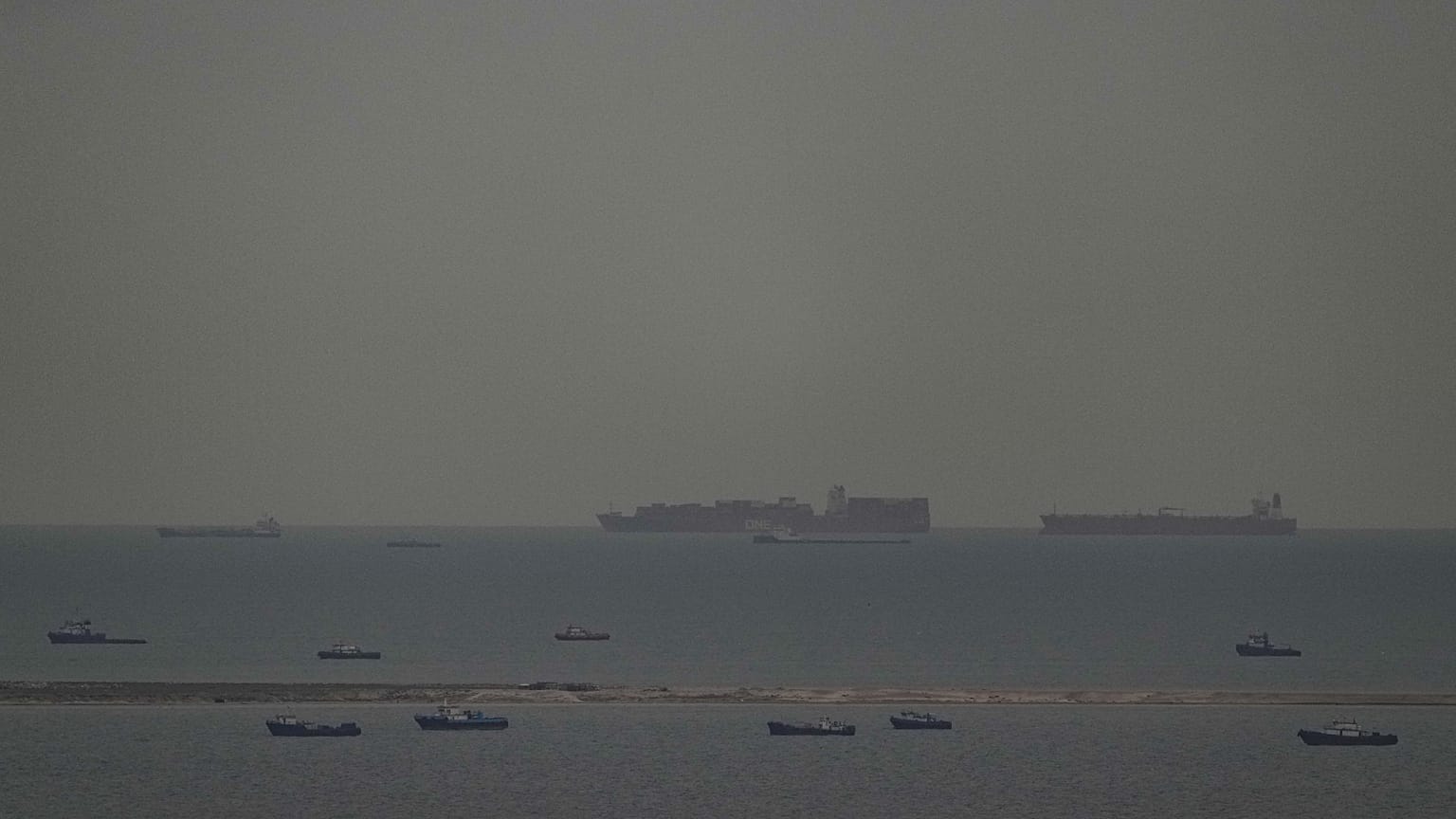













In a social media post, Trump said the surge of US warships and troops will remain around Iran “until such time as the real agreement reached is fully complied with.”
A two-week ceasefire deal to pause the war in Iran appeared to be shaky after Tehran closed the Strait of Hormuz again in response to Israeli attacks in Lebanon, and US President Donald Trump said American forces will remain "in place" until the Islamic Republic fully complies with the "real" ceasefire agreement.
 ADVERTISEMENT
ADVERTISEMENT
ADVERTISEMENT
The latest developments in the war come after the US and Iran both claimed victory after they reached a two-week ceasefire agreement on Tuesday night, but fresh violence in Lebanon threatened to scuttle the deal.
In an early Thursday morning social media post, Trump said the surge of US warships and troops will remain around Iran “until such time as the real agreement reached is fully complied with.”
“If for any reason it is not, which is highly unlikely, then the ‘Shootin’ Starts,’ bigger and better and stronger than anyone has ever seen before,” Trump wrote.
He also said Iran would not be able to build nuclear weapons and “the Strait of Hormuz will be open and safe."
Trump's comments appeared to be a way to pressure Tehran as uncertainty hangs over the deal.
Earlier on Wednesday, White House press secretary Karoline Leavitt said the closing of the Strait of Hormuz, reported in Iranian state media, was “completely unacceptable”. Leavitt repeated Trump’s “expectation and demand” that the channel be reopened.
Iran accuses US of breaking deal's conditions
Iranian media had announced the closure of the Strait of Hormuz again on Wednesday in what it said was a response to Israeli attacks against the Tehran-backed Hezbollah militants in Lebanon.
According to Iranian Foreign Minister Abbas Araghchi, an end to the war in Lebanon was part of the 10-point plan in the ceasefire deal agreed upon, a claim that Trump and Israeli Prime Minister Benjamin Netanyahu have rejected.
“The world sees the massacres in Lebanon,” Araghchi said in a post on X. “The ball is in the US court, and the world is watching whether it will act on its commitments.”
When the deal was announced, Pakistan’s Prime Minister Shehbaz Sharif, whose country served as a mediator, said in a social media post that it applied to "everywhere, including Lebanon and elsewhere.”

Much about the agreement appeared to be unclear late Wednesday as the sides presented vastly different visions of the terms, and remarks by senior Iranian regime officials signalled major disagreements.
In a social media post, Iranian parliament speaker Mohammad Bagher Ghalibaf said planned talks with the US were “unreasonable” because Washington broke three of Tehran’s 10 conditions for an end to the fighting.
Qalibaf objected to Israeli attacks on Hezbollah, cited an alleged drone incursion into Iranian airspace after the ceasefire took effect, and the US refusal to accept any Iranian enrichment capabilities in a final agreement.
Over 200 people killed in Lebanon strikes
Meanwhile, Lebanese authorities initially said Israeli strikes on Wednesday killed 182 people, the highest single-day death toll in the Israel-Hezbollah war, which has since been revised to 203.
In a statement, Lebanon's Prime Minister Nawaf Salam accused Israel of escalating at a moment when Lebanese officials were seeking to negotiate a solution and of hitting civilian areas in “utter disregard for the principles of international law and international humanitarian law — principles it has, in any case, never respected.”
The fleeting sense of relief among Lebanese after the ceasefire announcement turned into fear with what Israel’s military called its largest coordinated strike in the current war, saying it had hit more than 100 Hezbollah targets within 10 minutes in Beirut, southern Lebanon and the eastern Bekaa Valley.

Black smoke towered over several parts of the seaside capital, where a huge number of people displaced by war have taken shelter, and explosions interrupted the honking of traffic on what had been a bustling, blue-sky afternoon.
Several ambulances raced toward open flames as the apartment buildings were struck, according to media reports.
Israel’s military said it had targeted missile launchers, command centers and intelligence infrastructure. It accused Hezbollah fighters of trying to “blend into” areas beyond their traditional strongholds.
Residents and local officials denied that the buildings hit were military sites.
“Look at these crimes,” said Mohammed Balouza, a member of Beirut’s municipal council, at the scene of a strike in Corniche al Mazraa.
An apartment building behind a popular shop selling nuts and dried fruit had been hit. “This is a residential area. There is nothing (military) here.”
According to Lebanon’s health ministry, more than 1,000 people were wounded in Wednesday's strikes. Altogether, some 1,739 people have been killed and 5,873 wounded in Lebanon in just over five weeks since the outbreak of the war, the ministry said.