
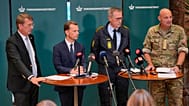






























Klöckner will also visit the German Bundeswehr brigade in Lithuania on Thursday. Around 5,000 German soldiers are to be deployed to Lithuania by 2027 to support the local military.
German Bundestag President Julia Klöckner travelled to Estonia and Lithuania this week to discuss security threats and cyber defence with Baltic leaders on NATO's eastern flank.
 ADVERTISEMENT
ADVERTISEMENT
ADVERTISEMENT
Klöckner met Estonian Prime Minister Kristen Michal and Riigikogu Speaker Lauri Hussar on Wednesday during her inaugural visit to the Baltic states. She also held talks with Lithuanian Seimas Speaker Juozas Olekas, President Gitanas Nausėda and Foreign Minister Kęstutis Budrys.
"We talked about the resilience of our parliaments against hybrid attacks - and about the need for the EU to speak with one voice in the current situation," Klöckner said on Instagram after the parliamentary visit.
The talks focused on bilateral relations and the security situation in the Baltic states in light of Russia's ongoing all-out war in Ukraine. Estonia shares more than 300 kilometres of border with Russia and is part of NATO's eastern flank.
Klöckner said she wanted to learn from Estonia's digital governance, noting the country is known for its high level of digitalisation. "Estonia in particular is known for its very high level of digitalisation. We can learn a lot from that," she said.
Estonia, digital pioneer
Estonia performs better than all other countries in Microsoft's Digital Futures Index for digital public services, which compares the digitalisation level of 16 European countries.
The country leads in e-governance and is above the average for Central and Eastern European countries.
According to the Digital Decade 2025 country report, the level of digitalisation of public services in Estonia remains above the EU average.
The use of AI in Estonian companies more than doubled in 2024 compared to the previous year, and most companies use cloud solutions, exceeding the EU average.
According to a Eurobarometer special report, 79% of Estonian citizens believe digitalisation of public and private services will make their lives easier. In Germany, the figure is 74%, while in Lithuania it is 77%.
Studies show that functioning digital administration increases transparency and efficiency and can strengthen democratic legitimacy.
During her Baltic states trip, Klöckner said she wanted to find answers to "the question of how administrations and parliamentary administrations can become even more digital and resilient."
Visit to German brigade
Klöckner will also visit the German Bundeswehr brigade in Lithuania on Thursday. Around 5,000 German soldiers are to be deployed to Lithuania by 2027 to support the local military.
"Of course, the question of how these small, very resistant and resilient states can really remain stable against cyber attacks is also of interest," Klöckner said. "And that's where we will discuss the geostrategic orientation and the security architecture."
A study by Diconium analysed 200 German industrial companies and found that around 74% see their companies as exposed to a high to very high threat of cyberattacks.
"The majority of companies take the threat of cybercrime seriously," said Saul Dickinson, senior director of cybersecurity at Diconium.
"But a real strategic response is often lacking," Dickinson said. "Without the right operational measures, the level of security remains stable, but fragile in an emergency." Only 50% of the companies surveyed have anchored security centrally in their corporate strategy.
In 2024, 80 cyberattacks on federal authorities were detected, according to the Bundestag's response to a parliamentary question from the FDP.
The German Ministry of the Interior said the number of cyber espionage attacks, including on critical infrastructure and government actors, continues to rise.
The Interior Ministry cited geopolitical developments and in particular Russia's war in Ukraine as a cause.
Russian intelligence services have an increased interest in reconnaissance against the backdrop of sanctions against Russia and Western support for Ukraine, according to the ministry.
Russia's activities in cyberspace are expected to continue to increase, the ministry said.