













Through workshops, design studios and local industries, silk production continues to link tradition with contemporary demand, preserving techniques shaped over centuries.
For centuries, silk has been embedded in life along the Silk Road. Valued for its softness, durability and natural sheen, it moved across regions as both a commodity and a cultural marker. Today, that legacy continues through a production system that remains active, manual and closely tied to local expertise.
 ADVERTISEMENT
ADVERTISEMENT
ADVERTISEMENT
Margilan and the production process
In Andijan, musical heritage is preserved and developed through the work of instrument makers. From the time of Amir Temur to today, instruments have remained central to cultural life, connecting generations of musicians and audiences.
In Margilan, located in the Fergana Valley, silk production follows a continuous, step-by-step workflow. At the Gold Silk factory, cocoons are processed on site, threads are spun and washed, and patterns are prepared before weaving begins.
Master craftsman Abdumannop Sultonov explains that the process starts with precise calculations. Patterns are reconstructed through a stage known as “davra,” where measurements, thread layers and design structure are defined in advance.
The material itself requires careful handling. Silk threads are extremely fine, and any damage at an early stage affects the final result. Producing atlas or adras fabrics can take up to ten days before weaving even begins, as each stage is completed manually.
Pattern design and colour planning
Once the threads are prepared, the process moves to design. What appears decorative is, in practice, highly structured work.
Pattern designer Nosirjon Hakimov works from samples, measuring and reconstructing motifs so they can be accurately transferred onto fabric. Each element is planned in relation to the fabric’s dimensions, ensuring balance and repetition.
Colour selection is one of the most critical stages. Once applied, it cannot be reversed, meaning that any mistake affects the entire production process. Designers therefore analyse samples carefully and, when necessary, adjust tones to achieve a consistent result.
A continuous system of production
From preparation to weaving, the process unfolds without interruption. Threads move through each stage in sequence, gradually forming a finished textile.
According to factory founder Ibrahim Sultanov, this system allows full control over production. Silk is sourced, processed and turned into finished goods within one space, including carpets, garments and accessories.
Production is closely linked to international demand. A large share of products is exported, while individual orders are also produced based on specific designs. At the same time, the factory functions as a space for visitors, where tourists can observe the process and interact with craftsmen.
Silk and the regional economy
Beyond individual workshops, silk production plays a broader role in the regional economy. The Fergana Region produces around 2,900 tonnes of cocoons each year, supporting multiple sectors, from textiles to carpet weaving.
Historically, cities such as Margilan were key points of exchange along the Silk Road. Caravanserais connected local producers with traders from other regions, enabling the spread of techniques and materials. Today, this exchange continues through tourism and exports.
Bukhara and silk in design
Moving west to Bukhara, silk production shifts from fabric-making to garment design.
Craftsman Nodirshoh Fayziyev works primarily with silk fabrics to create clothing, accessories and footwear. Each piece requires careful alignment of patterns, ensuring that motifs remain consistent across the final product.
Working with pure silk presents additional challenges. The material is thin and requires precision at every stage. At the same time, it offers flexibility. It can be combined with other fabrics or used in contemporary designs through cutting, embroidery and decoration.
Demand for silk products remains strong, both locally and internationally. Many items are produced by hand, often involving several artisans, reflecting the labour-intensive nature of the craft.
Khiva and interactive craftsmanship
Further west, in Khiva, silk production is presented in an interactive format.
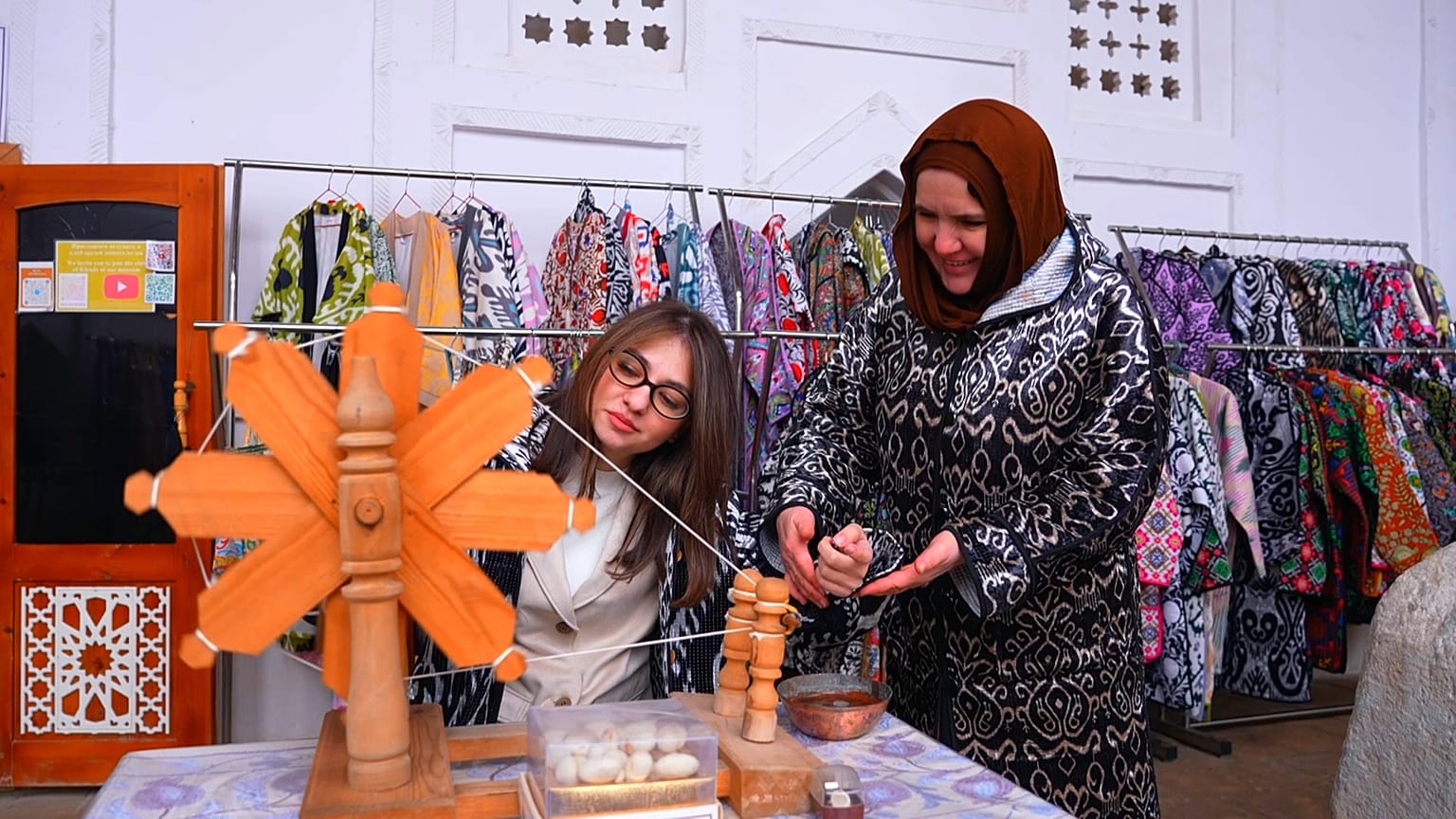
A dedicated museum brings together the full process within a single space, allowing visitors to observe and participate. Activities include extracting silk threads, weaving adras fabrics and dyeing scarves using natural pigments.
Workshops and masterclasses are central to this approach. Visitors engage directly with the material, gaining insight into techniques that are usually carried out behind the scenes. This interaction creates both educational and economic value for local artisans.
A tradition that continues to evolve
Across these regions, silk production operates as a connected system linking raw materials, craftsmanship and design.
Each stage, from cocoon processing to finished products, requires specialised knowledge and manual skill. The process remains time-intensive, shaped by both the material and long-established techniques.
At the same time, new methods are being introduced, including printed silk and planned jacquard weaving. These developments expand production possibilities while maintaining traditional foundations.
Silk continues to function as a living material rather than a historical reference. It is produced, adapted and used in contemporary contexts, reflecting a balance between continuity and change.
What begins as a cocoon passes through multiple stages before becoming a finished textile. This process reflects not only technical production, but also a system of knowledge passed down through generations, remaining relevant in modern life.
Read more