





























Once a crossroads of empires and ideas, Uzbekistan remains one of the best-preserved witnesses to the Silk Road’s influence on architecture, learning and spiritual life.
Uzbekistan lies at the heart of the ancient Silk Road, a vast network of trade routes that for centuries linked China with Central Asia, the Middle East and Europe. Across the country, trade and cultural exchange shaped cities that today stand among the world’s most carefully protected heritage sites.
 ADVERTISEMENT
ADVERTISEMENT
ADVERTISEMENT
Home to some of the Silk Road’s most storied cities, the country holds places so culturally rich and historically layered that UNESCO has recognised them as part of humanity’s shared heritage.
From ancient mosques that still echo with centuries of prayer to fortress cities preserved like open-air museums, the past isn’t just remembered — it is actively protected.
As Khilola Khudoyberdieva from the Navoi Region Tourism Department puts it, Uzbekistan’s many UNESCO-listed sites reflect “its rich history, ancient statehood, and unique culture and heritage.”
These landmarks are not merely remnants of the past. They are living spaces where architecture, science, devotion, and daily life still meet.
Samarkand: a crossroads marked by UNESCO
Samarkand, one of the oldest continuously inhabited cities in Central Asia, is among Uzbekistan’s most iconic UNESCO-listed sites, inscribed as “Samarkand – Crossroads of Cultures.”Often described as a meeting point of civilisations, the title feels tangible when standing in Registan Square.
Tour guide Khurshida Fayzullaeva shares the story of the three madrasas — traditional Islamic schools — that form the heart of this architectural ensemble.
The first was commissioned in the 15th century by Ulugh Beg, the Timurid ruler, astronomer and grandson of Amir Timur (also known in the West as Tamerlane), as a centre of scientific and religious learning.
By the 17th century, Samarkand’s intellectual life had grown so vibrant that a second madrasa was built. Fayzullaeva explains that it was designed as a deliberate visual “reflection” of the first — symmetrical in layout, much like matching eyebrows on a human face.
The third building, from the same century, combined a Friday mosque and a madrasa within one complex. Together, they form one of the most celebrated architectural ensembles in the Islamic world.
Bibi-Khanym: a monument of power and ambition
Another highlight within Samarkand’s UNESCO-listed ensemble is the Bibi-Khanym Mosque, a structure that rises with monumental scale and symbolic power.
After his military campaign in India in 1399, Amir Timur (Tamerlane), the Turco-Mongol conqueror who founded the Timurid Empire, ordered the construction of an immense congregational mosque in his capital.
The construction was overseen by his wife Saray Mulk Khanum, known as Bibi-Khanym.
Guide Maftuna Kakhramanova explains that more than 10,000 artisans and stone masons shaped its vast domes and soaring archways.
At the centre of the mosque sits a massive marble stand, believed to have been used as a Qur’an lectern.
It is believed that an ancient Qur’an was brought to Samarkand and placed on this stand during the 15th century. Today, the manuscript traditionally associated with this story is preserved in a museum in Tashkent.
Shah-i-Zinda: a ribbon of colour through time
Within the UNESCO-listed Samarkand ensemble, the necropolis of Shah-i-Zinda reveals a more intimate side of the city’s sacred history.
Walking through the complex is a journey across centuries. Generations of rulers, scholars and saints are buried here, yet their presence lingers in every tiled surface and carved portal.
Turquoise, cobalt and ultramarine tiles create a glazed corridor of time, where light and shadow animate centuries of craftsmanship.
The fairytale fortress of Khiva
Further west, the UNESCO-listed Itchan Kalarises behind its thick mud-brick walls, the inner city of Khiva preserved as though time itself had paused. Passing through its gates feels like stepping into a living storybook.
Anaposhsha Boltaeva, of the Itchan Kala Museum-Reserve, describes it as “a fairytale city” and an open-air museum where every madrasa, minaret and palace stands within one remarkably intact urban ensemble.
Bukhara: a UNESCO-listed centre of scholarship
Also inscribed as a UNESCO World Heritage Site, the Historic Centre of Bukhara stands as one of Central Asia’s oldest seats of learning and spiritual life.
The Lyabi-Hauz ensemble, part of the UNESCO-listed area, remains a lively gathering space where centuries-old mulberry trees shade a reflective pool. Locals sit in cafés, visitors drift through, and surrounding madrasas turn the square into a blend of cultural memory and contemporary life.
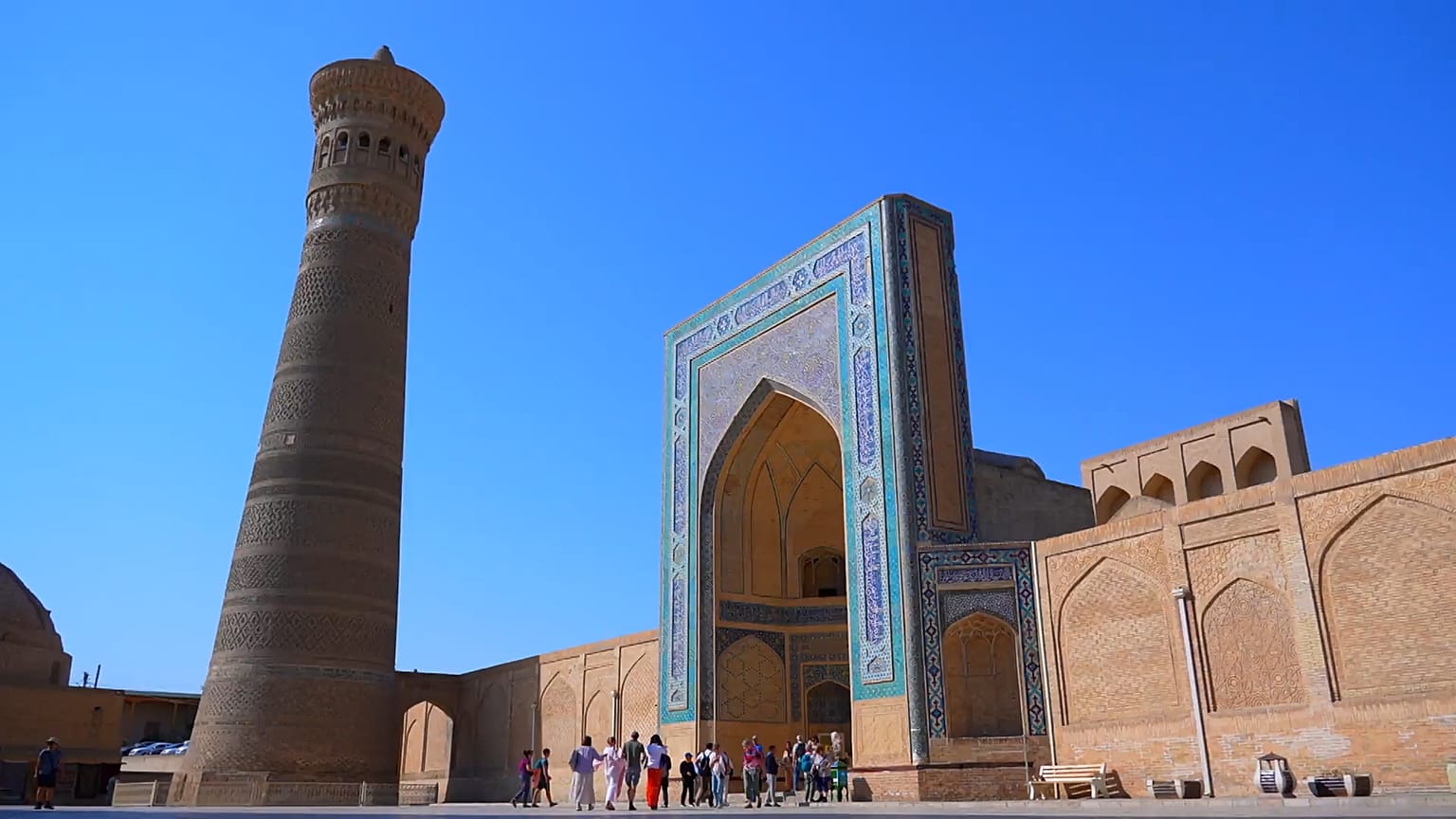
Nearby, the Po-i-Kalyan complex rises with its defining elements: the Kalyan Minaret, the Great Mosque, and the Mir-i-Arab Madrasa. Guide Dildora Safarova explains how these monuments together formed one of the region’s most striking religious and educational ensembles.
Within the broader UNESCO-protected zone, the Ark of Bukhara still stands as a monumental citadel of power, ceremony and governance, guarding the city’s long political and cultural narrative.
Navoi region: Silk Road echoes beyond the cities
While Samarkand, Bukhara and Khiva form Uzbekistan’s most widely recognised UNESCO-listed urban heritage, the Silk Roads: Zarafshan–Karakum Corridor is also inscribed as a transnational World Heritage Site.
This 866-kilometre corridor spans parts of Tajikistan, Turkmenistan and Uzbekistan, recognising a network of routes rather than a single monument.
Navoi, located along the Uzbek section of this corridor, was a significant historical hub. Goods were traded extensively along this route, making the region key to the movement of commodities, ideas and people between distant cultures.
Along these historic pathways, the Deggaron Mosque reflects centuries of architectural ingenuity. Deputy imam Erkinkhuja Usmonov describes an unusual acoustic feature: clay jars embedded within the walls create natural resonance, allowing even soft voices to carry clearly through the prayer hall.
Nearby, the Qosim Sheikh Complex demonstrates a different form of innovation. As Amriddin Abutoliyev explains, its structure maintains remarkably stable indoor temperatures throughout the seasons, creating a sanctuary shaped by both spiritual and environmental intelligence.
Preserving the Silk Road’s living legacy
Today, Uzbekistan’s UNESCO World Heritage Sites form a network of history protected on a global scale.
UNESCO recognition helps safeguard these places, but their true power lies in how they continue to function as living spaces — where faith, learning and daily life remain closely intertwined.
Read more