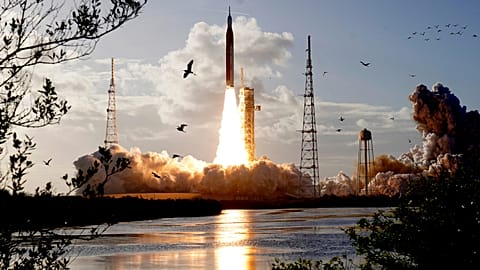






























NASA has unveiled the Artemis III crew for a proposed 2027 mission to test key Earth-orbit technologies ahead of sending a human crew to the Moon.
Italian astronaut Luca Parmitano will pilot Artemis III**,** NASA confirmed on Tuesday, one of the key missions to prepare a human crew to return to the moon for the first time since 1972.
 ADVERTISEMENT
ADVERTISEMENT
ADVERTISEMENT
Parmitano's inclusion underlines the central role played by Europe in the new phase of space exploration.
The mission, currently scheduled for the second half of 2027, will not head directly to the Moon. It will instead be an experimental flight in low-Earth orbit, designed to test key procedures and technologies, in particular those related to docking between NASA's Orion capsule and the lunar landing modules - known as pathfinders.
At an event at Houston's Johnson Space Center, Parmitano called Italy his "launchpad" into space and the European Space Agency (ESA) a bridge, before dubbing NASA "the rocket, figuratively and literally."
Luca Parmitano is in the European Astronaut Corps for the ESA and was the first Italian and third European to command the International Space Station during an expedition in 2019/2020.
In addition to Parmitano, the Artemis III crew will include US astronauts Andre Douglas, Frank Rubio and Randy Bresnik, with Bob Hines serving as backup.
All of them have been chosen to take part in a series of complex operational tests that are vital for the future lunar missions of the Artemis programme.
During the mission, the Space Launch System rocket will carry the astronauts into orbit, where rendezvous and docking manoeuvres will be simulated between Orion and the lunar lander modules supplied by Jeff Bezos' Blue Origin and Elon Musk's SpaceX.
These operations are among the most delicate stages to negotiate if humans are to return to the Moon, as they demand absolute precision when linking spacecraft together in space.
The Artemis programme brings together numerous international space agencies. The European Space Agency supplies key components for the Orion spacecraft, while the Italian Space Agency is manufacturing habitation modules intended for multiple uses on the lunar surface.
The shared goal is to build a stable infrastructure for exploration beyond Earth's orbit, paving the way for increasingly long and complex missions.