












While China and the US invest in autonomous vehicles, Europe hesitates.
An autonomous shuttle bus designed and built entirely in the European Union is finding its biggest markets in Japan, the Middle East, and the United States—not in Europe.
 ADVERTISEMENT
ADVERTISEMENT
ADVERTISEMENT
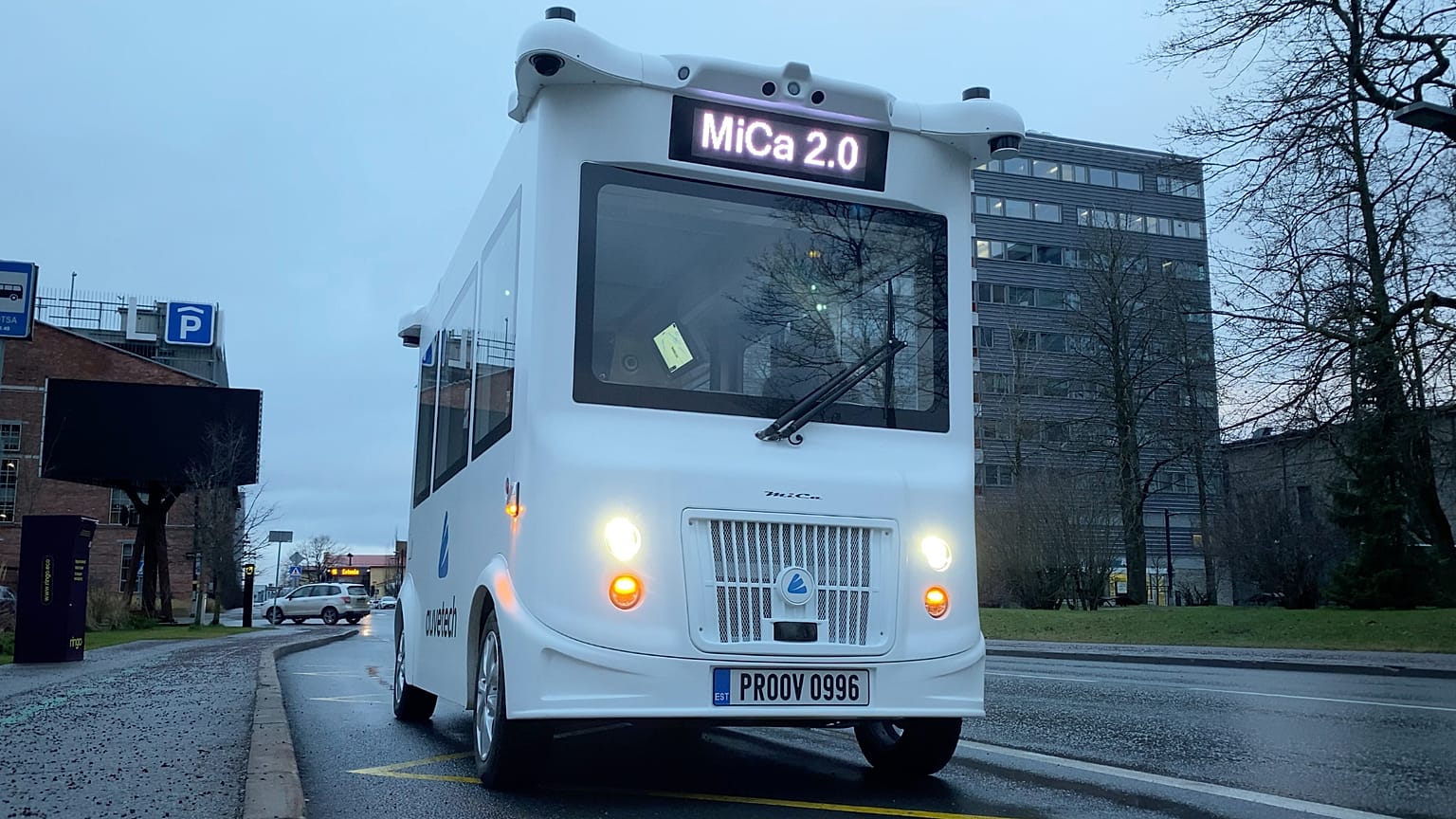
The MiCa, which seats eight passengers and operates up to 20 hours daily in self-driving mode at speeds reaching 25 km/h, represents a paradox: European innovation thriving everywhere except on its home continent.
The shuttle bus is heavily equipped with up-to-date technology, including sensors, LiDARs, cameras and, lately, improved software that enables artificial intelligence (AI)-based dynamic reaction to objects, overtaking vehicle detection or side detection.
“When the vehicle understands what's around it, then it's able to see where the road is, see where the possible objects are moving, where the crosswalk is, where the intersection is”, explained Kristjan Vilipõld, product manager at AuVe Tech OÜ, the Estonian company behind the shuttle development.
“Based on that and the next stop the bus is going to, the system is able to plan a path for its route,” he added.
In a European premiere last month, developers were allowed to conduct tests in Tallinn International Airport.
The vehicle could help transport maintenance staff around aircraft hangars 24/7 in cost-effective and environmentally efficient ways, managers claim. During the tests, autonomous prototypes have driven 2.150 km and transported 215 passengers around the airport’s runways.
The company was founded in 2018 in cooperation with Tallinn University of Technology.
Lack of funding and strategy
Its self-driving vehicles have so far operated in 17 countries, including several in Europe as well as in Japan, the United States, Israel, Saudi Arabia and the United Arab Emirates.
Yet, by far the most advanced projects are currently not to be found in European markets, but in the Middle East and in Asia, especially in Japan.
Managers blame first a lack of government funding in autonomous vehicles and an overall lack of strategy in the sector in the EU.
“In Japan, for example, they provide a very clear goal where the autonomous vehicles have to operate: let´s say 50-60 locations by the year 2027. China has significant investments. In Europe, we have been a little more conservative”, said Johannes Mossov, member of the management board at Auve Tech.
In Japan, there are already cities where autonomous buses are the only public transportation and the government is actively supporting that approach, Mossov said.
Developers claim the European self-driven technology is ready to be developed and showcased, but lately, there is not enough investment.
“The biggest problem in Europe is really (the lack of) investments into the technology, from both private and public sectors, especially when you compare it to what´s happening in the US or China,” said Mossov.
Then there is the “regulatory situation”, developers claim.
“In theory, we have one European Union, but when it comes to the self-driven sector, in practice, we have twenty-seven different regulations”, explained Taavi Rõivas, the company´s chairman of the supervisory board.
“Some regulators are very open to innovation, some regulators are very careful. In some countries, strict regulations are not even about autonomy, but about the cars themselves”.
Without urgent changes, the EU risks lagging and cutting the wings of a sector that could sharpen innovation and create jobs, developers say.
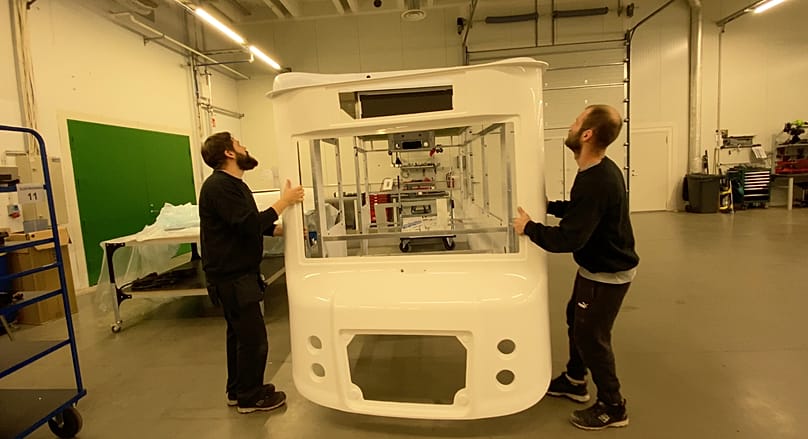
They set their own company as an example. Their vehicles are integrally manufactured in Estonia, one of Europe´s digital hubs.
Not enough drivers in Europe
One shuttle can be completed in one week. Managers say that not outsourcing production helps to ensure quality, control all the processes and manage manufacturing risks.
The urgency is real, developers insist. Europe faces a looming driver shortage that autonomous shuttles could help solve—but only if the continent acts quickly.
"We are not just showcasing fancy technology. It's a practical thing. In Europe, soon we won't have enough drivers," said Rõivas, pointing to data showing autonomous shuttles are already safer than most human drivers—a reality that Japan, the Middle East, and the US, have embraced while Europe hesitates.
Without regulatory harmonisation and increased investment, however, the "made in Europe" advantage could evaporate. The current fragmentation forces companies to spend resources navigating 27 different regulatory systems rather than perfecting the technology itself.
"The main part of investment has to go into the technology itself, not on working with the regulators to get the vehicle on the road," Mossov said.
The stakes extend beyond one company: regulatory paralysis and funding gaps could cost the EU jobs, manufacturing capacity, and a competitive edge in a sector poised for explosive growth.
Rõivas said it is a matter of European sovereignty: "Maybe Europe could really adopt a strategic autonomy and prefer European solutions. As a proud European, I see that we should not be late to the game."
That message appears to be gaining traction. A recent European Parliament event on autonomous vehicles warned that 2026 will be "a pivotal year" for Europe to develop its own self-driving technology, "before risking that the gap with USA and China becomes unbridgeable," according to the EU-funded Connected and Automated Driving platform.