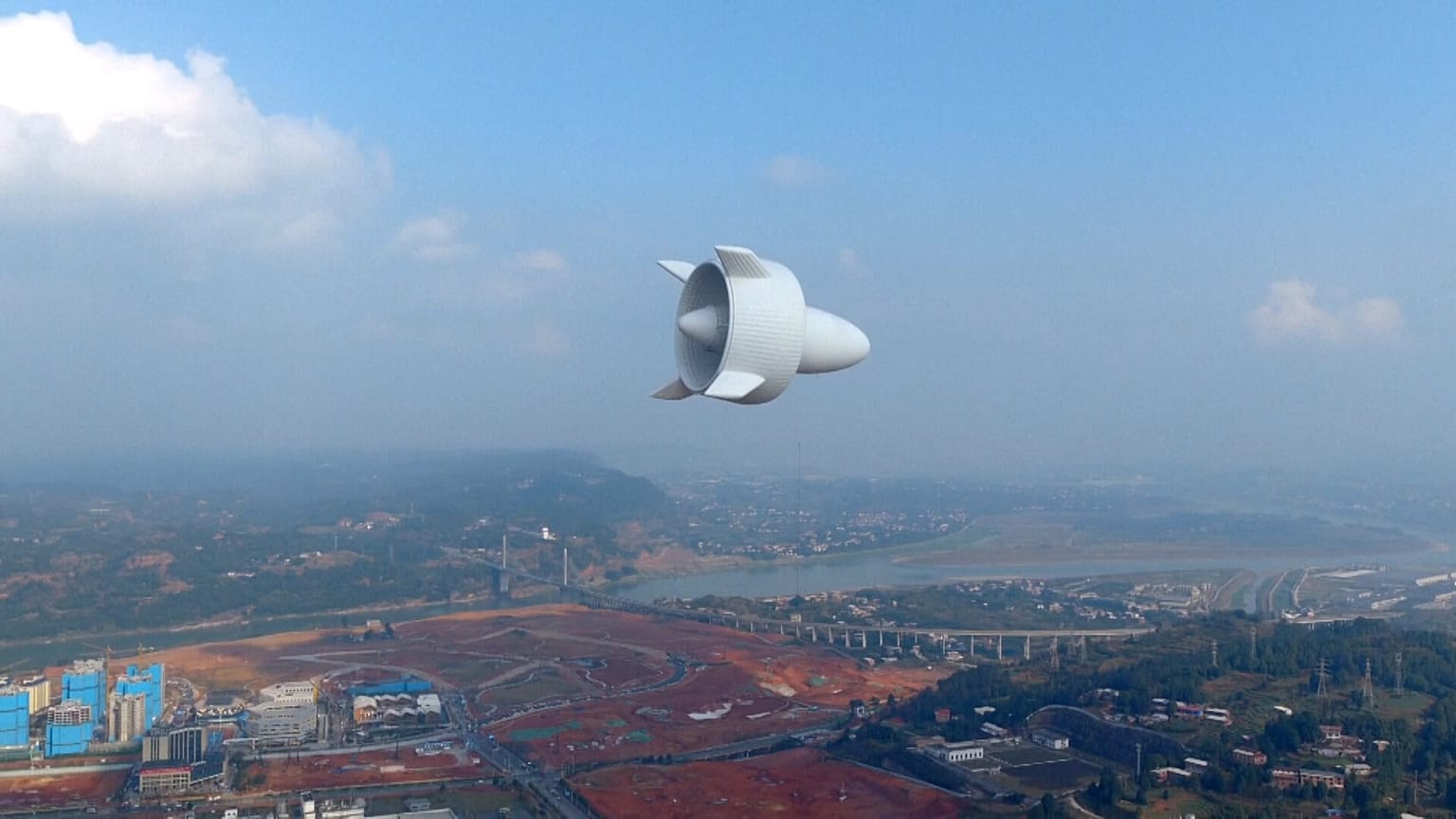














Wind power could soon come from the sky as China has successfully tested a megawatt-class airborne turbine that generates electricity while hovering 2000 metres up.
China has completed a test flight of what it says is the world’s first megawatt-class high-altitude wind power system designed for urban deployment.
 ADVERTISEMENT
ADVERTISEMENT
ADVERTISEMENT
The enormous S2000 Stratosphere Airborne Wind Energy System (SAWES) flew at an altitude of 2,000 metres in southwest China’s Sichuan Province, generating electricity and successfully connecting to the power grid - a world first for a high-altitude wind power device.
The aircraft-like structure functions as an “airborne power station” and combines an airship platform with wind turbines to capture stronger, more stable winds high above the ground.
"Traditional wind turbines operate by rotating their blades when wind strikes them, thereby generating electricity. This generator functions similarly, except that power generation occurs not at ground level but in the air," said Weng Hanke, co-founder and chief technology officer of Beijing Linyi Yunchuan Energy Technology.
"It harnesses wind energy to drive its blades for electricity production, which is then transmitted via overhead cables from the air down to the ground," he added.
A new possibility for renewable energy
During the test flight, the S2000 ascended for around 30 minutes and generated 385 kilowatt-hours of electricity. The system measures roughly 60 metres long, 40 metres wide and 40 metres high.
“We have achieved breakthroughs in the aerodynamic and structural design of these large, unconventional aerial vehicles, which form part of our proprietary technologies,” Weng said.
“Secondly, the entire power generation system has overcome challenges in high-power-density, medium-voltage direct-current transmission technology, enabling it to maintain lightweight construction while ensuring higher transmission efficiency.”
As well as providing electricity, the system can also support communications and monitoring equipment.
“In terms of application scenarios, beyond generating electricity for grid-like conventional power systems, it serves other purposes," Weng said.
"It can carry specialised equipment such as communication devices and ground monitoring apparatus, thereby acting as an enabler for the low-altitude economy,” he added.
For now, it’s still in test phase but could one day be the future of wind power in cities.