




























AI was a central discussion at Davos. The World Economic Forum’s AI chief tells Euronews Next about the pressing AI issues.
While geopolitics dominated this week's Davos economic conference, artificial intelligence (AI) emerged as an equally pressing concern for world leaders grappling with questions of technological sovereignty and strategic power.
 ADVERTISEMENT
ADVERTISEMENT
ADVERTISEMENT
The technology isn't merely reshaping economies — it's playing an increasingly important role in how countries position themselves globally, according to Cathy Li, head of the Centre for AI Excellence at the World Economic Forum, which organises the annual gathering.
"Not only is it possible, it's happening," Li told Euronews Next, describing the global race to secure technological independence. "Within this geopolitical environment, every country is doing their own planning. Of course, people are worried and concerned about not having the so-called sovereignty."
Mounting geopolitical tensions have made AI sovereignty – a nation’s ability to independently control and govern its own AI systems – a top priority for many countries. What exactly that would look like, though, remains to be determined.
For Li, AI sovereignty should not mean isolation, because it isn’t practical or even really possible for most nations to build each technology layer in one country. It also would not be sustainable for the planet.
“We try to move away from the notion that this needs to be a full national AI ownership, but more towards strategic interdependence,” she said.
This approach would see countries leveraging their unique strengths through targeted domestic investment and international partnerships, while making strategic trade-offs to identify the right collaborators.
Li pointed to Europe as a model, praising the continent's cross-border AI partnerships among member states. She advocated for layered cooperation to ensure "everyone can benefit from this powerful technology."
Can Europe lead in AI?
Despite the US and China dominating the AI race, tech leaders at Davos suggested the technology presents a significant opportunity for Europe.
Jensen Huang, founder and CEO of chip giant Nvidia, told the forum that AI is "exciting for Europe" because of its "incredibly strong manufacturing base" for building AI infrastructure.
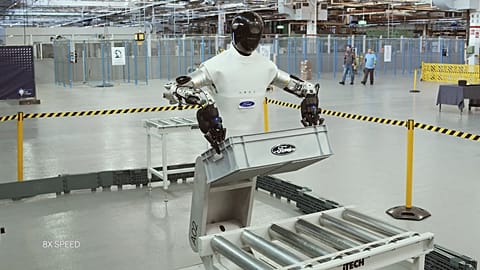
Huang described this as Europe's moment to "leapfrog" the software era, calling robotics a "once in a lifetime opportunity" for the continent.
Li echoed this optimism, citing Europe's advantages: exceptional talent, robust regulation, "a stable society that also encourages innovation," and strong industrial foundations.
However, she acknowledged significant challenges ahead. Market fragmentation across the continent makes cross-border expansion difficult for start-ups and prevents talent mobility.
"Many start-ups born in Europe still see it's much easier to enter a big market like the US than to try to tackle the fragmented domestic markets within the European Union," Li said.
The energy challenge
One of the other major challenges for AI – not just for Europe – will be energy. Data centres, which power AI systems, require massive amounts of electricity to operate.
This infrastructure is so important that Microsoft’s CEO Satya Nadella declared in Davos that energy costs will be the major factor in deciding which country wins the AI race.
Li added that the energy challenge also presented an opportunity to upgrade “outdated” energy systems.
“Those systems that start using clean energy will benefit the whole society overall, but we do need to think in the long term in terms of how we can build out the whole ecosystem,” she said.
The AI questions ahead
With AI advancing at speeds faster than we’ve ever seen before, Li said it “is almost like a year in our life now becomes 100 years in AI”. The applications being discussed today could easily become outdated tomorrow.
For example, this year’s Davos gathering showed how AI development is moving on from large language models (LLMs) to physical AI, such as robotics, and the decisions countries are making in how to invest in AI and regulate it, Li said.
Asked what she thinks the key topics will be at Davos next year, she said much will remain the same, such as how AI can serve humanity and not just corporate profits.
"How do we protect our children's future, not just our own?" Li asked. She criticised corporate leaders planning to cut entry-level jobs due to AI, calling it "the biggest mistake you will make."
Instead of excluding younger workers in this way, she urged companies to pair them with experienced senior management to maximise returns, arguing that younger workers are "AI-native" and naturally adept with the technology.
Li also said AI should not widen the digital divide between the Global North and South, and that more efforts should be made so AI systems are powered by clean energy.
“We really look at technology as an uplifting force that can uplift the whole of humanity. We're humans, we're unique because we take care of each other, so that needs to be front and centre of our agenda,” she said.