

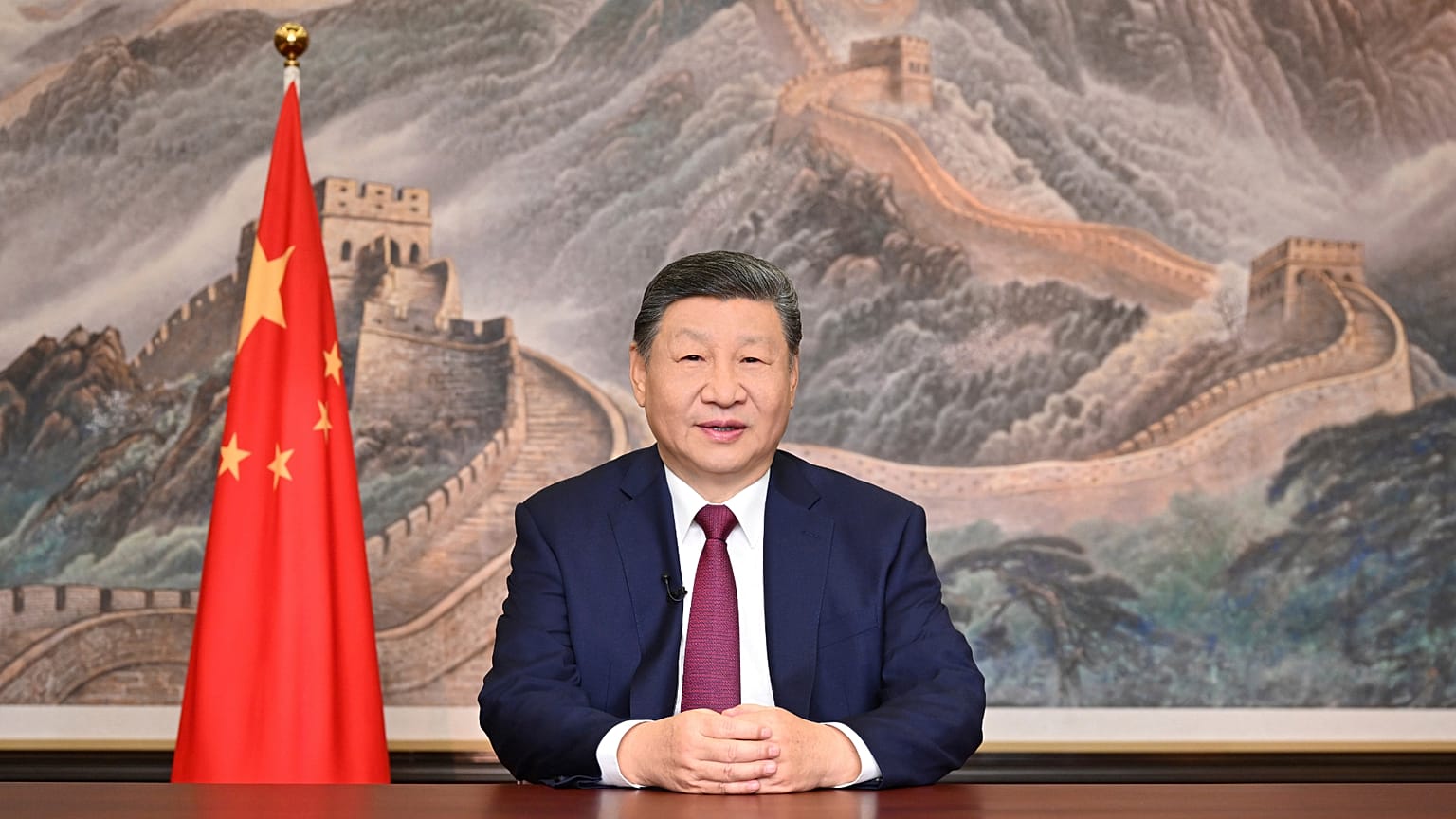













Chinese President Xi Jinping said 2025 was the year of breakthroughs for Chinese artificial intelligence and semiconductor chip companies. What did they accomplish and what can we expect in 2026?
Chinese President Xi Jinping said 2025 was the year that China’s technologies, including artificial intelligence and semiconductor chips, “reached new heights”.
 ADVERTISEMENT
ADVERTISEMENT
ADVERTISEMENT
In his New Year’s address, Xi lauded the efforts of Chinese artificial intelligence (AI) and semiconductor chip companies by saying that they "integrated science and technology deeply with industries, and made a stream of new innovations".
“Many large AI models have been competing in a race to the top, and breakthroughs have been achieved in the research and development of our own chips,” he added.
Xi’s comments came after China’s AI advancements dominated headlines in 2025. The country is widely regarded as a major competitor to the United States in the race to adopt and develop artificial intelligence models.
What did China accomplish in 2025?
The year started with the launch of Chinese AI company DeepSeek’s R1 AI model, which focused on complex tasks such as reasoning, coding, and maths.
At the time of its launch, it rivalled OpenAI’s o1, which was one of ChatGPT’s latest models.The launch of R1 sent US tech stocks plunging throughout the month of January. American semiconductor chip giant Nvidia saw shares plummet by 17 per cent in one day, erasing $600 billion (€510 billion) in market capitalisation.
By September, DeepSeek released DeepSeek-V3.2, an experimental model of DeepSeek V.31-Terminus that makes AI systems more “efficient”, according to a description on Hugging Face.
DeepSeek’s model has a capacity called Sparse Attention (DSA), which claims to reducecomputing costs by 50 per cent without hurting performance. The new model can also generate large amounts of training data for AI agents, programs that can complete tasks without human supervision.
The new model performs similarly to OpenAI’s latest model, ChatGPT-5, the company said on Hugging Face. Its high-compute model, the DeepSeek-V3.2-Speciale, outpaces GPT-5 and is closer in reasoning capacity to Gemini 3-Pro, the company added.
Some European countries such as Italy, Denmark and the Czech Republic banned government agencies from using DeepSeek models on their devices due to data security and cybersecurity concerns. Local media in Belgium report that government officials stopped using DeepSeek in December.
Alibaba and other Chinese giants
E-commerce giant Alibaba also launched two frontier AI models in 2025, first with the Qwen2.5-Max model in January and later with the Qwen3-Max Model in September. The company claimed that both models outperformed the latest DeepSeek model and Anthropic’s Claude on certain benchmark tests.
The AI model launches came in addition to a commitmentfrom Alibaba to invest 380 billion yuan (€50.6 billion) into cloud computing and AI in the next three years, one of the company’s largest tech investments to date.
Elsewhere, Chinese technology company Huawei said it was launching new computing technologies and AI chips to compete with Nvidia, the California-based company considered the world’s dominant chip producer.
China and the United States fought over access to Nvidia chips for most of the year, but in December, President Donald Trump said the company could sell its H200 chips to approved customers in China in exchange for a 25 percent surcharge.
Meanwhile, American social media and AI company Meta announced in December that it was buying Manus, an AI startup with Chinese roots, for a reported $2 billion (€1.7 billion). The company launched a general-purpose AI agent earlier this year that could be used for research and coding.
What’s to come in 2026
China will launch a new five-year social and economic development plan in 2026, which will set out the country’s goals to the end of the decade, Jinping said in his speech. China has been developing these plans since 1953.
Recommendations from the Communist Party of China for the “15th Five-Year Plan” include making “forward-looking plans” for “industries of the future”, such as AI, quantum technology and brain-computer interfaces.
Those plans could include new regulation methods, developing venture capital investment, and promoting the growth of small and medium-sized businesses.
According to Deloitte, the proportion of Chinese funding for basic research during the "15th Five-Year Plan" period may exceed 10%. Researchers predict that more R&D investment will be directed towards strategic emerging industries such as semiconductors and artificial intelligence. This would bring the country closer to the amounts dedicated to technology funding in the United States and Japan.
China is also expected to continue building AI infrastructure, such as data centers, domestic chips, and computing networks.
The country’s AI chip market is expected to grow seven to nine times bigger than the 2025 market, which is worth up to $40 billion (€34 billion) - outpacing the rest of the world, according to Deloitte.