

















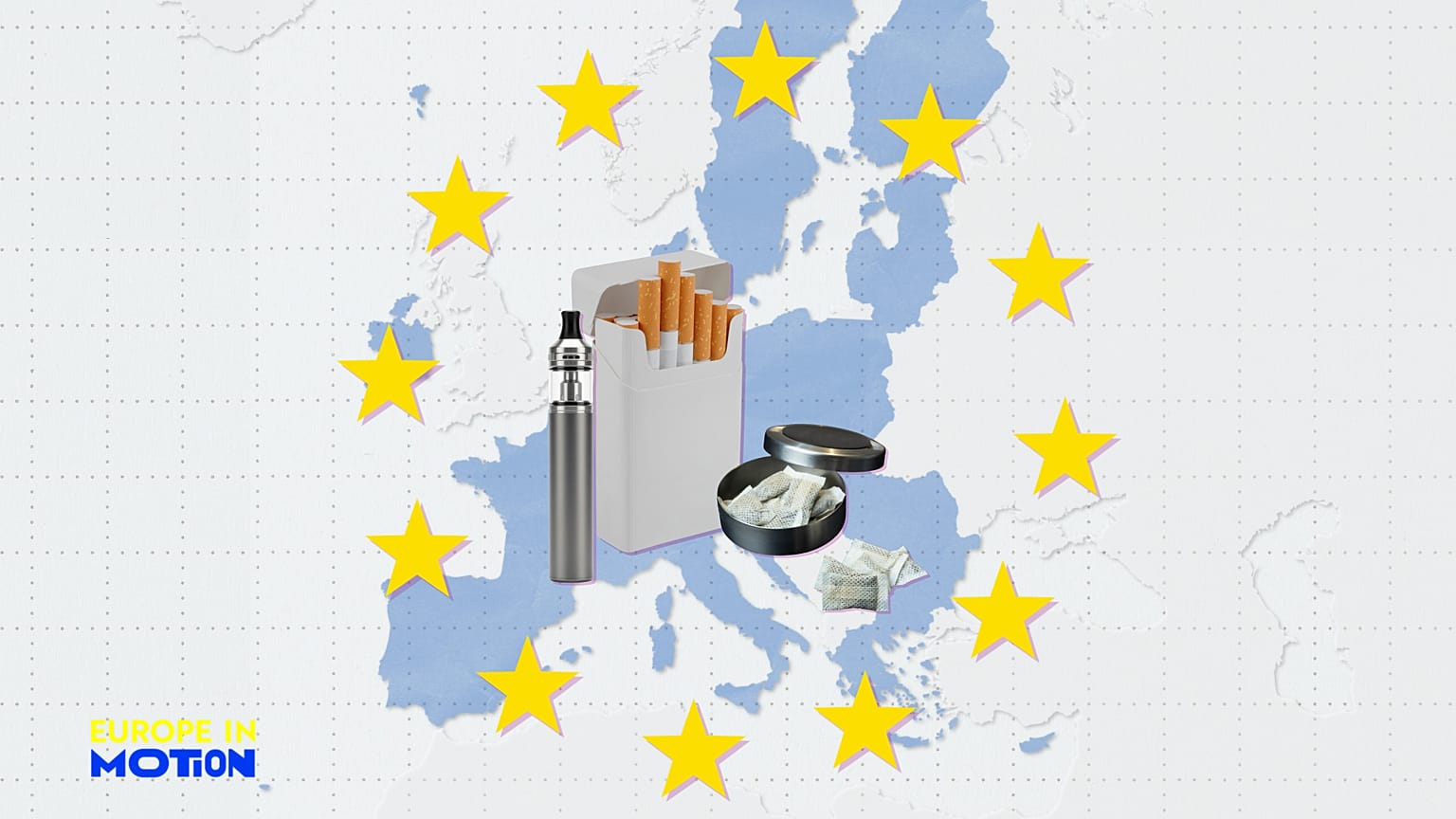














Despite the EU's goal of creating a "Tobacco-Free Generation" by 2040, more than 16% of people over 16 smoke and vape every single day. Who are the biggest smokers in the bloc?
It's well-known that smoking is harmful to your health, and the use of cigarettes in Europe is seeing a slow yet steady decline.
 ADVERTISEMENT
ADVERTISEMENT
ADVERTISEMENT
In 2025, one in six people aged 16 or older in the EU used tobacco and related products, such as e-cigarettes and nicotine pouches, every day, according to Eurostat.
The statistics office said that 20.8% of men smoked every day, compared with 12.6% of women.
However, both shares decreased slightly compared with 2022, when 22.2% of men and 13.1% of women smoked daily.
Tobacco kills 1.1 million people in Europe each year, with 153,000 of those dying from exposure to second-hand smoke, according to the World Health Organization (WHO).
Furthermore, deaths from lung cancer attributable to tobacco use are 71% for men and 46% for women.
As tobacco is such a prevalent cause of cancer, the EU has brought in measures to stem its use, including a goal to reduce its use to less than 5% of the population by 2040 under its Beating Cancer Plan.
Tobacco use varies by age, although not significantly. People aged between 35 and 49 years old registered the highest share (21.3%) of daily users of tobacco, e-cigarettes and nicotine pouches, according to Eurostat.
This was followed by people aged between 25 and 34 at 19.9%, and those aged between 50 and 64 at 19.8%.
Which countries smoke the most?
Among EU countries, Bulgaria (26.3%), Sweden (23.9%) and Croatia (23.6%) recorded the highest shares of the daily use of tobacco and related products.
In contrast, the Netherlands (9.9%), Ireland (11.7%), Belgium (13.6%) and Luxembourg (13.8%) had the lowest shares.
In 17 EU countries, the share of people who used tobacco and related products daily decreased between 2022 and 2025.
The largest decreases were in Spain and Luxembourg, while Croatia and Lithuania recorded the largest increases.
Are citizens aware of the smoking consequences?
Despite years of tobacco-control policies, graphic warnings and public-health campaigns about the dangers of smoking, medical journal BMJ Open found that awareness of its health consequences has barely improved over the past two decades.
More than 90% of respondents knew that smoking can cause lung cancer.
Yet, only about 80% identified heart disease as a consequence of smoking and even fewer knew about the stroke risk as well as second-hand smoke risks.
Researchers found that awareness that smoking causes lung cancer increased significantly in the Netherlands in the same timeframe, but declined in countries such as Germany, France, and Romania.