

















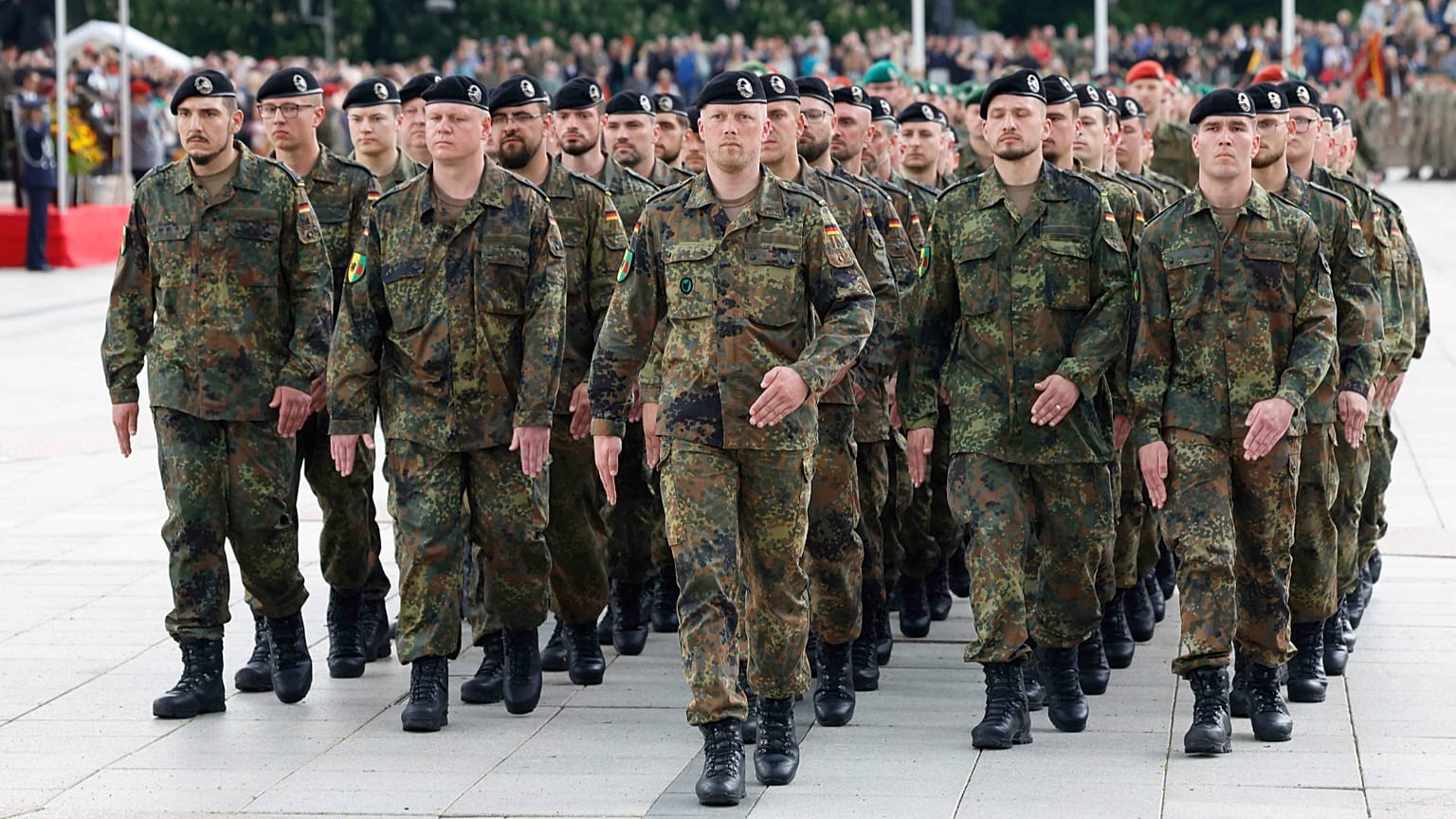














As Germany prepares to permanently station thousands of troops in Lithuania, Foreign Minister Kęstutis Budrys explains why Vilnius believes the deployment is essential to preserving peace.
"We are not interested in having the extension of Russia on our borders for many reasons," Lithuania's Foreign Minister Kęstutis Budrys said of neighbouring Belarus.
 ADVERTISEMENT
ADVERTISEMENT
ADVERTISEMENT
Those concerns are part of the reason for the Bundeswehr's first permanently stationed combat brigade abroad in its 71-year history.
By the end of 2027, around 5,000 German soldiers will be permanently stationed in Lithuania, just a few kilometres from the Belarusian border, to help protect NATO's eastern flank.
The Lithuania Brigade – officially Panzerbrigade 45 – will be the Bundeswehr's first permanent overseas deployment since it was founded in 1955.
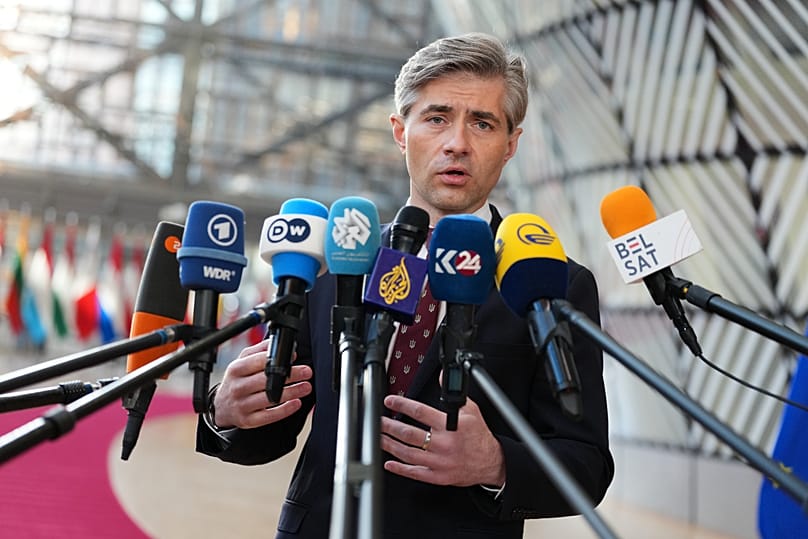
Budrys added there are some independent actions they see coming from Belarus, which are often connected to hybrid activities against Lithuania, such as instrumentalising migration, using meteorological balloons to violate the country's airspace, as well as Belarussian security services harassing the exiled opposition.
Belarus 'a military backyard of Russia'
Belarussian exiled opposition politician and president-elect after the 2020 elections, Sviatlana Tsikhanouskaya, also told Euronews, that Russia has turned the country into "a military backyard of Russia".
"They are deploying nuclear weapons, deploying Oreshnik. They are using our infrastructure. They have logistic capability to use Belarus. Lukashenka actually militarised our economy, about 300 Belarusian enterprises are producing military stuff for Russia," she told Euronews.
"It's a tough neighbour," Budrys added, arguing that Lithuania has learned the value of strong alliances.

"Our recipe and what we learned throughout these years is that regional partnership and partnership through EU and our NATO membership really helps in these situations," he said. Those partnerships, he added, "not only come in the form of political solidarity, but also in providing some collective instruments that we can apply."
The permanent deployment of Germany's battletank brigade is one of those instruments, albeit Berlin's military presence being not entirely new. Since 2017, the Bundeswehr was part of NATO's Enhanced Forward Presence (eFP) mission, contributing troops to a multinational battlegroup designed to deter Russia. Those deployments were temporary, though, with troops and equipment rotating in and out of the country.
That changed after Russia's full-scale invasion of Ukraine in 2022. Vilnius called for stronger security guarantees and then-Chancellor Olaf Scholz pledged to permanently station a brigade in the country.
"I have promised our friends in Lithuania that Germany will lead a robust Bundeswehr brigade that will also be permanently present in Lithuania and, in the event of a crisis, be reinforced immediately by forces from Germany. This is solidarity in action between friends and allies," Scholz told the Bundestag in June 2022.

Germany had initially intended to station only a brigade headquarters in Lithuania, while combat units would continue to deploy from Germany for exercises or if required, as part of NATO's already existing rotational model.
According to the German Bundeswehrverband, this strategy shifted in the summer of 2023, after Wagner group chief Yevgeny Prigozhin's failed mutiny against Russia's military leadership when thousands of his fighters moved to neighbouring Belarus, bringing heavily armed mercenaries to NATO's eastern border.
While the German government insists the Wagner mutiny and the relocation of Wagner fighters to Belarus were not the sole drivers of the permanent deployment to Lithuania, it has acknowledged that the events gave the decision additional momentum.
Weeks later, German Defence Minister Boris Pistorius and Chief of Defence General Carsten Breuer travelled to Lithuania to announce a major change: for the first time since the Bundeswehr was founded, Germany would permanently station a fully operational combat brigade outside its own territory. "It is our mission to play a decisive role in protecting NATO's eastern flank," Pistorius said later that autumn.

'No one here is preparing for war'
Lithuania's foreign minister Budrys told Euronews that "deterrence should start from the border," effectively defending every centimetre with "very exact forces" rather than hypothetical capabilities.
"We're so thankful for Germany taking this leadership and increasing its presence in Lithuania," he added, pointing out that he sees it as an "example for others to follow."
Budrys called this the "key to peace and success."
"No one is preparing here for war. We're preparing here to have a stable country, environment, secure for people to be, for the business to flourish," Budrys told Euronews.
Alongside NATO, each Baltic country has one acting security guarantor: the UK leads NATO's enhanced Forward Presence battlegroup in Estonia, while Canada is responsible for the combat-ready NATO Multinational Brigade Latvia and Germany provides protection with the eFP and the Lithuania Brigade.
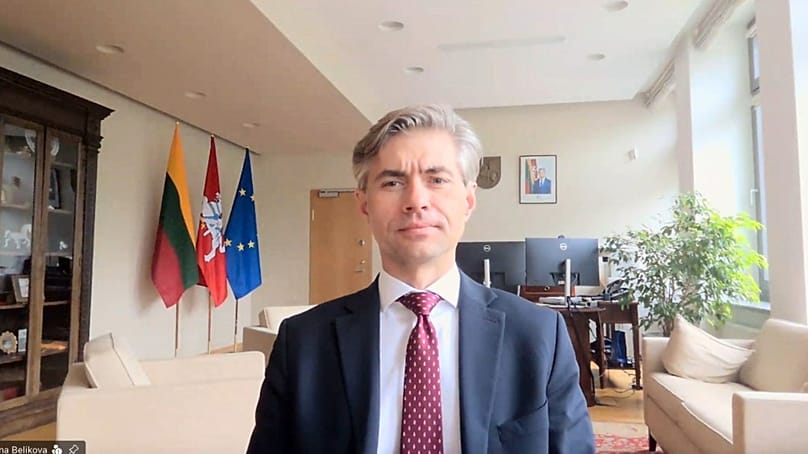
According to the minister, "more than 80% of the population In Lithuania trust Germany" and the country's decision to permanently deploy a battletank brigade to NATO's eastern flank.
A public opinion poll carried out by Spinter Research company in November 2023 at the request of the Strategic Communications Department of the Lithuanian Armed Forces supports Budrys' point, suggested that the overall approval of the German Brigade stationing in Lithuania was at 82% with a "positive view on the German military" at 83%.
In Germany, just 49% of respondents supported Pistorius' plan to deploy the Lithuania Brigade, a YouGov poll commissioned by the German Press Agency (dpa) from 2023 suggested.