













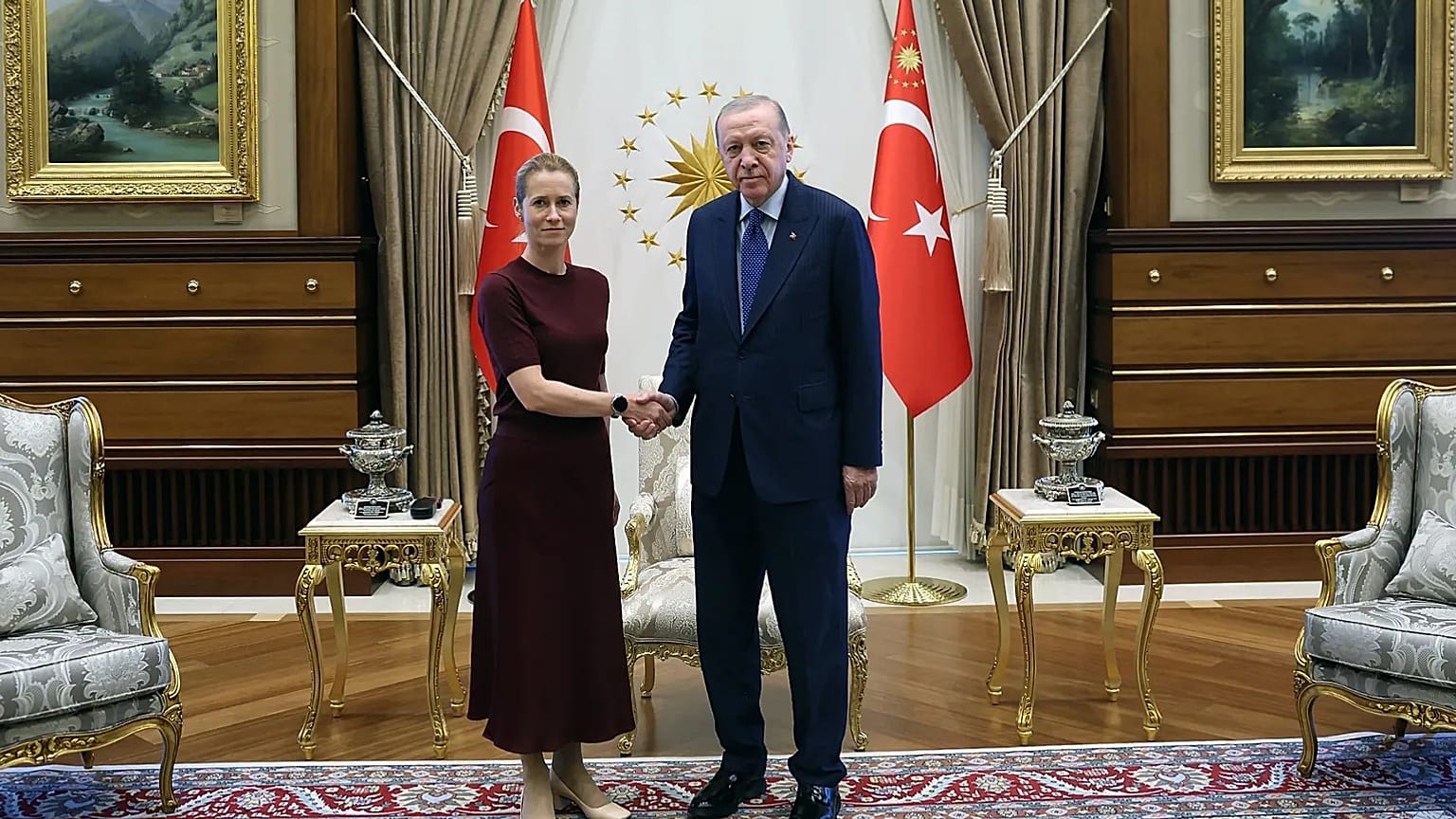













Three EU commissioners met the Turkish president in Ankara to improve cooperation on trade, migration and security with a key candidate for EU accession ahead of next week's NATO summit.
The European Union is moving to deepen ties with Turkey, which it views as key to regional stability in a shifting geopolitical landscape, advancing cooperation on foreign policy, connectivity, trade and migration.
 ADVERTISEMENT
ADVERTISEMENT
ADVERTISEMENT
On Tuesday, EU foreign policy chief Kaja Kallas, European Commissioner for Internal Affairs and Migration Magnus Brunner, and Commissioner for Enlargement Marta Kos travelled to Turkey to meet President Recep Tayyip Erdoğan, followed by talks with Foreign Minister Hakan Fidan. EU officials dubbed the trip a "jumbo meeting."
"Türkiye is a key partner on security, migration, and energy, as well as an EU candidate country," Kallas posted on X after meeting Erdoğan, adding that the country "is making a significant contribution to protecting NATO's eastern flank."
The visit came just a week before a critical NATO summit in Ankara, but the focus stayed on EU-Turkey bilateral relations – a standing format with a candidate country whose accession process has stalled since it was formally launched in 2005.
On foreign policy, talks centred on the Middle East, with both sides seeking alignment on Iran, Syria and Gaza, as well as Africa and the South Caucasus.
The joint statement issued after the meeting stresses a shared commitment to multilateralism, the rules-based order, and joint responsibility for global and regional issues.
Also on the table was Turkey's potential support for a future EU mission in Lebanon. With the mandate for the UN Interim Force there expiring this year, regional powers are weighing how to fill the gap.
Discussions also covered Turkey and Ukraine's recently enhanced security cooperation, which EU officials welcome, and Black Sea security, where Romania and Bulgaria are proposing a new Black Sea Maritime Security Hub.
The joint communique commits both sides to peace and prosperity in the South Caucasus, following the historic peace agreement Armenia and Azerbaijan signed last year.
European Commission President Ursula von der Leyen is set to visit Armenia and Azerbaijan this week, with energy security and connectivity high on the agenda.
Connectivity and economic cooperation
Brussels has prioritised development of the Trans-Caspian International Transport Route, also known as the Middle Corridor, an alternative connection between Europe and Central Asia that bypasses Russia via Turkey and the South Caucasus.
"The world around us is really changing very quickly," Kos said at the closing event for the Strengthening Intermodal Transport Services project on Tuesday. "Trade routes that once appeared secure can no longer be taken for granted. Competition between global powers is growing. Businesses are looking for more reliable supply chains."
"Countries want more options for trade, energy and digital connections. This gives the European Union and Turkey a shared opportunity, a big opportunity."
Kos also met Turkey's finance, transport and trade ministers, with talks touching on modernising Turkey's access to the EU customs union. That access is currently based on a 1995 agreement that still carries several exceptions.
The joint statement also stresses the importance of an inclusive, reciprocal approach to industrial policy – an indirect reference to the Industrial Accelerator Act, the flagship legislative push for European competitiveness that could shut non-EU companies out of public procurement.
The communique also welcomes Turkey's participation in the Single European Payments Area, the EU's initiative to harmonise cashless payments, and the gradual resumption of the European Investment Bank's operations in the country.
Other topics included Schengen visa liberalisation for Turkish citizens, circumvention of Russia sanctions, and implementation of the readmission agreement covering citizens residing illegally in each other's territory.
The joint statement also points to closer cooperation on border management and combating migrant smuggling.
"We work together with Turkey to prevent illegal migration, while creating more mobility opportunities and enabling people-to-people contacts," Commissioner Brunner wrote on X.
Potential hiccups
Despite the international context making a rapprochement between Brussels and Ankara easier for both sides, there are still significant differences to resolve.
The talks took place after von der Leyen delivered remarks at a conference marking Die Zeit's 80th anniversary in Germany in which she referenced Turkey alongside Russia and China as foreign powers seeking to influence Europe.
The comparison drew a sharp response from Ankara, given Turkey's status as both an EU candidate and a NATO member. EU officials noted that Erdoğan will have the chance to raise the issue directly with von der Leyen when the two meet at next week's NATO summit.
The joint communique also voices support for the efforts of the UN Secretary General on the issue of Cyprus, an EU member state whose territory has been partially occupied by Turkey for over 50 years.
Human rights and the rule of law also came up. Erdoğan's recent record has unsettled EU policymakers, not least the arrest last year of Istanbul mayor and presidential candidate Ekrem İmamoğlu of the opposition Republican People's Party.
"As a candidate country, we also expect Türkiye to meet the highest standards of democracy, rule of law and human rights," Kos said on X.