




























From the start, the accession bids of Moldova and Ukraine have been informally coupled. But now, after the opening of the first cluster of negotiations, the two candidates might go on separate ways.
The European Union has set the stage for decoupling Moldova's accession process from Ukraine's after both candidates overcame Hungary's two-year veto and opened the fist cluster of negotiations.
 ADVERTISEMENT
ADVERTISEMENT
ADVERTISEMENT
The two countries have been informally paired since the early days of Russia's war of Ukraine, which prompted the back-to-back membership applications.
Since then, the question on when Chișinău should part ways from Kyiv has been looming over the conversation. But the optics of leaving a country at war behind on the waiting list proved problematic and the duo remained united in practice.
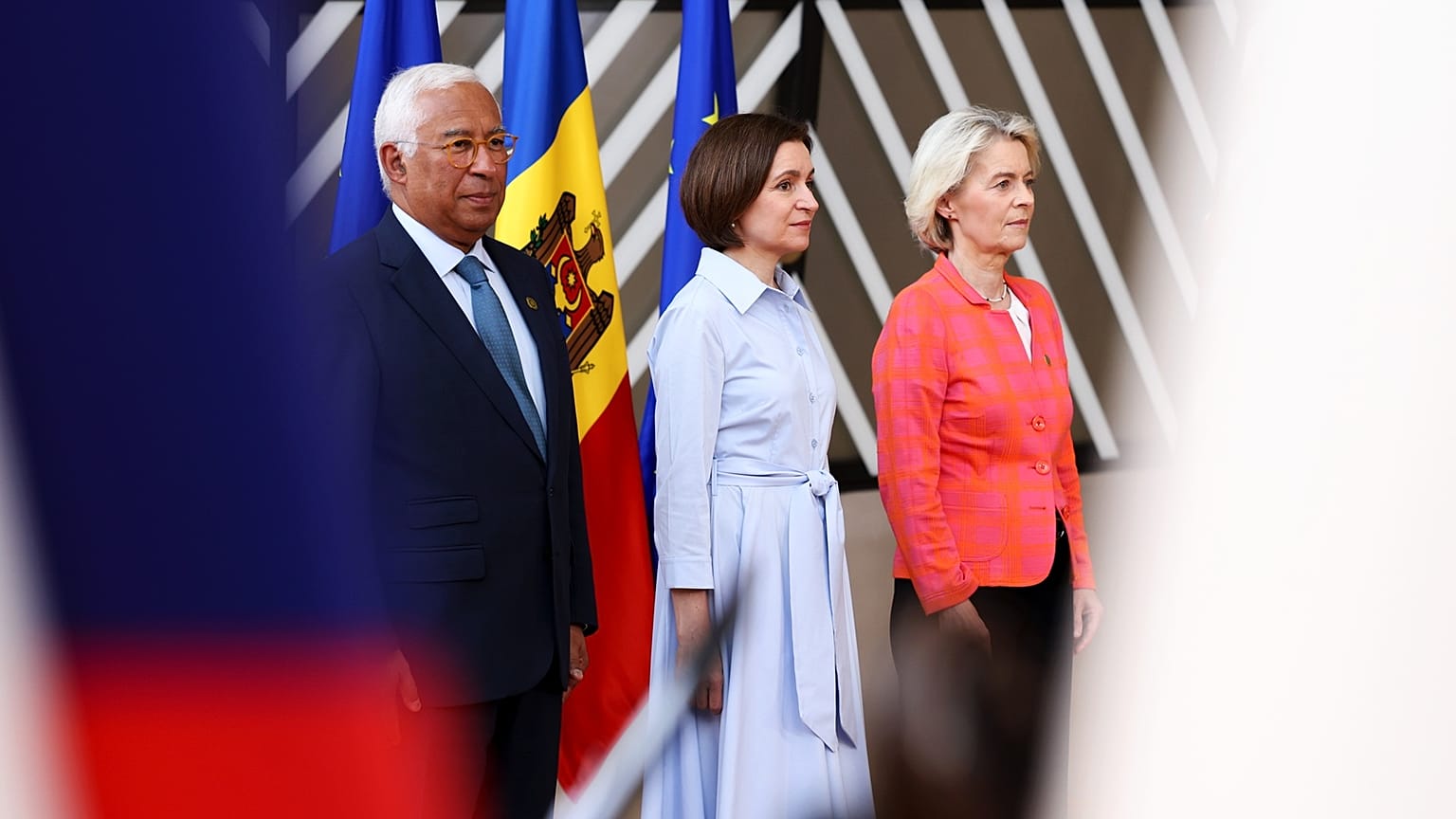
On Tuesday, at the end of an EU-Moldova summit in Brussels, the bloc's leadership suggested decoupling might soon be inevitable.
"Once the first cluster is open, every candidate country is responsible for itself, because they have to deliver different reforms, depending on what candidate country we're talking about," Ursula von der Leyen, the president of the European Commission, said.
"Here, I'm only speaking about Moldova," she stressed.
Standing by her side, António Costa, the president of the European Council, praised the Moldovan government for approving reforms "very fast" and predicted that, if the pace were maintained, the candidate could "rapidly" unlock the remaining five clusters.
"Enlargement is the most important geopolitical investment," Costa said.
Accession consists of 33 chapters split into six thematic clusters.
Moldova and Ukraine are considered technically ready to open all the cluster but, so far, have only opened the first one, known as "Fundamentals" because it covers the rule of law, human rights, anti-corruption and the judiciary.
"I think we should not have a too short-sighted approach," von der Leyen said.
"When a candidate country performs the way Moldova does, it merits to move forward. A merit-based process does not mean slow. It means fair. And the fairness is (that) if you deliver, we have to deliver. So far I'm not worried about the process."
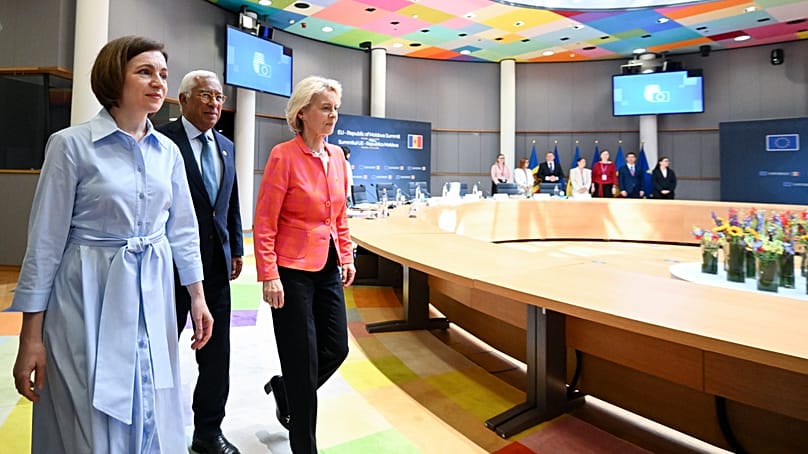
Moldovan President Maia Sandu, who also took part in the press conference, said the five remaining clusters should be opened "immediately and with no delays".
"As long as we're ready, I'm sure that this is going to happen," Sandu said.
As Ukraine dominates the conversation, Moldova's accession has remained largely under the radar, attracting limited attention but also limited controversy.
During last week's summit of EU leaders, Hungary's new prime minister Péter Magyar opposed a section in the joint conclusions that spoke about opening all clusters with Ukraine "as soon as possible". Magyar did not voice the same reservations regarding Moldova. However, for the sake of equal treatment, the 27 leaders decided to remove the same wording from the Moldova-related section.
Officials and diplomats in Brussels admit the question of decoupling is a matter of time as the formal process sets sail, even though it is not clear when, and how, it will happen. Some believe it is unfair to keep Moldova tied to Ukraine, as it creates a false equivalence between a country at peace and a country at war.
However, there is also recognition that for Ukraine, decoupling is a highly sensitive matter that could send the wrong message to the Ukrainian people. Brussels is keen to avoid a scenario in which Chișinău advances effortlessly and Kyiv is held back for political motives. One single veto is enough to pull the brakes.
Ukrainian President Volodymyr Zelenskyy attended last week's summit to underlinethe importance that his country attaches to accession as a future security guarantee.
"The first cluster was recently opened, and it is fully deserved for both Ukraine and Moldova," Zelenskyy told the 27 leaders.
"We are ready to move further. We will be happy to do it together. We can open the other five clusters as well."