

















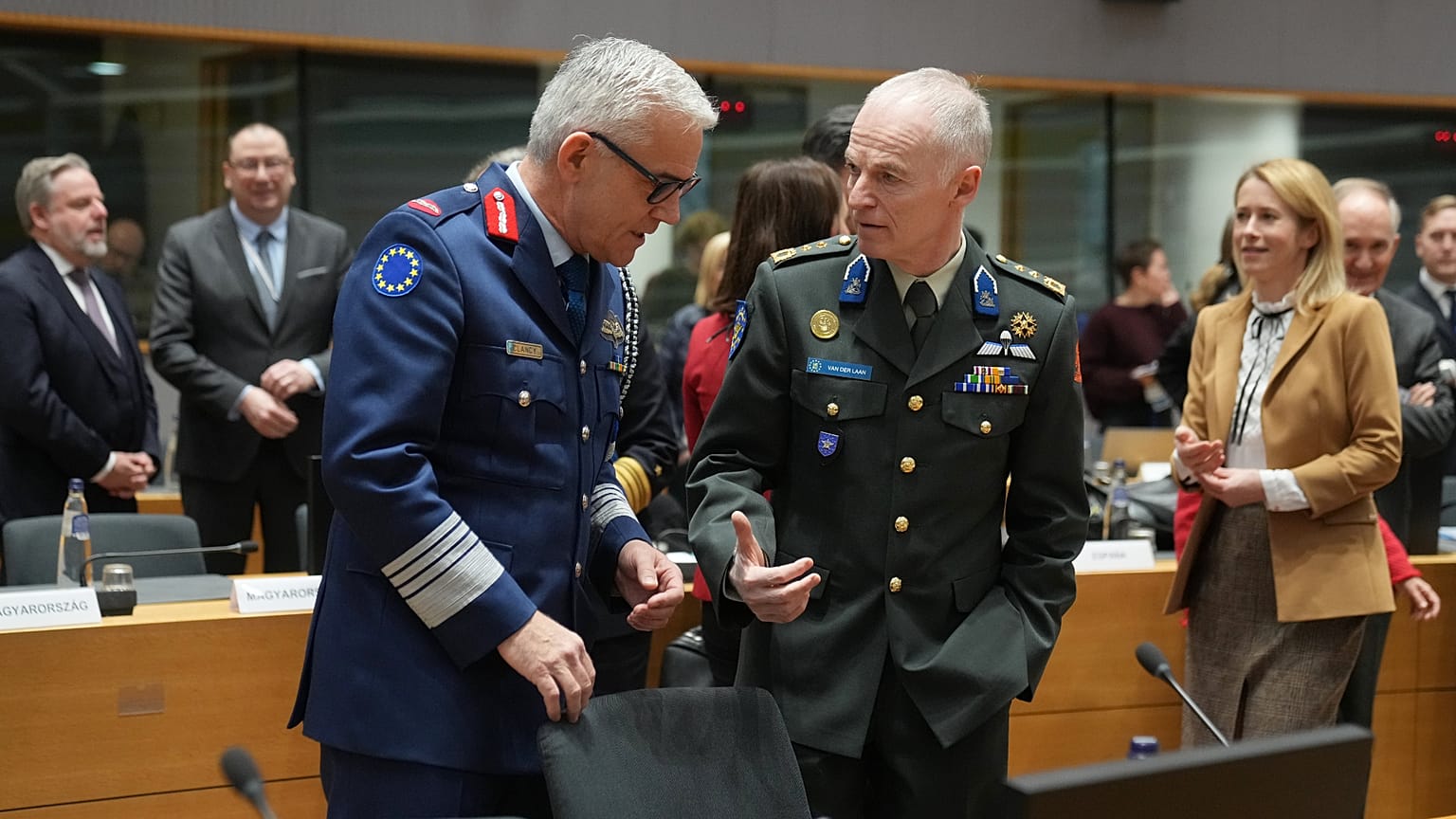













As wars spread and trust in Washington weakens, Europe is rearming and preparing for a world where it may have to defend its interests without relying on the US.
Europe is confronting a question that would once have seemed unthinkable: whether it can still rely on others for its security at all.
 ADVERTISEMENT
ADVERTISEMENT
ADVERTISEMENT
From Russia’s full-scale invasion of Ukraine and conflict in the Middle East to intensifying rivalry between the US and China, the European Union finds itself exposed in a world increasingly defined by hard power rather than rules-based cooperation.
“For the first time in living memory, we are truly alone together,” former Italian prime minister Mario Draghi said last week, capturing a growing sense of unease in European capitals.
The sentiment reflects a broader shift in strategic thinking, as governments across the continent reassess long-held assumptions about security, alliances and economic stability.
That reassessment is already visible in defence spending. EU member states have increased military budgets steadily since Russia invaded Ukraine in 2022, with combined spending reaching around €739 billion this year.
Germany is set to spend €117.2 billion in 2026, while France will allocate €68.5 billion. Countries on NATO’s eastern flank are moving even faster, with Poland now spending 4.48% of GDP on defence amid fears of further Russian aggression.
The shift marks a decisive break from decades of post-Cold War military restraint, but it is also being driven by a second, more structural change: growing uncertainty over the US.
The Trump factor
For most of the post-war era, European security rested on NATO and the US military guarantee, anchored in Article 5’s principle of collective defence. That assumption is now under strain.
Since the advent of Donald Trump’s second administration, European leaders have been confronted with a more unilateral and transactional approach to foreign policy, with Washington acting on major military and diplomatic decisions with limited consultation of allies.
Tensions have also extended into trade, with US tariffs on European goods and repeated threats of sanctions contributing to a broader sense in Brussels that the transatlantic relationship is becoming less predictable.
The result, officials say, is not a formal rupture, but a gradual erosion of certainty about US reliability – and that uncertainty is reshaping policy.
The EU has launched its Readiness 2030 plan, formerly known as ReArm Europe, aimed at unlocking more than €800 billion in defence investment through relaxed fiscal rules, joint procurement and expanded industrial capacity. Alongside this, the Commission’s Security Action for Europe (SAFE) instrument allows member states to access up to €150 billion in loans for joint procurement of military equipment, with 18 countries and Canada already expressing interest.
Beyond spending, Brussels is also exploring deeper integration. Proposals under discussion include a European Defence Union, a “Military Schengen” to enable rapid cross-border troop movement, and long-term projects such as a European Air Shield and Space Shield.
While still at different stages of development, they reflect a broader ambition to treat security as a shared European responsibility rather than a purely national one.
Europe is also expanding its network of defence partnerships beyond the US. The new EU-Canada Security and Defence Partnership signed in June 2025 reflects growing cooperation with Canada and the UK on procurement, resilience and industrial capacity. The aim is to build a wider coalition of like-minded partners as Europe seeks to reduce strategic dependence on any single power.
De-risking Europe
At the same time, the EU is grappling with mounting economic pressure from both Washington and Beijing.
US tariffs and trade disputes under Trump have revived concerns about economic coercion from traditional allies, while China’s industrial overcapacity and dominance in key supply chains continue to strain European industries. The EU runs a significant trade deficit with China, intensifying debates over long-term dependency and unfair competition.
In response, Brussels has adopted a strategy increasingly described as “de-risking” – reducing exposure to both the US and China without fully decoupling from either. This has included the gradual removal of Chinese technology firms such as Huawei and ZTE from critical infrastructure, as well as efforts to strengthen European alternatives in finance, digital payments and industrial production.
Yet despite these shifts, Europe remains deeply embedded in a global system shaped by great power bargaining. High-level US–China diplomacy, shifting US priorities in Asia, and deepening ties between China and Russia have reinforced fears in Brussels that Europe is increasingly a rule-taker rather than a rule-maker in global affairs.
Even on Ukraine, where the EU has provided more than €200 billion in combined assistance since February 2022, European leaders have often found themselves reacting to US-led initiatives rather than setting the strategic direction. A further €90 billion support package is now under discussion following the lifting of Hungary’s veto, underscoring both Europe’s financial weight and its political fragmentation.
Behind the acceleration in defence planning lies a more fundamental question: whether a union built around economic integration can become a credible geopolitical power.
For now, Europe is moving in that direction through rising defence spending, new procurement mechanisms and expanding partnerships. But key capabilities remain dependent on the US, and timelines for full military credibility stretch years into the future.
The result is a continent in transition, no longer able to rely on old guarantees but not yet fully capable of replacing them. In an era defined by renewed great power competition, that uncertainty has become Europe’s defining strategic condition.
Can the European Union defend its own interests? Watch the latest episode of The Ring, Euronews’ weekly debate programme featuring MEPs Lukas Mandl and Marc Botenga, tonight at 20.30 CET on Euronews.