



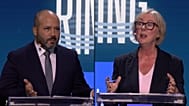




























The EU and the US should talk to each other as equal partners, European Parliament Vice-President and former Belgian Prime Minister Sophie Wilmès told Euronews' morning show Europe Today.
The EU must deal with the US as an equal partner, not as a junior one, European Parliament vice-president Sophie Wilmès told Euronews on Wednesday, as EU leaders weigh a harder line with Washington over the Iran war and trade tariffs.
 ADVERTISEMENT
ADVERTISEMENT
ADVERTISEMENT


"What is very important regarding the United States is that we are talking to each other as equal partners and not as a big brother against the little brother or the little sister," Wilmès said.
"Europe should do with Europe," the former Belgian prime minister replied when asked whether the EU should reduce its dependence on its transatlantic ally.
On Wednesday, Wilmès and her fellow EU lawmakers are set to discuss the rise of antisemitism in Europe, following the recent attacks against the Jewish communities in the Netherlands and Belgium.
“Antisemitism is definitely rising since the attack of 7 October,” the Parliament vice-president said, acknowledging the link between a spike in antisemitism, the Israel-Hamas war in Gaza and the broader Middle East conflict.
“We need to make a very cautious distinction between the government in Israel and the Jewish community;" Wilmès explained.
"Whatever a minister or a government does, it does not excuse antisemitic action,” she added, calling for an update of the European Commission’s 2021 strategy on combating antisemitism.
On the same day, the European Parliament is also voting on the European Commission’s 2025 rule of law report.
The vote coincides with the first visit to Brussels by Hungarian Prime Minister-elect Péter Magyar, who is due to meet Commission President Ursula von der Leyen on Wednesday evening.
“We are very hopeful that this new government will put things back on track. They say they will, and I think that we need to support that,” Wilmès said.
“It is much more difficult to put things back on track than to dismantle the rule of law,” she added.
The report to be voted on by the European Parliament reviews developments across all member states in four key areas: the justice system, anti-corruption frameworks, media pluralism and freedom, and institutional checks and balances.
Beyond the rule of law report, attention is also turning to upcoming negotiations on the EU’s long-term budget. Parliament on Tuesday adopted its stance, calling for an increase of nearly €200 billion, or around 10% of the overall sum.
Drawing on her experience as Belgium’s former premier, Wilmès said tensions between EU institutions and national governments are to be expected.
“I had the chance to sit in both situations, on the Parliament side but also at the Council side. It's very normal and usual that the member states push for a budget a little bit down, while the Parliament is pushing for more,” she said.
While the European Parliament has commonly softened its stance under pressure from member states, early signals suggest a tougher line this time, sources told Euronews.
“Reality is that we are facing a lot of new challenges, such as competitiveness, but also in security and defence. And those require more money, for sure,” Wilmès said.