

















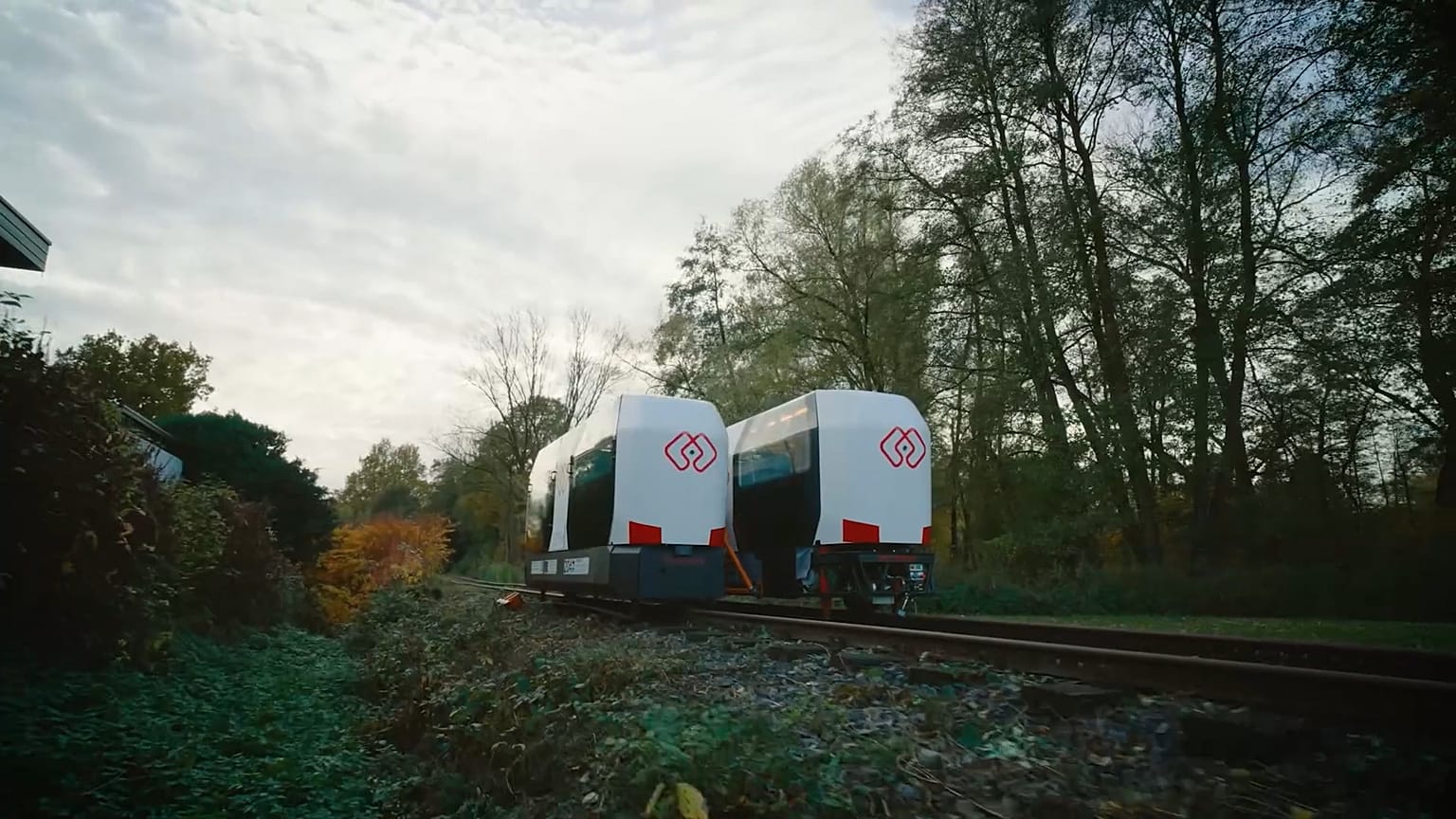














In North Rhine-Westphalia, the old, abandoned railway tracks have found a new lease of life – transporting people in futuristic monorail cabins around the region. The cabins are compact, driverless and can carry up to six passengers at once and operate on a single rail line.
This new futuristic-looking automated monorail is called MONOCAB OWL
 ADVERTISEMENT
ADVERTISEMENT
ADVERTISEMENT
and relies on abandoned rail infrastructure. The idea is to link the towns of North Rhine-Westphalia with the cities, thanks to a new, more agile public transport. "This is an ideal means of transport for covering the territory efficiently. Rural areas are too sparsely populated for a large railway. The MONOCAB bridges that gap between the bus and heavy rail. In addition, we offer it at the same price as the bus," says Achim Oberwöhrmeier, managing director of the municipal transport company KVG Lippe.
Oberwöhrmeier adds, “The faster public transport systems are, the greater their uptake and use. The MONOCAB comes very frequently: every ten minutes, even every five minutes. If we manage to go faster, we could practically double our share in the modal split. It's a huge opportunity for rural areas."
A new mobility for rural areas
The creator of MONOCAB is Thorsten Försterling. The idea was born in 2016 and came to fruition during the pandemic, together with a team of experts from the University of Applied Sciences and Arts of Ostwestfalen-Lippe and is now in the testing phase.
Försterling explains that the user will use an application to book their place, "It's like when you ski: you just take the next chairlift," he says. The cabins are designed to operate on a single rail, so that they can be crossed without problem when traveling in opposite directions. “Of course, we want more stops than we currently have on the old railway line. But it is important that there is something of interest at each stop: tourist destinations, new residential areas, isolated farms” he says.
Monorail cabins stabilise on their own and without mechanical support
The MONOCAB runs on an electric battery, similar to that of an electric car, as there is no electrification on the old railways. "The cabins weigh three tons. We are currently driving at about 25 km/h, but they are designed to reach 60 km/h”, says Martin Griese, director of technology at the University of Applied Sciences and Arts in Ostwestfalen-Lippe.
They are equipped with sensors and stop if they detect an obstacle. “The first monorail vehicle was built a hundred years ago by Louis Brennan, Griese recalls. A combination of systems is used to stabilise monorail cabins. One of them is gyroscopes: a gyroscope stabilises simply when we spin it. But here we use it technically, of course, on a much larger scale. The second is a compensation mass. You can imagine a large block, which moves naturally inside this vehicle”, he says.
In its first phase of development between 2020 and 2023, MONOCAB OWL's total budget was close to €4 million. The EU Cohesion Policy has financed half, the Energy Research Institute at the University of Applied Sciences in Lippe has financed 10%, and the remaining 40% has come from the North Rhine-Westphalia region. In its current phase, MONOCAB Key Technologies (15 June 2025 – 30 November 2026) the total planned expenditure exceeds €5 million.
On the Locomotive: Growth and Social Cohesion
In addition to seats for between four and six people, the cabins are equipped with devices for people with reduced mobility and have places for bicycles, child seats, or wheelchairs.
For the Lippe district , MONOCAB is an opportunity to boost economic growth and social cohesion in the area. Meinolf Haase, Lippe district administrator, explains it like this: "We are in a rural area, made up of 16 towns and municipalities. These cabins are somewhat smaller than the larger buses, and citizens, whether students, schoolchildren or senior citizens, can travel with great flexibility and reach their exact destination. We believe that in 2028 we will be able to successfully launch the testing phase. And by 2032, the project should already be in place.”
MONOCAB OWL has received a REGIOSTARS Award, a European award for excellence in projects funded by the European Union.